Share This Gerry Dawes's Spain Post


Instagram

In 2026, ranked #7 in the Top 30 Gastronomy Blogs (and Websites for Gastronomists & Gastronomes by Feedspot. (Ranked in the top 50 since 2019). "The Best Gastronomy blogs selected from thousands of Food blogs, Culture blogs and Food Science. We’ve carefully selected these websites because they are actively working to educate, inspire, and empower their readers with . . . high-quality information.

More than 3,640,000 views since inception, 123,000+ views in August 2026.


Ranked #7. Gerry Dawes's Spain: An Insider's Guide to Spanish Food, Wine, Culture and Travel gerrydawesspain.com

"My good friend Gerry Dawes, the unbridled Spanish food and wine enthusiast cum expert whose writing, photography, and countless crisscrossings of the peninsula have done the most to introduce Americans—and especially American food professionals—to my country's culinary life. . .” - - Chef-restaurateur-humanitarian José Andrés, Nobel Peace Prize Nominee and Oscar Presenter 2019; Chef-partner of Mercado Little Spain at Hudson Yards, New York 2019

Showing posts with label Salvador Dalí. Show all posts

9/15/2019

Gerry Dawes's Persistence of Memory Melting Watch Awards (With tip of my sombrero to Salvador Dalí, whose genius persists in memory).


* * * * *


Gerry Dawes's Persistence of Memory* (Salvador Dalí)  Melting Watch Awards.


For at least three decades, I  have been wearing a Salvador Dalí Persistence of Memory pin in my lapel whenever I  wear a jacket, suit or even a tuxedo.  It invariably attracts curious responses.  To women who ask, "Is that a banana?", the response is obvious.  Men, for some reason, don't usually ask that question.

After so many years of wearing these pins, which I buy in Barcelona, they have really become a part of my public persona, so I decided to begin using representations of the pin to denote experiences, people, places, events, dishes, wines, art, buildings, fiestas, etc. that persist in my memory.

Periodically, I will rate an experience, a person (or persons), a restaurant, a dish, a wine, an event, etc. with from one-five Persistence of Memory melting watches (from the famous Salvador Dalí paintings) that are, indeed, persistently memorable.  At the end of each year, I will compile my Persistence of Memory awards.  

Below is  a series of articles on restaurants, tapas bars, chefs, dishes and experiences from around Spain that I think, from my very personal experience, deserve Five of Five Dalí POM (Persistence of Memory) Melting Watch Award pins.  I frankly don’t give a damn about Michelin ratings, Repsol or any of the rest.  I have been traveling and eating and drinking wine all over Spain for nearly 50 years and I have been to the restaurants in these articles multiples times.  Yes, I am influenced by the friendly relationships I have with many of the chefs and owners of these establishments, but I would not have built these friendships if these chefs, restaurants and establishments were not as good as they are.  And I take into consideration the downside for those who might not be connected in some of the restaurants, hotels and people I am writing about.  Nonetheless, I personally have had repeated Five Melting Watch experiences in all the places I am writing about. 

*Note: From now on, I will be awarded only the five Melting Watches as my rating system for restaurants, dishes, wines, experiences and personalities.  I have had enough five Melting Watch encounters in my decades of traveling in Spain, that for what time I have left on this planet, it will probably take me that long to write them all up. 

My criteria is as follows:
1) I will not be rating many Michelin-star awarded restaurants, because they already have Michelin rating them.  However, Chefs, whether they have three Michelin Stars are not will be the objects of my ratings. 
2) I do not really worry about what other critics may or may not think about my five Melting Watch choices.   They are mine and my judgement and I will stand by them.
3) There will be lots of unheralded places, tapas bars, wines and events that I personally believe are worthy and thus will get my five Dalí Persistence of Memory Melting Watch Awards. 
4)  There will be lots of Spaniards, some unknown or relatively unknown who will get the awards and I will give my reasons.

This was my former rating system:

*Five Watches:  Exceptional Persistence of Memory
Four Watches:  Unforgettable, excellent.
Three Watches: Unforgettable, very good.
Two Watches: Memorable, quite good.
One Watch:  Memorable, good.

Any of these Geraldo-Dalí Persistence of Memory Melting Watch ratings signifies an experience, place, person, restaurant, dish, wine or event worthy of consideration. 

*The Persistence of Memory, a Salvador Dalí painting (1931).  

Since 1934, it has been owned by the Museum of Modern Art (MoMA), New York.

6/06/2019  Valencia: Casa Montaña, One of Spain´s Greatest Bodegas & Tapas Restaurants, Five Geraldo-Dalí Persistence of Memory Melting Watches Award to Casa Montaña & Its Owners, Emiliano García Domene & His Son General Manager Alejandro García

5/14/2019 Casa Bigote & Chef Fernando Hermoso (and His Retired Brother Paco), Sanlúcar de Barrameda (Cádiz), Andalucía: Another Five Dali Melting Watch Award for Chef Hermoso and His Crew, Bar Bigote, Casa Bigote Restaurant and Unparalleled. Ambience

4/28/2019  El Torreón de Tordesillas: The Five Dalí Melting Watch Domain of "The Greatest Showman (El Gran Showman)," The Magnificent Jeremias de Lozar

4/20/2019 Vicente Leal, the Maestro de Salazones (Salt-and-air cured Fish, a Craft as Old as Civilization in the Mediterrean) at the Mercado de Abastos de Alicante. 

3/29/2019  Madrid Classics: Casa Lucio, Cava Baja Update on Lucio´s Birthday Today - Five Salvador Dalí Persistence of Memory Melting Watches 
3/12/2019 Quim de la Boquería, La Boquería Market, Barcelona. Five Dalí POM (Persistence of Memory) Melting Watches 

2/07/2019 Restaurante Campero, Barbate (Cádiz), Famous for its Almadraba, Tuna Round-up. Sensational Lunch at Camapero: Boquerones en Vinagre, Mojama de la Almadraba, Carpaccio of Zucchini, Seafood Rice and Black Rice with Basil All-i-oli, Plus 85€ per Person Almadraba-caught Tuna Tasting Menu Explained. Persistence of Memory* (Salvador Dalí) Fiver Melting Watch Awards

4/19/2018 Andalucian Journal: Sanlúcar de Barrameda, Home of Manzanilla Sherry: A Five Dalí Melting Watch Adventure with Javier Hidalgo, Producer of La Gitana Manzanilla, in Las Marismas, Lunch in a Very Secret Place (Updated)

2/11/2018  The Bar at Marisquería Rafa: A Five Dalí POM (Persistence of Memory) Melting Watch Award Experience

11/14/2017  Chinchón III: Upgraded to Five Stars! Back a La Balconada, One of My Favorite Castilian Cuisine Restaurants. Chef-owner Manuela Nieto Recio and her Husband Isidro Olivar. This time with John (Docsconz) and L. J. Sconzo

 5/03/2017 Restaurante d’Berto, O Grove (Galicia) One of the Best Shellfish Restaurants in the World

 3/07/2017 Upgraded to Five Dalí Watches: El Crucero in Corella (Navarra), Lunch with the Wines of Aliaga at One of the Great Restaurants of Navarra's Ribera Baja Wine-growing Region, Also Home to One of Spain's Finest Vegetable Growing Regions and Some of Navarra's Little-known, But Best Country Restaurants.

2/21/2017 Another Five Dali Melting Watch Award Restaurant: Casa Bigote, Sanlúcar de Barrameda (Andalucía)

7/15/2017 A Homage to Culinary Adventures with Juan Suárez, One of the Great Non-professional Cooks in Spain: Teaching Famous Culinarians How to Fry an Egg, Cocido Madrileño, Cooking in Napa Valley at Cindy Pawlcyn's, Cooking at Home for the Madrid Fusión Mejicano Contingent and a Magical Adventure at Kaia near San Sebastián

11/18/2016  Madrid Classics: Five Dalí POM (Persistence of Memory) Melting Watches to Casa González, founded in 1931, is a high quality bar-deli-gourmet food and wine shop with a wonderful old-fashioned air in Madrid's Literary Quarter.

 3/20/2014 Charcutería: The Soul of Spain by Jeffrey Weiss. Foreword by José Andrés. Highly Recommended. Five Dalí Persistence of Memory Melting Watch Awards

3/05/2014 Five Dalí POM Watches to L'Escaleta, Another Great Alicante Restaurant, One of the Best in Spain

8/15/2012  Sanlúcar de Barrameda, The Incredible Horse Racing on Bajo de Guía Beach in August Gerry Dawes's Persistence of Memory* (Salvador Dalí) Five Melting Watch Awards.

12/16/2009 To Hell with Michelin! I Have the GeralDalí 'Persistence of Memory' Watch Awards and I am Bestowing Five Watches, My Top Rating, on Restaurante Quique Dacosta (formerly El Poblet), Chef Quique DaCosta and Quique Dacosta's Staff

 More to come soon.

* * * * *
  Shall deeds of Caesar or Napoleon ring
More true than Don Quixote's vapouring?
Hath winged Pegasus more nobly trod
Than Rocinante stumbling up to God?
 
Poem by Archer M. Huntington inscribed under the Don Quixote on his horse Rocinante bas-relief sculpture by his wife, Anna Vaughn Hyatt Huntington,
in the courtyard of the Hispanic Society of America’s incredible museum at 613 W. 155th Street, New York City.
 ____________________________________________________________________________________

 Gastronomy Blogs

About Gerry Dawes

My good friend Gerry Dawes, the unbridled Spanish food and wine enthusiast cum expert whose writing, photography, and countless crisscrossings of the peninsula have done the most to introduce Americans—and especially American food professionals—to my country's culinary life." -- Chef-restaurateur-humanitarian José Andrés, Nobel Peace Prize Nominee and Oscar Presenter 2019


Gerry Dawes is the Producer and Program Host of Gerry Dawes & Friends, a weekly radio progam on Pawling Public Radio in Pawling, New York (streaming live and archived at www.pawlingpublicradio.org and at www.beatofthevalley.com.)

Dawes was awarded Spain's prestigious Premio Nacional de Gastronomía (National Gastronomy Award) in 2003. He writes and speaks frequently on Spanish wine and gastronomy and leads gastronomy, wine and cultural tours to Spain. He was a finalist for the 2001 James Beard Foundation's Journalism Award for Best Magazine Writing on Wine, won The Cava Institute's First Prize for Journalism for his article on cava in 2004, was awarded the CineGourLand “Cinéfilos y Gourmets” (Cinephiles & Gourmets) prize in 2009 in Getxo (Vizcaya) and received the 2009 Association of Food Journalists Second Prize for Best Food Feature in a Magazine for his Food Arts article, a retrospective piece about Catalan star chef, Ferran Adrià. 


". . .That we were the first to introduce American readers to Ferran Adrià in 1997 and have ever since continued to bring you a blow-by-blow narrative of Spain's riveting ferment is chiefly due to our Spanish correspondent, Gerry "Mr. Spain" Dawes, the messianic wine and food journalist raised in Southern Illinois and possessor of a self-accumulated doctorate in the Spanish table. Gerry once again brings us up to the very minute. . ." - - Michael & Ariane Batterberry, Editor-in-Chief/Publisher and Founding Editor/Publisher, Food Arts, October 2009. 
 
Pilot for a reality television series on wine, gastronomy, culture and travel in Spain.
 

3/29/2011

Salvador Dalì's Pan (Bread), Pa en Catalan, Pa de Figueres (Girona)


* * * * *
Salvador Dalì claimed, "Bread has been one of the oldest subjects of fetishism and obsessions in my work, the number one, the one to which I have been most faithful." 


The distinctive shape of the local pa de crostons
or triangular-shaped bread of Figueres, Salvador Dalì's hometown.


Once ubiquitous in the Empordà region of Catalunya, pa de crostons was Dalì's inspiration for the decorative biege concrete "breads" that decorate the façade of the museum the Salvador Dalì Museum in Figueres (Girona), Catalunya. 


Short Slide Show of pa de crostons and the façade of the Salvador Dalì Museum in Figueres.

The Dalí museum (his final resting place--his tomb is in the museum) is studded with hundreds of representations of the pa de crostons three-cornered breads that meant so much to Dalì in his youth.  (Is Dalì's bread the equivalent of Orson Welles' Citizen Kane's "Rosebud" ?)

Pa de crostons in a shop near the Salvador Dalì Museum in Figueres. As a child, Dalì would hollow out the bottom of one of these pas de crostons and wear it as a hat, which some have likened to a bullfighter's montera (which has only two lobe-like projections).  As an adult, Dalì sometimes appeared with a large flat, sombrero-like circular bread (not pa de croston) on his head and the pan-on-the-head theme appears in numerous Dalì paintings.


Salvador Dalí (Spanish, 1904-1989). The Basket of Bread, 1926. Oil on panel. 13 x 12 1/2 in. (33 x 31.8 cm).
The Salvador Dalí Museum, St. Petersburg, Florida. © The Salvador Dalí Museum, Inc.

One of his famous paintings, the Zurbaràn-like Basket of Bread, is of the rather ordinary pan (bread) of the Spain, not pa de crostons


From Gerry Dawes's Visual Encyclopedia of Spanish Gastronomy & Wine


12/01/2009

Memories of the Superb 2005 Salvador Dalí Exhibition at the Philadelphia Museum of Art

.
* * * * *

Gerry Dawes's Persistence of Memory* (Salvador Dalí) Melting Watch Awards.

* * * * *

A Look Back at a Stunning Show in 2005

The Depth & Excellence of the Salvador Dalí Exhibition 
at the Philadelphia Museum of Art Was Astounding!

Commentary on the exhibition by Gerry Dawes.

Spanish Wine Dinners Featured at
Restaurant Associates Museum Restaurant
During the Exhibition


Postscript on Catalan Super-Star Chef Ferran Adrià of elBulli.

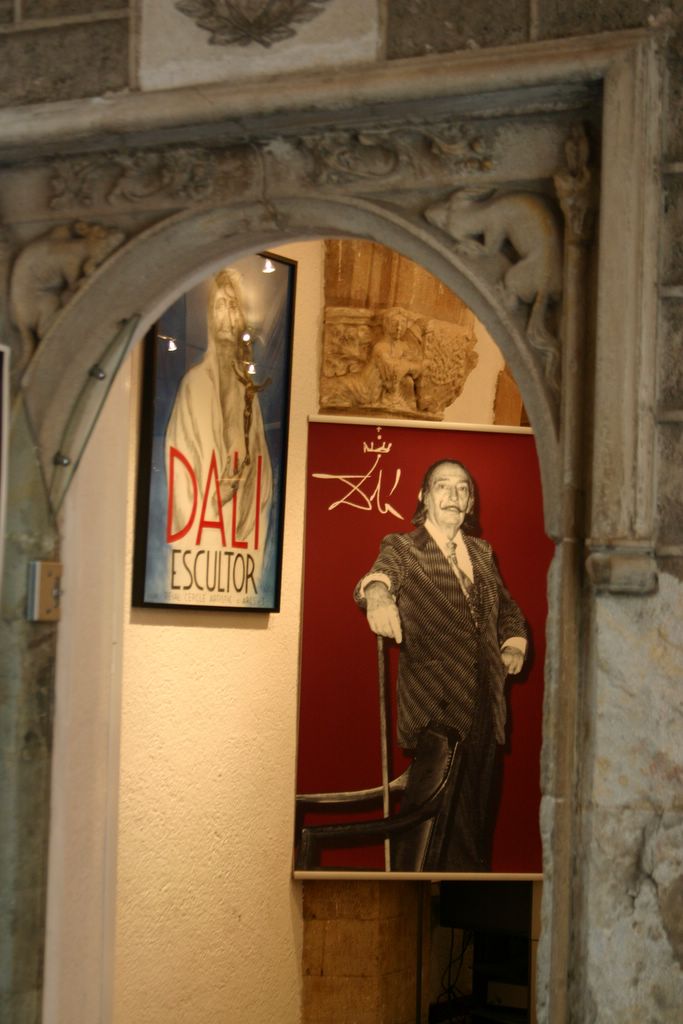
Dalí Museum, Figueres (Girona).  
Those "knobs" (as described by one travel writer) on the building 
are representative of a typical style of Catalan bread called pa de crotons
Gerry Dawes©2004

The depth and excellence of the Advanta-sponsored Salvador Dalí exhibition at the Philadelphia Museum of Art, which ran from February 15 - May 15, 2005 was nothing short of astounding.

Dalí Gala 2005 - Philadelphia Museum of Art
Gerry Dawes©2005

Dalí Gala 2005 - Philadelphia Museum of Art
Gerry Dawes©2005

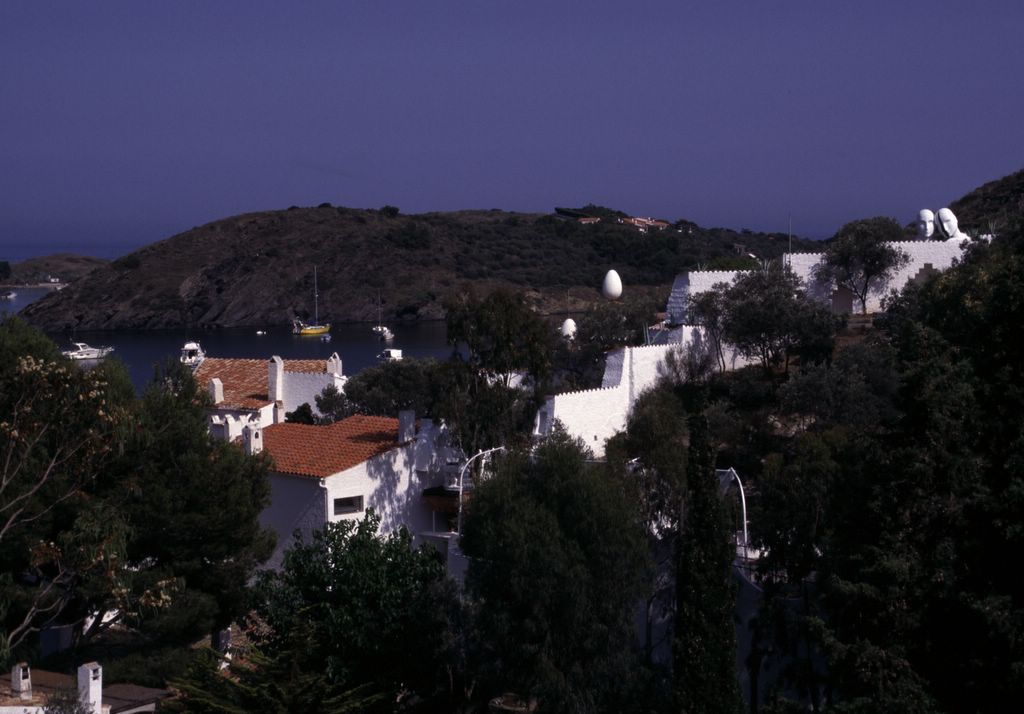
Although I have travelled in Spain for more than 40 years, visited Dalí's incredible casa-museo on the lovely cove at Port Lligat (Girona), his over-the-top museum in Figueres (his birthplace) and Gala's castle at Pubol, none of that prepared me for the depth, quality and evocative power of this exhibition.

Dalí's House, Port Lligat (Girona)
Gerry Dawes©2004

Port Lligat cove, From above Dalí's house
Gerry Dawes©2004

In the past, I tended to dismiss Dalí as a very talented, very difficult-to-understand surrealist and a mad publicity hound who lived up to André Breton's anagram "Avida Dollars." But, after seeing the 200-piece Philadelphia exhibition twice (and partially at least three-four more times), I am convinced that Dalí--dead since 1989 and long-since stripped of the smoke screen of his outrageous publicity-seeking antics--was the real deal, a unique talent and one of the greatest artists ever.

Dalí, Barcelona
Gerry Dawes©2004

Don't let all those photos of a wild-eyed lunatic fool you.  Dalí was a tormented genius and like many of the inhabitants of his native Empordá, no doubt was affected for days on end by the tramuntanas, the wild cyclones in northern Cataluña which not only bend trees and grape vines, sculpt rocks and leave beaches and plains swept clean, they seriously torque the minds of the region's inhabitants, leaving them just a little loco.  These wild winds have even been known to have toppled a train.  In Dalí's case, the wind doesn't quite explain everything, because he was also infected with a world-class locura (madness) that manifested itself in often outrageous social behavior, but his manias were also the driving force behind a phenomenal artistic talent.

Dalí, Barcelona
Gerry Dawes©2004

But, undeniably a genius Dalí was, the likes of which we have never seen in art. He was endowed with a prodigious technical talent--equal to that of any of the great masters (Velasquez, Goya, Zurbarán, Bosch) that one sees in the Prado--along with vision, originality and the ability to project his deepest psychological demons onto the medium like no one ever has (not even the great Hieronymus Bosch could equal Dalí in such visions).  In a mano a mano with Picasso, Dalí would likely win out.

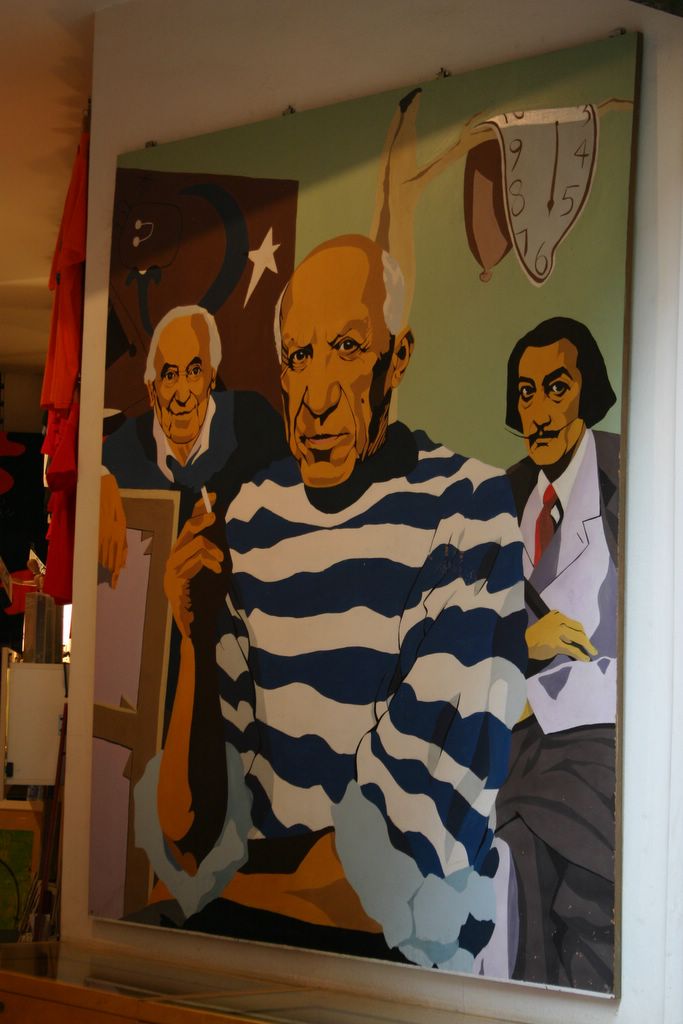
Picasso, Dalí, Miró. 
In this picture in a Barcelona tourist shop, Picasso dominates, 
but after the Dalí exhibition in Philadelphia, one wonders if it should be the other way around.
Gerry Dawes©2004

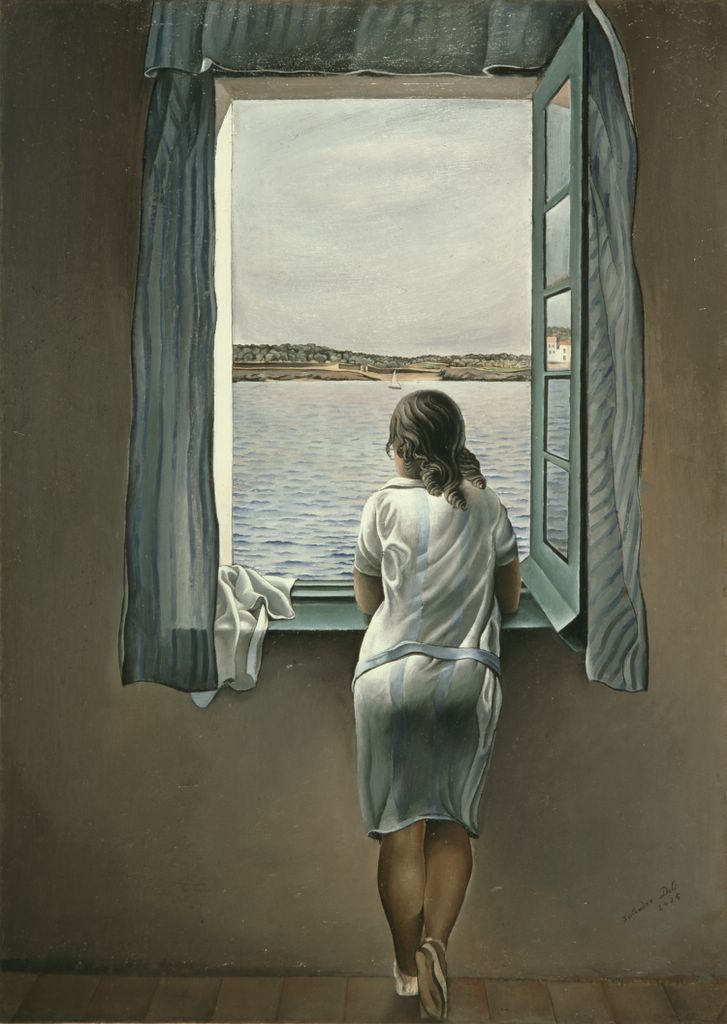
In the Philadelphia exhibition, the haunting, unforgettable Portrait of My Father, a picture of Dalí's imposing, overbearing father dressed in a heavy black bourgeois clothes dominating the wildly colorful backdrop of the legendary Costa Brava village of Cadaqués (where the Dalí family spent their summers) and the lovely impressionistic Lane to Port Lligat with View of Cap Creus, both painted in 1921, are alone enough to establish Salvador Dalí as an artist (at 17!) with a major talent.  In 1924, at 20, Dalí's Portrait of Luís Buñuel is further proof, as are another powerful Portrait of My Father and, in 1925, the compelling Figure at a Window (Dali's sister Ana María gazing out the window, painted from behind).


Figure at a Window, 1925 
Courtesy Philadelphia Museum of Art

The same goes for several other portraits painted in 1925 and Woman at the Window at Figueres, painted the following year (1926).  Also in 1926, with The Basket of Bread, Dalí showed he could paint still-lifes as well as Velàsquez, Francisco de Zurbarán and the great 18th-century master of bodegones, or still lifes, Luís Meléndez.


Basket of Bread, 1926 
Courtesy Philadelphia Museum of Art

Then, in 1929, began an incredible series of psychologically charged and quite disturbing surrealist paintings (they gave André Breton nightmares) that are among Dalí's most famous works: The First Days of Spring, The Great Masturbator, The Enigma of Desire and The Accommodations of Desire, followed by several pornographic drawings, the castration nightmare of William Tell (1930), the erotically charged The Font (1930) and his famous The Persistence of Memory (with the melting watches).


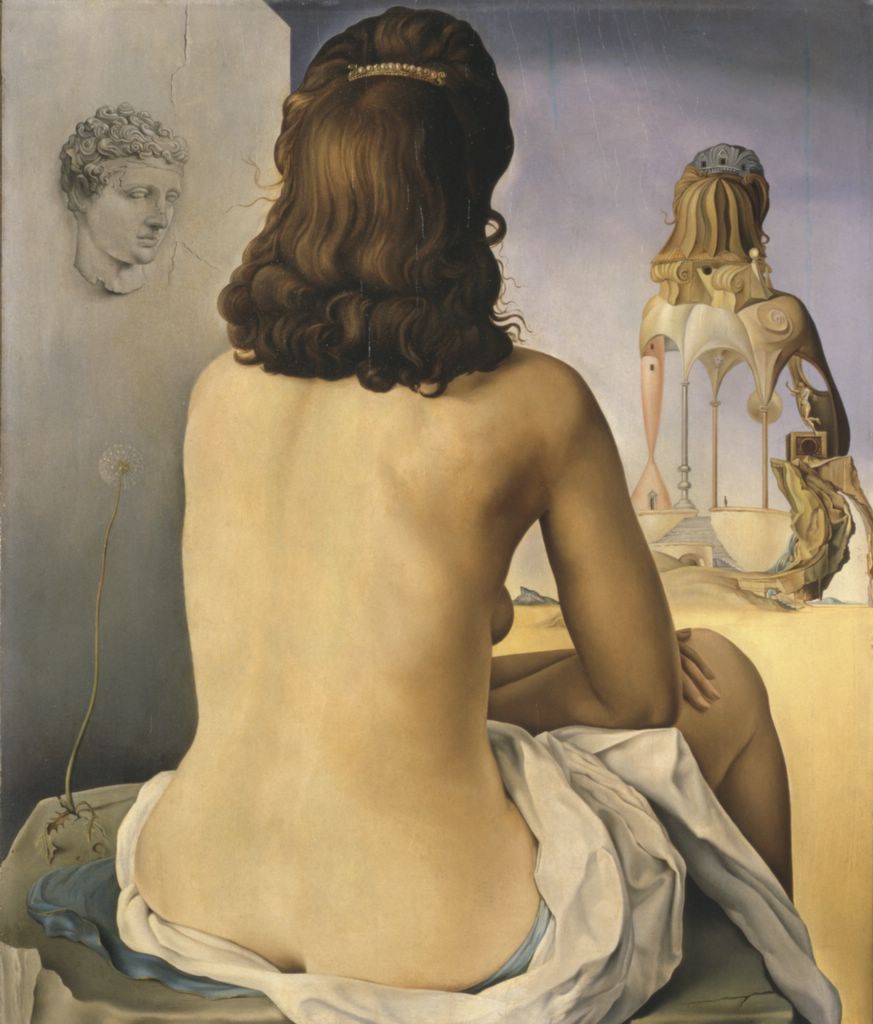
"My Wife, Nude, Contemplating Her Own Flesh Becoming Stairs,
Three Vertebrae of a Column, Sky and Architecture, 1945
 
Courtesy Philadelphia Museum of Art


There are a number of paintings in the Philadelphia exhibition from the period when Dalí was obsessed with the legend of William Tell, a metaphor for his relationship with his domineering father, and, even more so, there are numerous riffs on the Jean-Françoise Millet's The Angelus (1857), both of which were deeply imbedded with a castration complex according to Dalí's "paranoic-critical" way of seeing the world. In 1935, he painted the classical, powerful Angelus of Gala, which depicts his muse and wife, Gala, in a brocade jacket simultaneously facing the viewer with a version of the Angelus on the wall behind her and from the back showing the design of the brocade jacket (on the back of her skirt are wrinkles that look like a large hand on her ass, undoubtedly one of Dalí's "in" jokes). So important are Dalí's Angelus paintings that The Architectonic Angelus of Millet was chosen as the cover for the Philadephia exhibition catalogue.


Madonna of Port Lligat 
Courtesy Philadelphia Museum of Art

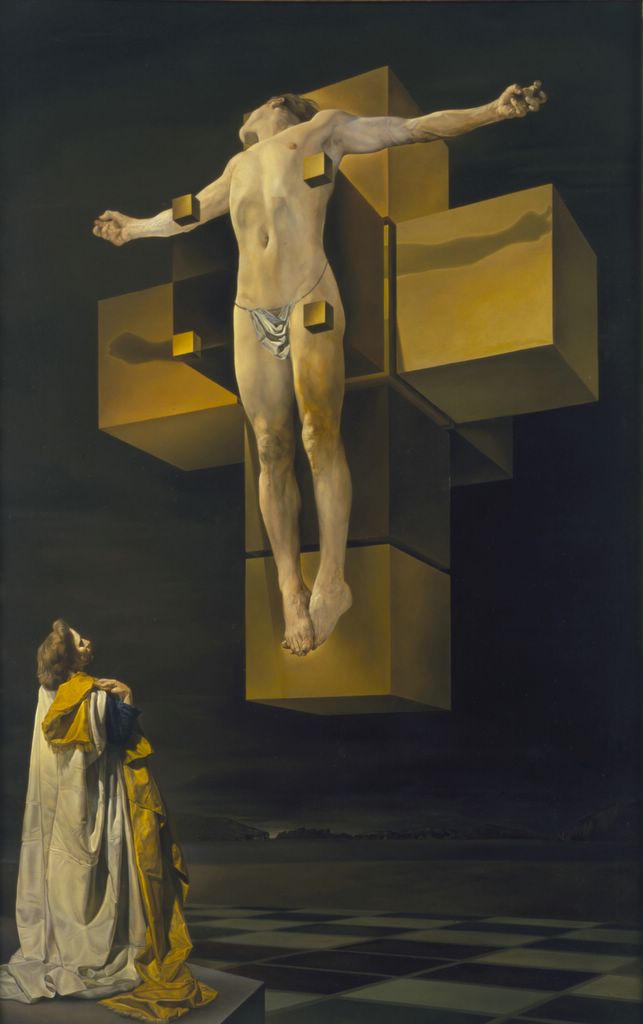
Much as I would like to, I won't go through the whole catalogue here, but by the end of the collection, when you see Dalí's later religious paintings--Gala as the Madonna of Port Lligat, The Christ of Saint John of the Cross, Nuclear Cross, Crucifixion (Corpus Hypercubicus) and Ascension--you realize that this wild mind was the driving force behind one of the greatest painters in history and that you have to come back and see this mystical exhibition again before it disappears forever.

Suffice to say that it takes a good two hours just to peruse the incredible works in this collection, which was curated by Dalí expert Dawn Adis and by Michael R. Taylor. After lingering fascinated by the whole show at the gala opening, I realized I had barely scratched the surface, but, because I had a consulting gig at the museum with Restaurant Associates (set up by my friend, Dana Madigan of R.A.), I was lucky enough to see the exhibition twice. I designed Spanish regional-themed wine dinners at the Restaurant Museum during the exhibition and spoke about Spanish food and wine at the dinners, so I got to see the exhibition several times. That and the half dozen books I bought on Dalí allowed me to begin to understand this extraordinarly complex artist.  (My participation at these events was pre-destined; since 2002, I had been wearing on my lapel a Dalí melting watch pin--like the ones you see at the beginning of this piece-- that I bought in Barcelona 
long before I heard about this show.)


Crucifixion (Corpus Hypercubicus), 1953-54
Courtesy Philadelphia Museum of Art


Ouefs Sur la Plat (Fried Egg on the Plate without the Plate).

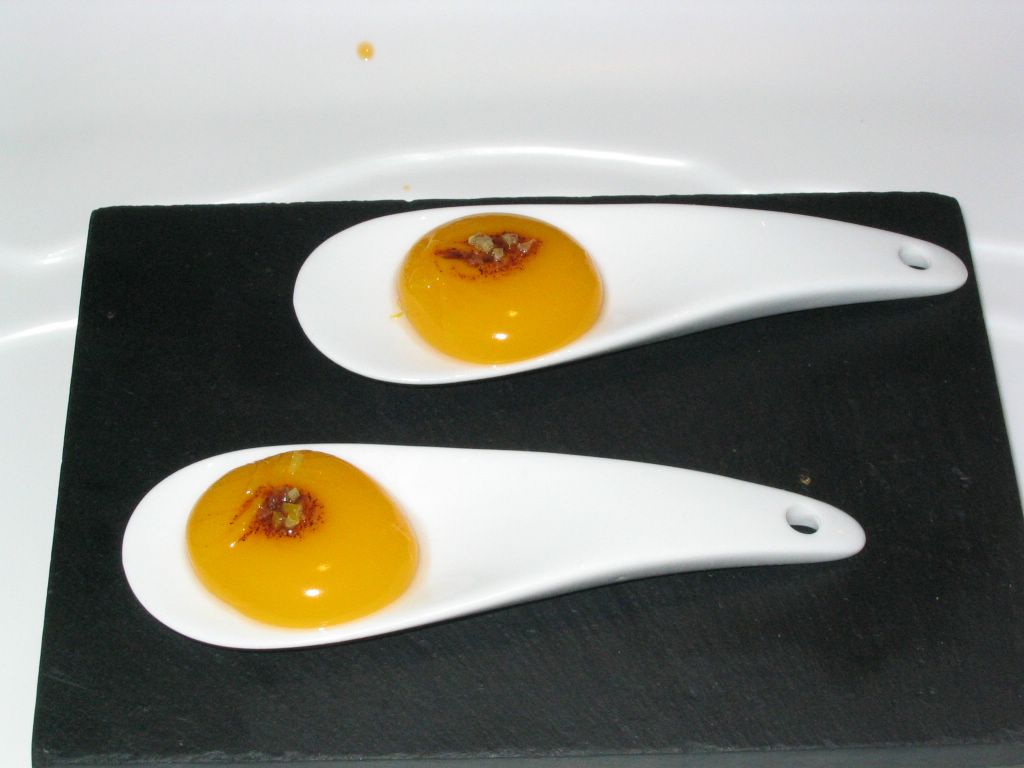
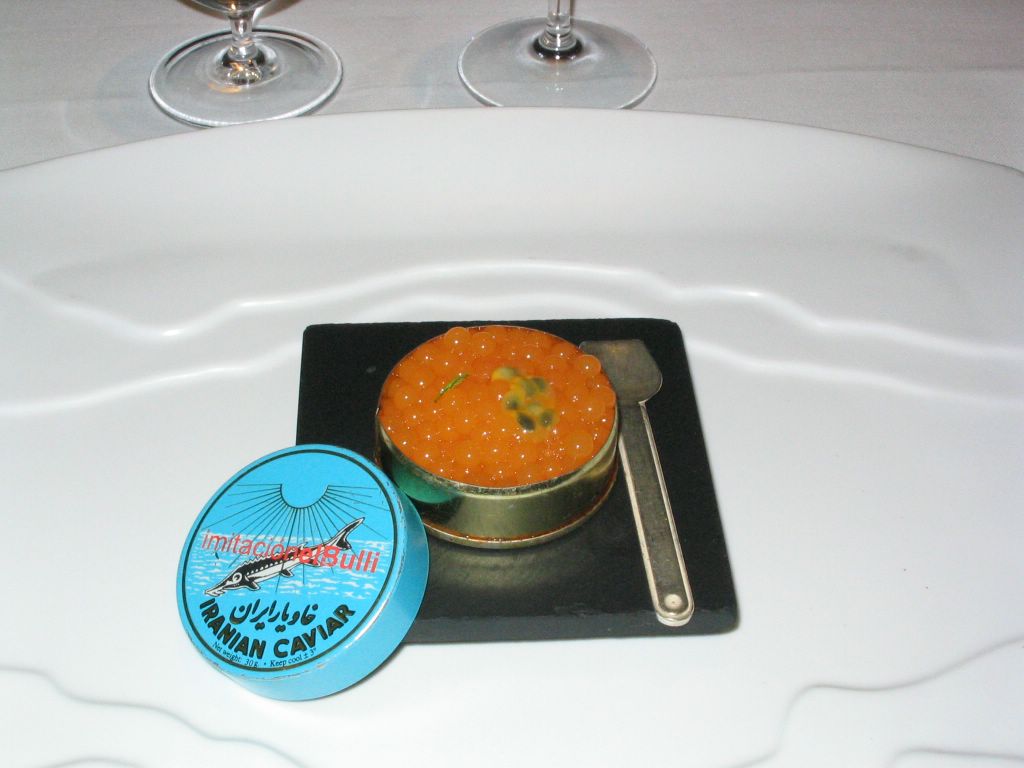
From Dalí's Ouefs Sur la Plat (Fried Egg on the Plate without the Plate), we may be seeing a painting that could have inspired Catalan super-star chef, Ferran Adría, to pass over into a new dimension of food with such dishes as a mango "egg yolk" served on a Chinese spoon, ravioli de mango, melón caviar (a ringer for samon caviar, made from melón puree dropped into a calcium chloride solution), spaghetto de parmesano (two yards plus of spaghetto made from Parmesan cheese), etc., all dishes that Dalí would have understood instantly.


Mango "egg yolks," El Bulli by Ferran Adrià 
Gerry Dawes©2004


The famous "espuma de zanahorias," carrot foam, featured in a New York Times
cover story about Ferran Adrià and El Bulli.
 
Gerry Dawes©2004


Melon "Caviar" - El Bulli 
Gerry Dawes©2004


Philadelphia Museum of Art Friday night Dinner Series celebrating the Salvador Dali exhibition at the Museum, Philadelphia, Pennsylvania.Featured Speaker on the Cuisines & Wines of Spain:
Gerry Dawes


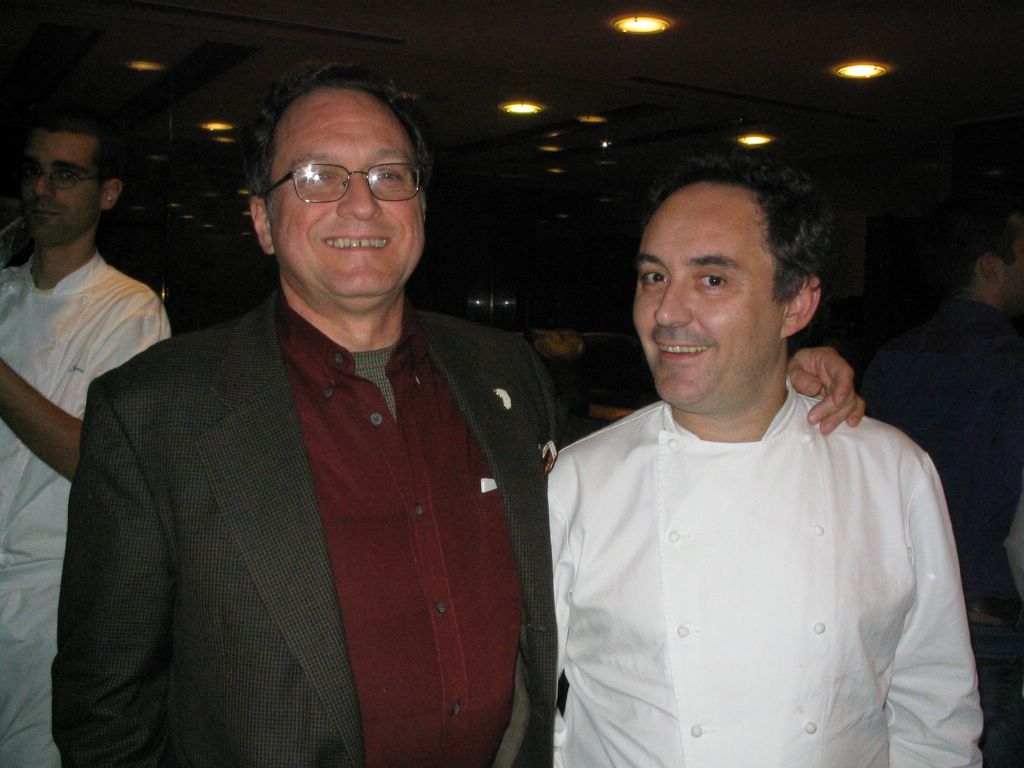
Gerry Dawes with Ferran Adrià of El Bulli at Cala Montjoi,
which is a short distance for Cadaqués and Dalí's home at Port Lligat.
George Semler©2004


February 18 (Catalan Cuisine & wines)

March 11 (Book and Cook Catalan Dinner with author Colman Andrews
speaking on Catalan Cuisine and GD on Catalan wines)

March 18 (Basque Country Cuisine & Wines with Executive Chef Santi Zabaleta of Washington, D.C.'s top-rated La Taberna del Alabardero)

April 22 (Food and Wines of Valencia & the Spanish Levante)

May 13, 2005 (Castilian Cuisine & the Greatest Red Wines of the Ribera del Duero).


Dalí-inspired lobster dish by Chef Tracey Hopkins,
Museum Restaurant, Philadelphia Museum of Art
Gerry Dawes©2005


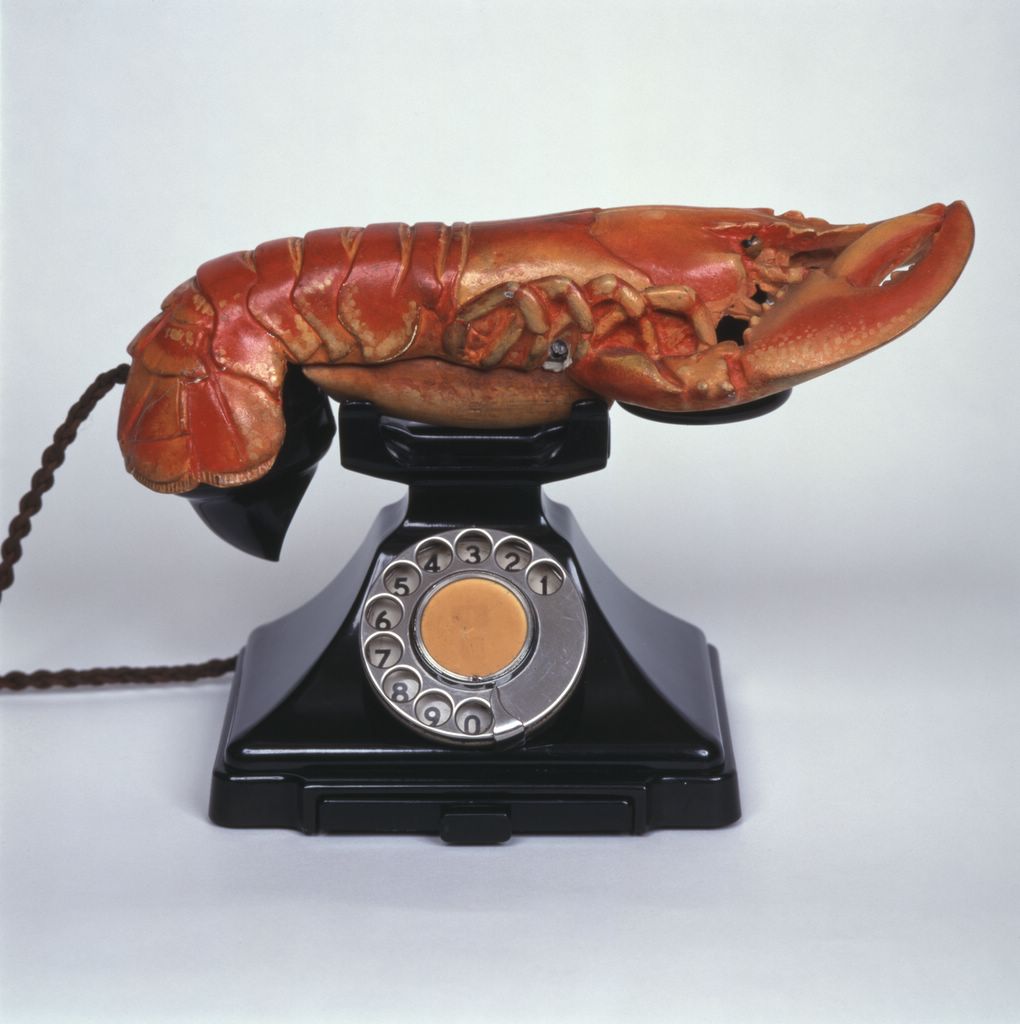
Lobster Telephone, 1936, Chichester, West Sussex, The Edward James Foundation
Courtesy Philadelphia Museum of Art

Postscript

At every stage of his career, even at his most commercial, Dalí showed his unique, singular talent and creative genius. Few artists consistently break the mold and few still can invent entirely new ways of seeing life, death, love, sex, childhood (and adult) fears and the infinite depths of the psyche and can paint them as powerfully with such emotional impact married to such artistic and technical ability.

 * * * * *


Related Posts with Thumbnails