Share This Gerry Dawes's Spain Post


Instagram

In 2026, ranked #7 in the Top 30 Gastronomy Blogs (and Websites for Gastronomists & Gastronomes by Feedspot. (Ranked in the top 50 since 2019). "The Best Gastronomy blogs selected from thousands of Food blogs, Culture blogs and Food Science. We’ve carefully selected these websites because they are actively working to educate, inspire, and empower their readers with . . . high-quality information.

More than 3,640,000 views since inception, 123,000+ views in August 2026.


Ranked #7. Gerry Dawes's Spain: An Insider's Guide to Spanish Food, Wine, Culture and Travel gerrydawesspain.com

"My good friend Gerry Dawes, the unbridled Spanish food and wine enthusiast cum expert whose writing, photography, and countless crisscrossings of the peninsula have done the most to introduce Americans—and especially American food professionals—to my country's culinary life. . .” - - Chef-restaurateur-humanitarian José Andrés, Nobel Peace Prize Nominee and Oscar Presenter 2019; Chef-partner of Mercado Little Spain at Hudson Yards, New York 2019

Showing posts with label Murcia. Show all posts

9/15/2026

Sephardic Spain: Update on My Search for Jewish Historical Sites in Spain Part III of III Lorca's (Murcia) Jewish Village & Synagogue in a Castle and the Most Incredible Holy Week Processions Ever


* * * * *
Gerry Dawes with Jewish figure sounding the shofar at Archaeological Museum of Lorca, Lorca (Murcia).


Lorca (Murcia)

When I picked up my partner, Kay, at Alicante airport, she was running late from a delayed flight from New York that caused her to miss her connection in Madrid, and we headed for Cartagena on Saturday, April 13, the day before Palm Sunday, I had no idea what we were going to find a few days down the road.


When we arrived at Hotel Los Habaneros in Cartagena, one of the few major towns in Spain to which I had never been, she showed me an article from the in-flight magazine she picked up on Air Nostrum, the regional airline that flies from Madrid to such places as Alicante and Valencia.  It was a article about Holy Week in an outback town called Lorca, a place I may have only passed through once, if that, years ago and a town that was not on my radar and not on our agenda for the trip we had planned for Semana Santa, Holy Week.  

We were going to get acquainted with historic Roman Cartagena, a town with one of the most beautifully protected harbors in the Mediterranean, then we were going to Almeria, where for years
I had been promising her lunch on the beach at Cabo de Gata.  Then we were going to the villages of the Alpurjarras, south from Granada, where my one-time Spain literary hero, Gerald Brenan wrote South From Granada.   In the 1970s, I would subsequently come to know Brenan, visit him at his home near Alhaurín el Grande (with letters of introduction from both the great doyenne of bullfight aficionadas Alice Hall and theater legend Kenneth Tynan), have dinner with at the home of my mentors Bill Byron (author of Cervantes) and have him to our home in Mijas for dinner.  Brenan wrote South From Granada about his life in the 1920s in the isolated Sierra Nevada mountain village of Yegen.  His book and others, The Face of Spain and Literature of the Spanish People became classic and were a great inspiration to me, but other than a couple of minor forays, I had done no in-depth exploring of the villages he wrote about so many years ago.
First off, not only would Lorca not be on my radar, I had no plans to go there, but with bad weather forecast and the prospect of making a trip to Granada later this Fall, which would allow us to visit the Alpujarras, coupled with the sight in that airline magazine of Roman chariots racing down the streets of Lorca during Holy Week, brought about a change in plans, so when Kay did some research on hotels in Lorca, found only the Parador available, we decided to change our plans and go to Lorca for Holy Thursday.  It was a remarkable twist of events that lead us to the most incredible Semana Santa spectacle I have ever seen and ironically it would also lead me to a Jewish village that I had no idea existed,  inside a castle and on grounds of the Parador de Lorca, no less.


The discovery of Lorca’s Jewish village began in 2002, ironically when excavations began to build the new Parador de Turismo on whose grounds the village, synagogue and museum are located.  Jews lived for two centuries with the protection of the Kings of Castile and within the protective confines of the castle above Lorca, which was a Castilian frontier bastion against the Moorish taifas and the Moorish bastion of Granada.  The Jews were fluent in Arabic and helped negociate Christian and Moorish prisoner releases and ransom payments.  They also engaged in agriculture and the raising of livestock and were merchants and craftsmen.   


This Jewish village was on the Eastern side of the fortress on a terraced hillside.  To date, 18 houses have been excavated with their walls, alcoves, benches, kitchens and cupboards.  Many artifacts have also been recovered, including pottery, mezuzahs, menorahs (including some that were eight small pottery oil lamps, with a ninth, large one at the end) and more than 2,000 pieces of glass from the the candlelight glass lamps that were suspended from the ceiling and illuminated the synagogue were discovered.  One house was even found to have a domestic bathroom.


The synagogue in this Jewish village at Lorca’s Fortaleza del Sol  is particularly important, partly because it is the only known synagogue recovered in Spain that had never been converted into a Christian church.  Part of the original walls with the layout of the building, including the entranceway for men and their prayer benches, have been preserved in their original state.  Also uncovered were pieces of plasterwork with intricate designs and colored ceramics tiles.  The area above the main hall where women worshiped has been reconstructed with a wooden screen that allowed them to see, but kept them unseen by the men in the congregation (since this area is small, there is some doubt as to whether women worshipped at this synagogue at the same time as men).  The excavators also uncovered the aron kodesh (“holy ark”), the Sephardim called the ark,  the holiest place in the synagogue--where the Torah Scrolls are kept--the heichal (“chamber”).  They also uncovered the foundations of a raised stone podium the bema, or bima,  in ancient Greece.  This podium, using for reading the Torah during the services, is known a bimah in synagogues.


Some of the glass lamps that archaeologists found are apparently unique in the world, since they are the only such lamps that were used to illuminate a Medieval synagogue.  More than 20 of these lamps have been reconstructed with some of the fragments of the original glass and are now displayed in the Archaeological Museum of Lorca.  


 Kay Balun at the Museo Arquelogico de Lorca with some of the re-constructed glass latterns found in the synagogue at the unearthed Jewish village at the Forteleza del Sol castle on the grounds of the Parador de Turismo de Lorca.

Re-constructed glass lattern found in the synagogue at the unearthed Jewish village at the Forteleza del Sol castle on the grounds of the Parador de Turismo de Lorca.

Re-constructed glass lattern found in the synagogue at the unearthed Jewish village at the Forteleza del Sol castle on the grounds of the Parador de Turismo de Lorca.

Also found were the fragments of pottery that were part of the horizontal Hannukah lamp menorahs, which were eight smaller oil lamps and one larger shammash lamp used to light the others at the end .  The lamps  were a part of their pottery platform and all glazed in green (a similar style of menorah, done in white ceramics with hand-painted designs was found in a Jewish excavation in the provincial capital of Teruel, some 430 kms. to the north in Aragón.)  Both the Lorca and Teruel menorahs had to be almost completely re-built, since only fragments were found.  In December of 2012, the first lighting of the candles of Hanukah in more 500 years took place in the ancient synagogue of Lorca.  Now, the Hanukah candle lighting ceremony is an annual event at the synagogue. 


Depiction of lighting of the Lorcan style ceramics Menorah at the Museo Arquelogico de Lorca.  Now, the Hanukah candle lighting ceremony is an annual event at the synagogue in Lorca.

We were again reminded of the Jewish heritage of Lorca during the incredible Semana Santa processions, when we saw the character representing King Solomon draped with one of the superbly embroidered, ornate robes that Lorca’s processions are famous for adorned with a large star of David.  And there is also an appearance by the Queen of Sheba and her retinue. And, as a part of another procession, several men carry a golden ark of the covenant (calling Indiana Jones!).  Lorca’s  Holy Week celebrations are mind-blowing.  The out Hollywood Hollywood and, with the racing Roman chariots with their haughty drivers, including several striking young women, sometimes we thought we were in the middle of a re-enactment of Ben-Hur, Spartacus or King Solomon’s mines.
King Solomon's Cape (from 1934), worn during the Queen of Sheba's visit to King Solomon  Holy Week processions, Museo de Bordados Paso Blanco, Lorca (Murcia).

Part of the Queen of Sheba's visit to King Solomon Procession, Holy Week, Lorca (Murcia).
This photo courtesy Protocol Bloggers Point.

Queen of Sheba's visit to King Solomon Procession, Holy Week, Lorca (Murcia).  Photo by Gerry Dawes.

 Festival of Contemporary Jewish Culture takes place in Lorca in September.

More on Sephardic Spain:


4/01/2019 Sephardic Spain: Update on My Search for Jewish Historical Sites in Spain Part I of III Return to Ribadavia (Galicia) & La Tafona de Herminia's Sephardic Recipe Pastries 


 * * * * *
Constructive comments are welcome and encouraged.
 
If you enjoy these blog posts, please consider a contribution to help me continue the work of gathering all this great information and these photographs for Gerry Dawes's Insider's Guide to Spanish Food, Wine, Culture and Travel. Contributions of $5 and up will be greatly appreciated. Contributions of $100 or more will be acknowledged on the blog. Please click on this secure link to Paypal to make your contribution.
 
Text and photographs copyright by Gerry Dawes©2021.  Using photographs without crediting Gerry Dawes©2021 on Facebook.  Publication without my written permission is not authorized.
 
* * * * *
  Shall deeds of Caesar or Napoleon ring
More true than Don Quixote's vapouring?
Hath winged Pegasus more nobly trod
Than Rocinante stumbling up to God?
 
Poem by Archer M. Huntington inscribed under the Don Quixote on his horse Rocinante bas-relief sculpture by his wife, Anna Vaughn Hyatt Huntington,
in the courtyard of the Hispanic Society of America’s incredible museum at 613 W. 155th Street, New York City.
 _______________________________________________________

 Gastronomy Blogs

In 2019, again ranked in the Top 50 Gastronomy Blogs and Websites for Gastronomists & Gastronomes in 2019 by Feedspot. (Last Updated Oct 23, 2019) 

"The Best Gastronomy blogs selected from thousands of Food blogs, Culture blogs and Food Science blogs in our index using search and social metrics. We’ve carefully selected these websites because they are actively working to educate, inspire, and empower their readers with frequent updates and high-quality information."  

36. Gerry Dawes's Spain: An Insider's Guide to Spanish Food, Wine, Culture and Travel


About Gerry Dawes

My good friend Gerry Dawes, the unbridled Spanish food and wine enthusiast cum expert whose writing, photography, and countless crisscrossings of the peninsula have done the most to introduce Americans—and especially American food professionals—to my country's culinary life." -- Chef-restaurateur-humanitarian José Andrés, Nobel Peace Prize Nominee and Oscar Presenter 2019


Gerry Dawes is the Producer and Program Host of Gerry Dawes & Friends, a weekly radio progam on Pawling Public Radio in Pawling, New York (streaming live and archived at www.pawlingpublicradio.org and at www.beatofthevalley.com.)

Dawes was awarded Spain's prestigious Premio Nacional de Gastronomía (National Gastronomy Award) in 2003. He writes and speaks frequently on Spanish wine and gastronomy and leads gastronomy, wine and cultural tours to Spain. He was a finalist for the 2001 James Beard Foundation's Journalism Award for Best Magazine Writing on Wine, won The Cava Institute's First Prize for Journalism for his article on cava in 2004, was awarded the CineGourLand “Cinéfilos y Gourmets” (Cinephiles & Gourmets) prize in 2009 in Getxo (Vizcaya) and received the 2009 Association of Food Journalists Second Prize for Best Food Feature in a Magazine for his Food Arts article, a retrospective piece about Catalan star chef, Ferran Adrià. 


". . .That we were the first to introduce American readers to Ferran Adrià in 1997 and have ever since continued to bring you a blow-by-blow narrative of Spain's riveting ferment is chiefly due to our Spanish correspondent, Gerry "Mr. Spain" Dawes, the messianic wine and food journalist raised in Southern Illinois and possessor of a self-accumulated doctorate in the Spanish table. Gerry once again brings us up to the very minute. . ." - - Michael & Ariane Batterberry, Editor-in-Chief/Publisher and Founding Editor/Publisher, Food Arts, October 2009. 
 
Pilot for a reality television series on wine, gastronomy, culture and travel in Spain.
 

7/18/2018

Arrós en paella with Calasparra rice from Murcia, shrimp, scallops, squid rings, chorizo, green beans, peas, red pepper "stars", Pimentón de Murcia and saffron


 * * * * *

Arrós en paella with Calasparra rice from Murcia, shrimp, scallops, squid rings, chorizo, green beans, peas, red pepper "stars," Pimentón de Murcia and azafrán (saffron)--yeh, we know it is overloaded with ingredients and yes, it's about the rice, Get over it. I had seven hungry paella lovers to feed! Paella after it came of the grill and prior to covering with a towel a few minutes before serving. Photo: Gerry Dawes©2011 / gerrydawes@aol.com. 

* * * * *
Slide show on making the paella. 
__________________________________________________________________________
About Gerry Dawes  

Gerry Dawes was awarded Spain's prestigious Premio Nacional de Gastronomía (National Gastronomy Award) in 2003. He writes and speaks frequently on Spanish wine and gastronomy and leads gastronomy, wine and cultural tours to Spain. He was a finalist for the 2001 James Beard Foundation's Journalism Award for Best Magazine Writing on Wine, won The Cava Institute's First Prize for Journalism for his article on cava in 2004, was awarded the CineGourLand “Cinéfilos y Gourmets” (Cinephiles & Gourmets) prize in 2009 in Getxo (Vizcaya) and received the 2009 Association of Food Journalists Second Prize for Best Food Feature in a Magazine for his Food Arts article, a retrospective piece about Catalan star chef, Ferran Adrià. 


". . .That we were the first to introduce American readers to Ferran Adrià in 1997 and have ever since continued to bring you a blow-by-blow narrative of Spain's riveting ferment is chiefly due to our Spanish correspondent, Gerry "Mr. Spain" Dawes, the messianic wine and food journalist raised in Southern Illinois and possessor of a self-accumulated doctorate in the Spanish table. Gerry once again brings us up to the very minute. . ." - - Michael & Ariane Batterberry, Editor-in-Chief/Publisher and Founding Editor/Publisher, Food Arts, October 2009. 

 
Trailer for a proposed reality television series on wine, gastronomy, culture and travel in Spain.
 

12/02/2006

Speaking Appearances

Wines of Murcia, Power Point presentation and tasting of the Wines of Murcia at Morrell & Company, followed by a wine tasting dinner speaking engagement on the Wines of Murcia at Solera restaurant, New York City. Nov. 20, 2006

All photos are copyright 2006 by Gerry Dawes and may not be reproduced without permission. 
(Click on image for a larger view.)


San Antonio New World Wine & Food Festival (Nov. 6-12, 2006; dedicated to Spain ). Seminar presenter, Spanish co-ordinator, emcee & guest speaker at gala auction dinner.
http://www.nwwff.org/main/whochef.php?uid=31


CIA-Greystone, Napa Valley (Nov. 1-4): Five seminars with Power Point presentations on Spanish regional gastronomy, cheeses, wines, etc. at the most important Spanish gastronomy conference ever held in the United States.


General Session I: The Spanish Market Basket: Iconic Elements of Tradition, Exchange, and Invention
A culinary exploration of six foods—olive oil, salt, garlic, tomatoes, peppers, and wine—that have shaped the Spanish table and its contribution to world cooking


Moderator/presenter: José Andrés
>Presenters/guest chefs and experts: Miguel Palomo, Mª Carmen Velez, Karen MacNeil, Dani García, Gerry Dawes, Enric Canut, Colman Andrews, Rafael Vidal, María José San Román, Llorenç Petràs, Carles Gaig


General Session III: Rice Traditions of Spain: Preserving, Adapting, and Re-imagining Moderator: Gerry Dawes Presenters: Chefs María Muria Lloret, Carles Gaig, MªCarmen Vélez, and a live feed from our “PaellaCam” with Rafael Vidal in our outdoor rice kitchen


Seminar I B Ecolab Theater
Tasting Valencia: Of Gardens, Groves, and Vineyards
 

Moderator/presenter: Gerry Dawes Presenters: Chefs María Muria Lloret, MªCarmen Vélez, Rafael Vidal

Seminar V A Phelps Room
Spanish Cheeses, American Menus—and the Wines that Match
Moderator: Gerry Dawes Presenters: Cheese Experts & Authors Max McCalman, Enric Canut

Seminar IV Williams Center for Flavor Discovery
Tasting the Best of Traditional and Modern Spain: A Visual Feast of Markets, Tapas Bars, and Classic (and “Modern Classic”) Kitchens
Moderator/presenter: Gerry Dawes Presenter: Chef Jesús Ramiro, Mushroom Expert Llorenç Petràs


Also see Videos of Gerry Dawes speaking on Sherry at CIA-Worlds of Flavor Conference 2003.

Spain's Ten Conference (New York City, Oct. 13, 14, & 15): Emcee & presenter of chefs at a day-long event featuring ten of Spain’s greatest chefs and the most important Spanish gastronomic event ever held in New York.

Podcast Interview with Gerry Dawes about Spain's Ten

Star Chefs and Presenter Gerry Dawes at Spain's Ten


Daniel Boulud, Paco Torreblanca, Ruth Reichl at Spain's Ten

9/01/2006

The Wines of Murcia: Jumilla, Land of Monastrell

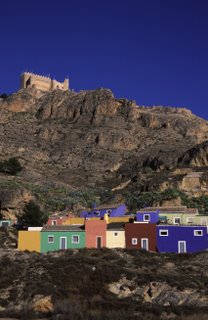
Jumilla, a region whose rich, hefty wines are made from the indigenous Monastrell grape have historically been used for blending, has now come into its own. No longer the rustic country bumpkin, Jumilla now produces wines that are finding a growing audience for fans of ripe, fruity, full-flavored wines that are reasonably priced and compare favorably to those from warm-country growing areas such as California and Australia.

Located in an arid mountain valley, some 50 miles inland from the Mediterranean Coast of Alicante, southwest of Valencia in the province of Murcia, Jumilla's 100,000-plus acres of vineyards are planted at altitudes that range from 1,300 to nearly 3,000 feet above sea level. Temperatures here can be extreme, soaring to more than 100 degrees on summer days and dropping to well below freezing in winter. Jumilla gets some 3,000 hours of sun per year and only about 16 inches of annual rainfall, but roots of traditional old vines burrow deep in search of moisture and most modern vineyards are fed by drip irrigation.

But don't be fooled by the climatic conditions in Jumilla. Like many other regions in Spain (the second most mountainous country in Europe), the secret behind making successful, balanced wines in areas that would seem to be too warm to make seriously good wines, is altitude. The vineyards' thermostats may be cranked up during the daylight hours in summer, but at night temperatures at these altitudes cool down dramatically. This allows the vines a good night's rest to buttress themselves for the coming day and is the secret behind Jumilla's emergence from near obscurity. The grapes get properly ripe, but still have enough acids because of the cool nights to carry the hefty weight of the wines they produce.

The brownish soil (with underlying chalk) and the arid conditions in Jumilla are inhospitable to the phylloxera bug that devastated Europe in the late-19th century; so inhospitable that many old Monastrell vineyards in Jumilla are planted on pie franco, or ungrafted French rootstock. In contrast, the vast majority of vineyards in Europe had to be grafted long ago onto American, phylloxera-resistant rootstock.

In Jumilla, Monastrell is the most important authorized grape variety and accounts for 90% of the wine produced. Monastrell is an indigenous grape variety, also sometimes called Mataró or Murviedro in Spain, but known to the rest of the world by the French name Mourvèdre (believed to be the French pronunciation of the ancient Spanish town of Murviedro). To be labelled 'Monastrell,' a Jumilla wine must contain at least 85% of the variety. Other red varieties authorized in the Jumilla denominación de origen (D.O.) are Garnacha Tintorera, which makes a powerful, deeply colored blending wine; Garnacha, the great Spanish grape that is also used widely in La Rioja, Navarra, Aragón and Priorat; Tempranillo/Cencibel, the main grape of neighboring La Mancha; Cabernet Sauvignon; Merlot; the exceptionally promising French Syrah; and Petit Verdot (authorized since 2003), which also shows great promise (Casa de la Ermita makes an exceptional example).

Though white grapes are insignificant at this stage, also authorized are Airén (so widely planted in La Mancha that its acreage ranks first among the world’s white grapes); Macabeo, known as Viura in La Rioja; Pedro Ximénez of Montilla-Moriles (and Sherry) fame; the ancient Mediterranean white variety, Malvasía; and Moscatel Grano Menudo (small berry Moscatel, an important grape of neighboring Alicante and Valencia). This last grape was approved in 2003, along with Chardonnay and Sauvignon Blanc. While not yet officially approved, Viognier may have promise in Jumilla as well, though few bodegas make wines from it.
Aficionados of Spanish wines are discovering the joys of Jumilla wines, and, given the excellent price-quality ratio of many of these Monastrell-based wines, those who are looking for wines that deliver a lot of bang of their buck may find their nirvana in these flavor-packed wines.

Bodegas Agapito Rico is widely distributed by Classical Wines of Seattle, WA (www.classicalwines.com). Agapito Rico's Carchelo Monastrell, a very reasonably-priced wine made from old vines Monastrell blended with small amounts of Syrah and Merlot, has enjoyed steady sales for many years in the U.S. Carchelo Monastrell is an unoaked, bright, full-flavored, balanced wine with delightful ripe red fruit-plums, cherries, red currants-that is a good match for grilled meats, pizza, paella and pasta. Agapito Rico makes just over a thousand cases of Canalizo, an intense 100% Syrah wine that spends 18 months in oak and needs several years in bottle to fully develop. They also produce Altico Monastrell-Syrah, a powerhouse blend that is aged for ten months in French oak.

Bodegas Mayoral 1890, named for the date of its founded in 1890, has also had considerable success in the U.S. with their balanced, richly flavored, inexpensive Jumilla wines. Wines from this bodega include the unoaked Mayoral, a blend of 60% Monastrell and 40% Tempranillo; a crianza (12 months in oak), which contains 70% Monastrell; and a reserva with Monastrell, Tempranillo and 20% Cabernet Sauvignon. They also make a Cabernet Sauvignon (100%), Syrah (100%), and Mayoral Selección (a blend of Cabernet Sauvignon, Monastrell and Tempranillo), all of which spend just four months in oak.

Bodegas Bleda, produces the well-known Castillo de Jumilla brand and exports 85% of its production, mostly to northern Europe. These relatively inexpensive wines are very well-made and show attractive, easy-drinking peppery, black currant, blackberry and chocolate flavors. All these very well balanced wines - even their bright, fruity rosado - are made with a minimum of 55%-60% Monastrell, 40% Tempranillo, and sometimes 5% Merlot. There is also a Castillo de Jumilla Monastrell (100%) and the first-rate Divus, made with 90-95% Monastrell and 5-10% Cabernet Sauvignon or Merlot.

Finca Luzón, an impressive estate vineyard planted en espaldera (on wires), is surrounded by stark, grey mountains. They produce well-made wines, including several Monastrell-based (50%) blends of Cabernet Sauvignon, Merlot and Tempranillo that are aged in new French and American oak. They also make a delicious Monastrell rosado; a rich, sweet 80% Monastrell Finca Luzón; Castillo de Luzón, a crianza (aged one year in oak) with 75% Monastrell; and their top-of-the-line Altos de Luzón, a blend of Monastrell from 50-year-old vines, Cabernet Sauvigon and Tempranillo.

Casa de la Ermita, another impressive small winery that overlooks a vast valley of vines, is drawing attention with their 100% Viognier white wine; a young red that is a blend of Monastrell, Tempranillo, Cabernet Sauvignon, Merlot and Syrah; a Casa de la Ermita crianza made with a predominance of Monastrell and Tempranillo, laced with Cabernet Sauvignon; an organically farmed Ecológico Monastrell (100%); and a set of Monasterio de Santa Ana mono-varietals–Merlot, Monastrell, and Syrah–all of which spend three months in oak. But the Casa de la Ermita wine that is drawing the most interest from Spanish wine aficionados is their 100% Petit Verdot, aged 12 months in new American (75%) and French oak.

The Jumilla winery that has earned the most kudos from both the Spanish and international press is Julia Roch e Hijos Casa Castillo. Their success is based on some splendid old vines vineyards, some of which are well over 50 years old, planted on ungrafted French rootstock in soils that show pronounced terroir. Many of the Casa Castillo wines contain some of the best Monastrell in the Jumilla D.O. The Casa Castilla 2001, blend of 50% monastrell and 50% tempranillo, was a rich mélange of sweet blackberry, currant, chocolate and licorice with a graphite mineral finish. The Casa Castillo Monastrell (85%) is sweet and rich with blackberry and currant flavors. The Casa Castillo Crianza, a Monastrell with 10% Syrah, shows even more of those rich blackberry, currant, chocolate and licorice flavors, again laced with an intriguing mineral finish. Their Las Gravas, a concentrated blend of 70% Monastrell, 15% Cabernet Sauvignon and 15% Syrah, is a tannic wine crammed with cherry, currant and blackberry flavors. The now legendary Pie Franco, a 100% Monastrell wine made from vines planted in 1941 on un-grafted rootstock, is another towering powerhouse that is loaded with soft fruit and has an engaging silky finish. Casa Castillo also produces limited quantities of a top-notch, well-balanced, sweet, late harvest Moscatel de Grano Menudo.

Olivares makes the big, ripe Altos de la Hoya Monastrell table wines from ungrafted old vines. Their red table wines are intense and mineral-laced, but still a bit rustic. However, it is their Monastrell-based sweet wines that are some of the most exciting in the emerging genre of Spanish dessert wines. Olivares can't make these late harvest wines every year, but when they do the results are superb. Olivares Monastrell Dulce, made from low-yield, old vines fruit, is a deep, black wine with currants and exotic spices in the nose and rich, sweet blackberry, coffee and chocolate flavors on the palate. The Olivares Viejísimo 1930 is a very dry Fondillón, an unusual, compelling rancio wine with a cornucopia of flavors - coffee, tobacco, dates, dried citrus peel. But these magnificent, once nearly extinct wines from Murcia and Alicante are a subject deserving of an entire article to themselves.

Many of the better wines of Jumilla are exported. Indeed, some bodegas export 90% of their wines and new wineries like Hijos de Juan Gil with their new brand, Wrongo Dongo, made by an Australian winemaker, are almost entirely aimed at the American market. Juan Gil and the Spanish dynamo in the American market, Jorge Ordoñez of Fine Estates From Spain, also produce the exorbitantly rated and wildly overpriced Clio and El Nido, though fans of Parkerista blockbusters with deep pockets may find much to like in these polished, but niche market-targeted wines.

About the author:

Gerry Dawes was awarded Spain's prestigious Premio Nacional de Gastronomía (National Gastronomy Award) in 2003. He writes and speaks frequently on Spanish cheeses, wine and gastronomy. He was a finalist for the 2001 James Beard Foundation's Journalism Award for Best Magazine Writing on Wine. He has personally visited more than 30 wineries in the Levante region, which includes the Murcia regions of Jumilla, Yecla and Bullas and La Comunitat Valenciana D.O.s of Alicante, Utiel-Requena and Valencia.

O:\Wine Articles & Notes\Jumilla Wines for website.wpd
Related Posts with Thumbnails