Share This Gerry Dawes's Spain Post


Instagram

In 2026, ranked #7 in the Top 30 Gastronomy Blogs (and Websites for Gastronomists & Gastronomes by Feedspot. (Ranked in the top 50 since 2019). "The Best Gastronomy blogs selected from thousands of Food blogs, Culture blogs and Food Science. We’ve carefully selected these websites because they are actively working to educate, inspire, and empower their readers with . . . high-quality information.

More than 3,640,000 views since inception, 123,000+ views in August 2026.


Ranked #7. Gerry Dawes's Spain: An Insider's Guide to Spanish Food, Wine, Culture and Travel gerrydawesspain.com

"My good friend Gerry Dawes, the unbridled Spanish food and wine enthusiast cum expert whose writing, photography, and countless crisscrossings of the peninsula have done the most to introduce Americans—and especially American food professionals—to my country's culinary life. . .” - - Chef-restaurateur-humanitarian José Andrés, Nobel Peace Prize Nominee and Oscar Presenter 2019; Chef-partner of Mercado Little Spain at Hudson Yards, New York 2019

Showing posts with label Plaza Santa Ana. Show all posts

7/10/2015

Flamenco at Villa Rosa, Plaza de Santa Ana, Madrid (Short Video)


* * * * *
 
 Flamenco Dancer & Troupe, Villa Rosa, Madrid
Photo by Gerry Dawes©2015

_________________________________________________________________  

Dawes was awarded Spain's prestigious Premio Nacional de Gastronomía (National Gastronomy Award) in 2003. He writes and speaks frequently on Spanish wine and gastronomy and leads gastronomy, wine and cultural tours to Spain. He was a finalist for the 2001 James Beard Foundation's Journalism Award for Best Magazine Writing on Wine, won The Cava Institute's First Prize for Journalism for his article on cava in 2004, was awarded the CineGourLand “Cinéfilos y Gourmets” (Cinephiles & Gourmets) prize in 2009 in Getxo (Vizcaya) and received the 2009 Association of Food Journalists Second Prize for Best Food Feature in a Magazine for his Food Arts article, a retrospective piece about Catalan star chef, Ferran Adrià. 


". . .That we were the first to introduce American readers to Ferran Adrià in 1997 and have ever since continued to bring you a blow-by-blow narrative of Spain's riveting ferment is chiefly due to our Spanish correspondent, Gerry "Mr. Spain" Dawes, the messianic wine and food journalist raised in Southern Illinois and possessor of a self-accumulated doctorate in the Spanish table. Gerry once again brings us up to the very minute. . ." - - Michael & Ariane Batterberry, Editor-in-Chief/Publisher and Founding Editor/Publisher, Food Arts, October 2009. 
 
Trailer for a proposed reality television series on wine, gastronomy, culture and travel in Spain.

8/19/2013

Anniversary of the Death of Federico García Lorca, Murdered by Nationalist Forces Outside His Hometown of Granada on August 19, 1936


 * * * * *

Statue of Federico García Lorca (b.1898–murdered by rightist forces August 19, 1936, Granada) in the Plaza de Santa Ana, Madrid. Sculptor: Julio López Hernández 1986.  
Photo copyright by Gerry Dawes 2007 / gerrydawes@aol.com.

 
Slide Show: Statue of Federico García Lorca, Plaza Santa Ana, Madrid.
____________________________________________________
About Gerry Dawes   


* * * * *

"Gerry Dawes, I can't thank you enough for opening up Spain to me." -- Michael Chiarello on Twitter. Chef Chiarello toured northern Spain with me in October 2011 and was just in Barcelona again in January 2013.  He is preparing to open his new Spanish inspired restaurant, Coqueta, at San Francisco's Pier 5 in April.

* * * * *

"In his nearly thirty years of wandering the back roads of Spain," Gerry Dawes has built up a much stronger bank of experiences than I had to rely on when I started writing Iberia...His adventures far exceeded mine in both width and depth..." -- James A. Michener, author of Iberia: Spanish Travels and Reflections

 * * * * *

Gerry Dawes was awarded Spain's prestigious Premio Nacional de Gastronomía (National Gastronomy Award) in 2003. He writes and speaks frequently on Spanish wine and gastronomy and leads gastronomy, wine and cultural tours to Spain. He was a finalist for the 2001 James Beard Foundation's Journalism Award for Best Magazine Writing on Wine, won The Cava Institute's First Prize for Journalism for his article on cava in 2004, was awarded the CineGourLand “Cinéfilos y Gourmets” (Cinephiles & Gourmets) prize in 2009 in Getxo (Vizcaya) and received the 2009 Association of Food Journalists Second Prize for Best Food Feature in a Magazine for his Food Arts article, a retrospective piece about Catalan star chef, Ferran Adrià. 


 ". . .That we were the first to introduce American readers to Ferran Adrià in 1997 and have ever since continued to bring you a blow-by-blow narrative of Spain's riveting ferment is chiefly due to our Spanish correspondent, Gerry "Mr. Spain" Dawes, the messianic wine and food journalist raised in Southern Illinois and possessor of a self-accumulated doctorate in the Spanish table. Gerry once again brings us up to the very minute. . ." - - Michael & Ariane Batterberry, Editor-in-Chief/Publisher and Founding Editor/Publisher, Food Arts.
 
Mr. Dawes is currently working on a reality television series
on wine, gastronomy, culture and travel in Spain.
 
Experience Spain With Gerry Dawes: Customized Culinary, Wine & Cultural Trips to Spain & Travel Consulting on Spain  

Gerry Dawes can be reached at gerrydawes@aol.com


3/01/2013

Plaza Santa Ana, Plaza Mayor, Goya's Madrid, John Dos Passos "Rosinante To The Road Again" (1922)

 * * * * *

"All the gravel paths of the Plaza Santa Ana were encumbered with wicker chairs. At one corner seven blind musicians all in a row, with violins, a cello, guitars and a mournful cornet, toodled and wheezed and twiddled through the "Blue Danube." 

At another a crumpled old man, with a monkey dressed in red silk drawers on his shoulder,  ground out "la Paloma" from a hurdygurdy. In the middle of the green plot a fountain sparkled in the yellow light that streamed horizontally from the cafés fuming with tobacco  smoke on two sides of the square, and ragged guttersnipes dipped their legs in the slimy basin round about it, splashing one another, rolling like little colts in the grass.


From the cafés and the wicker chairs and tables, clink of glasses and dominoes, patter of voices, scuttle of waiters with laden trays, shouts of men selling shrimps, prawns, fried potatoes, watermelon, nuts in little cornucopias of red, green, or yellow paper. Light gleamed on the buff-colored disk of a table in front of me, on the rims of two beer-mugs, in the eyes of a bearded man with an aquiline nose very slender at the bridge who leaned towards me talking in a deep even voice, telling me in swift lisping Castilian stories of Madrid. 


First of the Madrid of Felipe Cuarto: corridas in the Plaza Mayor, auto da fé, pictures by Velasquez on view under the arcade where now there is a doughnut and coffee shop, pompous coaches painted vermilion, cobalt, gilded, stuffed with ladies in vast bulge of damask and brocade, plumed cavaliers, pert ogling pages, lurching and swaying through the foot-deep stinking mud of the streets; plays of Calderon and Lope presented in gardens tinkling with jewels and sword-chains where ladies of the court flirted behind ostrich fans with stiff lean-faced lovers.

Then Goya's Madrid: riots in the Puerta del Sol, majas leaning from balconies, the fair of San Isidro by the river, scuttling of ragged guerrilla bands, brigands and patriots; tramp of the stiffnecked grenadiers of Napoleon; pompous little men in short-tailed wigs dying the dos de Mayo with phrases from Mirabeau on their lips under the brick arch of the arsenal; frantic carnivals of the Burial of the Sardine; naked backs of flagellants dripping blood, lovers hiding under the hoop skirts of the queen. 


Then the romantic Madrid of the thirties, Larra, Becquer, Espronceda, Byronic gestures, vigils in graveyards, duels, struttings among the box-alleys of the Retiro, pale young men in white stocks shooting themselves in attics along the Calle Mayor. "And now," the voice became suddenly gruff with anger, "look at Madrid. They closed the Café Suizo, they are building a subway, the Castellana looks more like the Champs Elysées every day.... It's only on the stage that you get any remnant of the real Madrid. Benavente is the last madrileño.  Tiene el sentido de lo castizo. He has the sense of the ..." all the end of the evening went to the discussion of the meaning of the famous word "castizo."


The very existence of such a word in a language argues an acute sense of style, of the manner of doing things. Like all words of real import its meaning is a gamut, a section of a spectrum rather than something fixed and irrevocable. The first implication seems to be "according to Hoyle," following tradition: a neatly turned phrase, an essentially Castilian cadence, is castizo; a piece of pastry or a poem in the old tradition are castizo, or a compliment daintily turned, or a cloak of the proper fullness with the proper red velvet-bordered lining gracefully flung about the ears outside of a café.  

Lo castizo essence of the local, of the regional, the last stronghold of Castilian arrogance, refers not to the empty shell of traditional observances but to the very core and gesture of them. Ultimately lo castizo means all that is salty, savourous of the red and yellow hills and the bare plains and the deep arroyos palaces and belfries, and the beggars in snuff-colored cloaks and the mule-drivers with blankets over their shoulders, and the discursive lean-faced gentlemen grouped about tables at cafés and casinos, and the stout dowagers with mantillas over their gleaming black hair walking to church in the morning with missals clasped in fat hands, all that is acutely indigenous, Iberian, in the life of Castile."
 

About Gerry Dawes

Gerry Dawes was awarded Spain's prestigious Premio Nacional de Gastronomía (National Gastronomy Award) in 2003. He writes and speaks frequently on Spanish wine and gastronomy and leads gastronomy, wine and cultural tours to Spain. He was a finalist for the 2001 James Beard Foundation's Journalism Award for Best Magazine Writing on Wine, won The Cava Institute's First Prize for Journalism for his article on cava in 2004, was awarded the CineGourLand prize in 2009 and received the Association of Food Journalists 2009 Second Prize for Best Food Feature in a Magazine for his Food Arts article, a retrospective piece about Catalan star chef, Ferran Adrià.


Mr. Dawes is currently working on a reality television
series on wine, gastronomy, culture and travel in Spain.


Experience Spain With Gerry Dawes: Culinary Trips to Spain & Travel Consulting on Spain

Gerry Dawes can be reached at gerrydawes@aol.com; Alternate e-mail (use only if your e-mail to AOL is rejected): gerrydawes@hotmail.com

2/28/2013

John Dos Passos: A Tale of Madrid, La Plaza Santa Ana, Jorge Manrique, Pastora and Why We Love Spain!


 * * * * *

ROSINANTE TO THE ROAD AGAIN
Copyright, 1922, George H. Doran Company, New York
I: A Gesture and a Quest

Telemachus had wandered so far in search of his father he had quite forgotten what he was looking for. He sat on a yellow plush bench in the café El Oro del Rhin, Plaza Santa Ana, Madrid (see related story on Cervecerías in the Plaza Santa Ana), swabbing up with a bit of bread the last smudges of brown sauce off a plate of which the edges were piled with the dismembered skeleton of a pigeon. Opposite his plate was a similar plate his companion had already polished.  Telemachus put the last piece of bread into his mouth, drank down a glass of beer at one spasmodic gulp, sighed, leaned across the table and said:

"I wonder why I'm here."
 

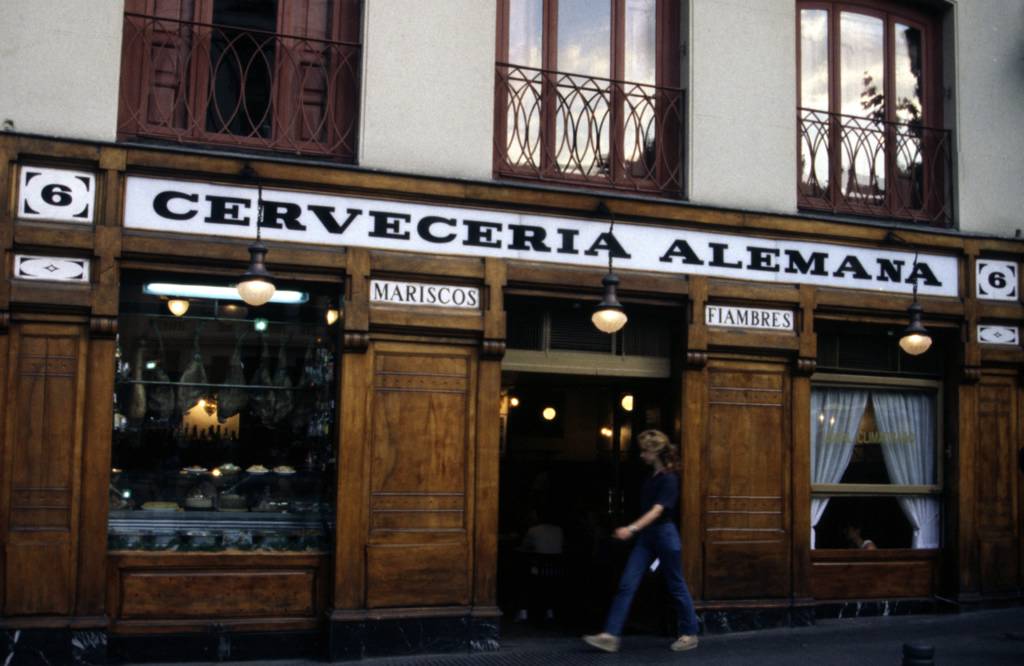
Cervecería Alemana, Hemingway Hangout
Gerry Dawes copyright 2011
 
"Why anywhere else than here?" said Lyaeus, a young man with hollow cheeks and slow-moving hands, about whose mouth a faint pained smile was continually hovering, and he too drank down his beer.

At the end of a perspective of white marble tables, faces thrust forward over yellow plush cushions under twining veils of tobacco smoke, four German women on a little dais were playing Tannhauser. 

Smells of beer, sawdust, shrimps, roast pigeon.

"Do you know Jorge Manrique? That's one reason, Tel," the other man continued slowly.


With one hand he gestured to the waiter for more beer, the other he waved across his face as if to brush away the music; then he recited, pronouncing the words haltingly:

    'Recuerde el alma dormida,
    Avive el seso y despierte
    Contemplando
    Cómo se pasa la vida,
    Cómo se viene la muerte
    Tan callando:
    Cuán presto se va el placer,
    Cómo después de acordado
    Da dolor,
    Cómo a nuestro parecer
    Cualquier tiempo pasado
    Fué mejor.'
[O let the soul her slumbers break, 
Let thought be quickened, and awake;
Awake to see
How soon this life is past and gone,
And death comes softly stealing on,
How silently!
Swiftly our pleasures glide away,
Our hearts recall the distant day
With many sighs;
The moments that are speeding fast
We heed not, but the past,—the past,
More highly prize.]

"It's always death," said Telemachus, "but we must go on."

It had been raining. Lights rippled red and orange and yellow and green on the clean paving-stones. A cold wind off the Sierra shrilled through clattering streets. As they walked, the other man was telling how this Castilian nobleman, courtier, man-at-arms, had shut himself up when his father, the Master of Santiago, died and had written this poem, created this tremendous rhythm of death sweeping like a wind over the world. He had never written anything else.

They thought of him in the court of his great dust-colored mansion at Ocaña, where the
broad eaves were full of a cooing of pigeons and the wide halls had dark rafters painted  with arabesques in vermilion, in a suit of black velvet, writing at a table under a lemon tree.
Down the sun-scarred street, in the cathedral that was building in those days, full of a smell of scaffolding and stone dust, there must have stood a tremendous catafalque where lay with his arms around him the Master of Santiago; in the carved seats of the choirs the stout canons intoned an endless growling litany; at the sacristy door, the flare of the candles flashing occasionally on the jewels of his mitre, the bishop fingered his crosier restlessly, asking his favorite choir-boy from time to time why Don Jorge had not arrived.

And messengers must have come running to Don Jorge, telling him the service was on the point of beginning, and he must have waved them away with a grave gesture of a long white hand,while in his mind the distant sound of chanting, the jingle of the silver bit of his roan horse stamping nervously where he was tied to a twined Moorish column, memories of cavalcades filing with braying of trumpets and flutter of crimson damask into conquered towns, of court ladies dancing, and the noise of pigeons in the eaves, drew together like strings plucked in succession on a guitar into a great wave of rhythm in which his life was sucked away into this one poem in praise of death.

    Nuestras vidas son los ríos
    Que van a dar en la mar,
    Que es el morir....

Telemachus was saying the words over softly to himself as they went into the theatre. The orchestra was playing a Sevillana; as they found their seats they caught glimpses beyond people's heads and shoulders of a huge woman with a comb that pushed the tip of her mantilla a foot and a half above her head, dancing with ponderous dignity. Her dress was pink flounced with lace; under it the bulge of breasts and belly and three chins quaked with every thump of her tiny heels on the stage. As they sat down she retreated bowing like a full-rigged ship in a squall.  The curtain fell, the theatre became very still; next was Pastora.

Strumming of a guitar, whirring fast, dry like locusts in a hedge on a summer day. Pauses that catch your blood and freeze it suddenly still like the rustling of a branch in silent woods at night. A gipsy in a red sash is playing, slouched into a cheap cane chair, behind him a faded crimson curtain. Off stage heels beaten on the floor catch up the rhythm with tentative interest, drowsily; then suddenly added, sharp click of fingers snapped in time; the rhythm slows, hovers like a bee over a clover flower. A little taut sound of air sucked in suddenly goes down the rows of seats. With faintest tapping of heels, faintest snapping of the fingers of a brown hand held over her head, erect, wrapped tight in yellow shawl here the embroidered flowers make a splotch of maroon over one breast, a flecking of green and purple over shoulders and thighs, Pastora Imperio comes across the stage, quietly, unhurriedly. 

In the mind of Telemachus the words return:

    Cómo se viene la muerte
    Tan callando.

Her face is brown, with a pointed chin; her eyebrows that nearly meet over her nose rise in a flattened "A" towards the fervid black gleam of her hair; her lips are pursed in a half-smile as if she were stifling a secret. She walks round the stage slowly, one hand at her waist, the shawl tight over her elbow, her thighs lithe and restless, a panther in a cage.


At the back of the stage she turns suddenly, advances; the snapping of her fingers gets loud, insistent; a thrill whirrs through the guitar like a covey of partridges scared in a field. 

Red heels tap threateningly.


    Decidme: la hermosura,
    La gentil frescura y tez
    De la cara
  
    El color y la blancura,
    Cuando viene la viejez
    Cuál se para?

She is right at the footlights; her face, brows drawn together into a frown, has gone into shadow; the shawl flames, the maroon flower over her breast glows like a coal.


The guitar is silent, her fingers go on snapping at intervals with dreadful foreboding. Then she draws herself up with a deep breath, the muscles of her belly go taut under the tight silk wrinkles of the shawl, and she is off again, light, joyful, turning indulgent glances towards the audience, as a nurse might look in the eyes of a child she has unintentionally frightened with a too dreadful fairy story.


The rhythm of the guitar has changed again; her shawl is loose about her, the long fringe flutters; she walks with slow steps, in pomp, a ship decked out for a festival, a queen in plumes and brocade....

    ¿Qué se hicieron las damas,
    Sus tocados, sus vestidos,
    Sus olores?

   ¿Qué se hicieron las llamas
    De los fuegos encendidos
    De amadores?


And she has gone, and the gipsy guitar-player is scratching his neck
with a hand the color of tobacco, while the guitar rests against his
legs. He shows all his teeth in a world-engulfing yawn.

When they came out of the theatre, the streets were dry and the stars
blinked in the cold wind above the houses. At the curb old women sold
chestnuts and little ragged boys shouted the newspapers.
"And now do you wonder, Tel, why you are here?"
 
__________________________________________________________________________________
About Gerry Dawes

Gerry Dawes was awarded Spain's prestigious Premio Nacional de Gastronomía (National Gastronomy Award) in 2003. He writes and speaks frequently on Spanish wine and gastronomy and leads gastronomy, wine and cultural tours to Spain. He was a finalist for the 2001 James Beard Foundation's Journalism Award for Best Magazine Writing on Wine, won The Cava Institute's First Prize for Journalism for his article on cava in 2004, was awarded the CineGourLand prize in 2009 and received the Association of Food Journalists 2009 Second Prize for Best Food Feature in a Magazine for his Food Arts article, a retrospective piece about Catalan star chef, Ferran Adrià.


Mr. Dawes is currently working on a reality television
series on wine, gastronomy, culture and travel in Spain.


Experience Spain With Gerry Dawes: Culinary Trips to Spain & Travel Consulting on Spain
 

Gerry Dawes can be reached at gerrydawes@aol.com; Alternate e-mail (use only if your e-mail to AOL is rejected): gerrydawes@hotmail.com

10/24/2012

Cervecerías: Madrid's Beer Bars (With a Couple in Barcelona)

First appeared in Food Arts
by Gerry Dawes


La Maja Desnuda, now with a padlock over a sensitive portion of her anatomy, at the very campy Cervecería Los Gatos tapas bar, Madrid.  Curro Romero is the bullfighter.  
Photo by Gerry Dawes©2010 / gerrydawes@aol.com.


Cervecería Alemana, Hemingway Hangout
Gerry Dawes copyright 2010

If you ask the average Spaniard (and most foreigners, for that matter) for a definition of a cervecería, one of Spain’s ubiquitous so-called beer bars, you will get all kinds of answers, almost none of them right.

“It’s a bar where they only serve beer,” a woman in Madrid told me. (Most cervecerías serve wine, hard liquor, coffee, and tapas--Spain’s answer to hors d’oeuvres and the best fast food in Europe.)

La Cañita, Madrid.
Gerry Dawes copyright 2010

“A cervecería is a bar that specializes in beers.” (Most cervecerías traditionally had only a couple of beers on tap, but almost all offer draft beer, but so do most bars and tapas bars.)

And those Irish, English, or German beer pubs, which every major city seems to have? There are plenty of international-style beer bars such as Oldenburg in Madrid, which claims The Guinness Book of World Records title for most beers offered in the smallest space (163 beers in a bar that is 14.5 square meters [156 square feet]) and many others in larger cities such as Barcelona, where they are called cerveserias (Catalan). They offer a wide variety of beers from around the world and technically they are also cervecerías, but they certainly aren’t your typical Spanish cervecería.

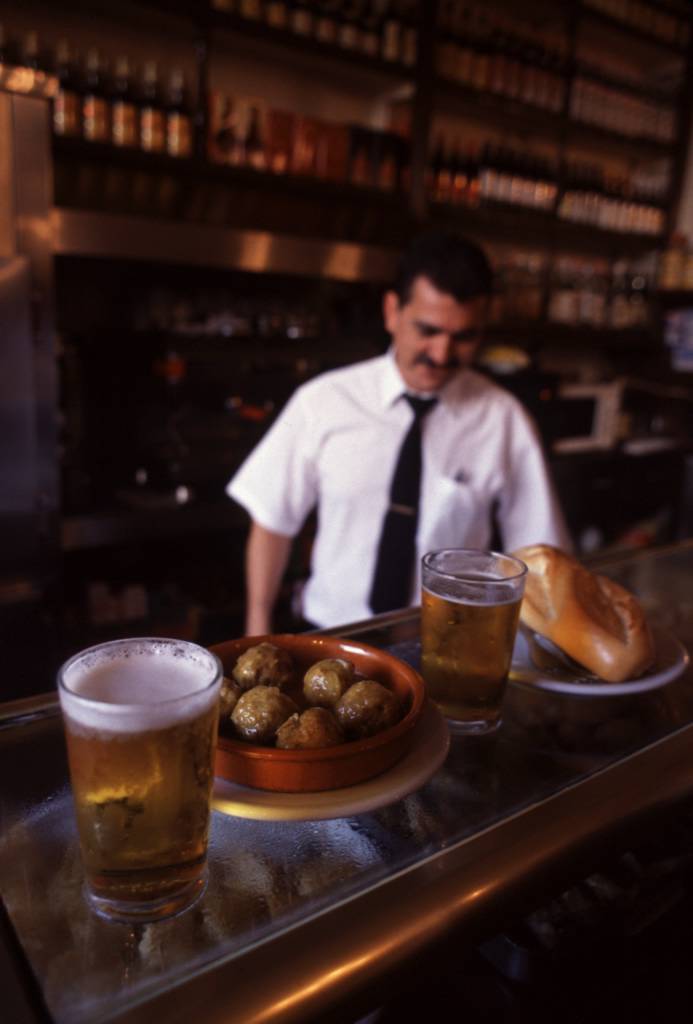
Waiter in Madrid with glasses of beer.
Gerry Dawes copyright 2008

So, what then is a Spanish cervecería? After traveling Spain for three decades without getting a clear, fixed definition, the best I can figure is that a typical Spanish cervecería is a place to go when you want sit down with a cold glass of draft beer, don’t really mind whether there is a large selection, and wouldn’t mind having a tapa or two with your brew. Unlike many tapas bars, which are often stand-up-and-picar (snack on little bites of food) places with little or no seating, a cervecería will usually have plenty of chairs and tables where you can sit down with friends, sip your cerveza, and engage in one of those great gab sessions called tertulias. (Don’t drink alcoholic beverages? You can still enjoy the atmosphere and food of Spain’s cervecerías. Cerveza sin alcohol, alcohol-free beer accounts for 7.5% of the Spanish market, tops in the European Union.)

The average Spanish cervecería would drive most American drinks writers crazy, because most cervecerías in Spain actually don’t make that much of a fuss over beer. In a typical Spanish cervecería, the selection on draft in most cervecerías is limited to selections from the company that paid for taps, which are usually emblazoned with the logos of one of the five major Spanish breweries (San Miguel, Cruzcampo, Damm, Mahou, or El Aguila).

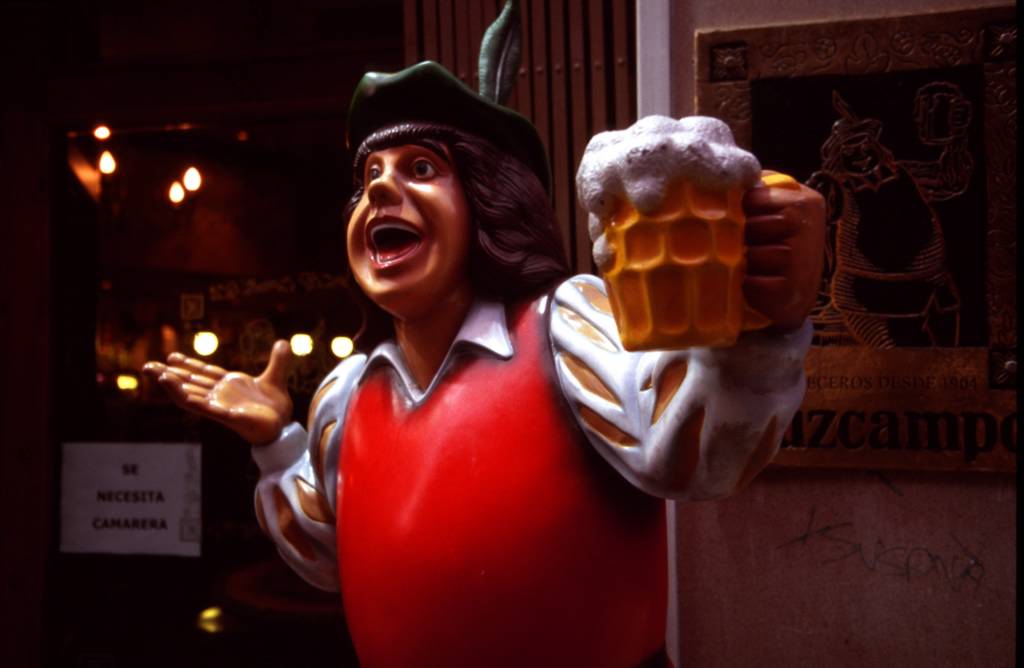
Cruzcampo, which was founded in 1904 and is now owned by Heineken (which also owns El Aguila), even has its own franchised string of colorful cervecería/tapas bar/restaurant establishments called Gambrinus, which is represented by drawings and statues of a jovial, portly, rather Alpine-looking, distinctly good-old-hombre kind of character lifting a beer stein.


Gambrinus, Logroño.
Gerry Dawes copyright 2010

(The Gambrinus of legend was a 14th- or 15th-Century Burgundian, who is often referred to and depicted as the “King of Beers,” which will come as a big surprise to most Americans, who think the “King of Beers” is Budweiser.) The very good, fast-growing, San Miguel-owned Cañas y Tapas franchise, which was founded in 1999 and already has some 20 outlets in the Madrid and more than 50 around Spain, features San Miguel on draft and excellent tapas.

Spain has more than 20 national brands of beer and is the European Union’s third-largest beer producer (behind England and Germany) and ranks ninth in the world. Spanish beer exports have nearly doubled over the past six years, but full-blown beer connoisseurship has not yet descended on Spaniards - - as wine geekdom has (this, too, has changed over the past decade; there are many more beer bars specializing in Spanish and European artisan beers now). Nevertheless, most Spanish beer tastes great, especially if you are the type who doesn’t lament that you are not drinking Guinness, Chimay, Fischer, etc.

In a cervecería, Spanish beer is normally served chilled in cañas (short water-glass style quaffs). [If you want a bigger beer simply ask for a doble (a large wider-mouthed glass) or a tanque (tankard, a larger mug or stein); for a dark beer, cerveza negra.] A Spaniard will pop in to a cervecería and order a caña, which will probably be accompanied by a little oval dish of green olives and/or potato chips, sometimes house-made.

Woman's hand reaching for a beer.
Gerry Dawes copyright 2004

He or she (women of all ages frequent cervecerías for a refreshing caña) will sip their beer, munch on the olives and potato chips, and move to wherever it was they were going before they got thirsty. A caña is just a quick pick-me-up and thirst quencher. Pairs will come in, order a round of beers and a couple of tapas, then move on to the next bar, which may be another cervecería or a tasca specializing in tapas and wine, at which point they may switch drinks. Groups tend to settle in at a table, order a round of beers, a couple of glasses of vino and a few raciones, larger group-sized portions of tapas. Then they set about slaking their thirst, holding the hunger wolf at bay, and getting down to the serious business of the tertulia—shooting the breeze. The topic of conversation most certainly will not be a discussion of the merits of various brands of beers or grousing about why the joint doesn’t offer 163 different brands.

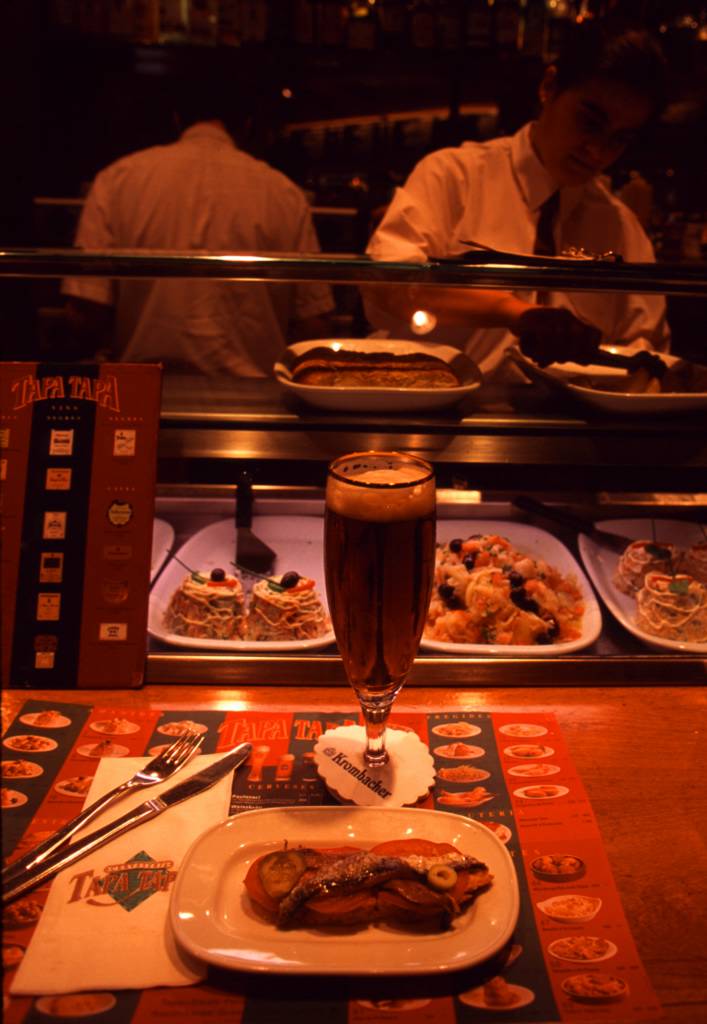
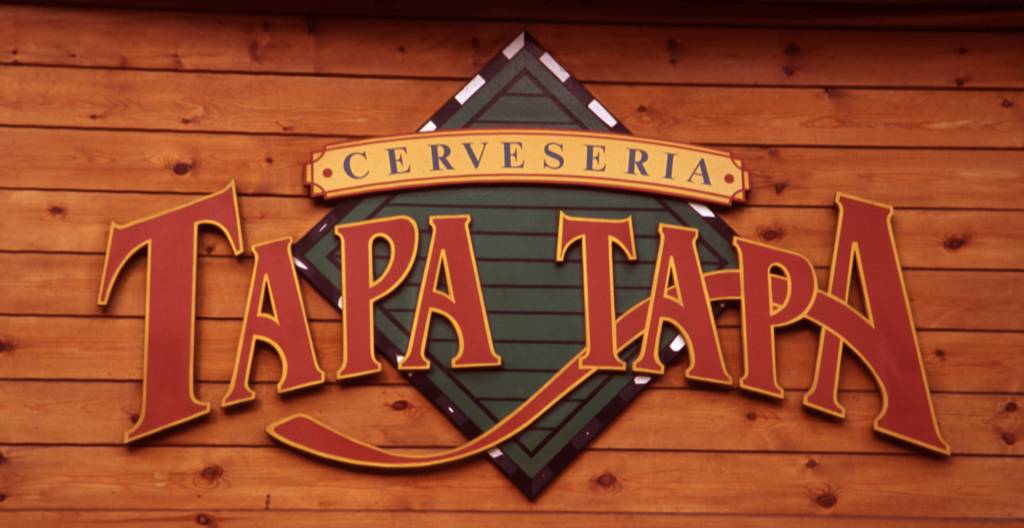
Cerveseria Tapa-Tapa, Barcelona.
Gerry Dawes copyright 2004

Cervecerías are easy to find in Madrid, Barcelona, and any town of any size in Spain (and the Cañas y Tapas and Gambrinus franchises are spreading like foam out of a fresh beer tap), but a good place to get acquainted with cervecerías is Madrid, where these beer halls have a long and warmly regarded, communal history. An excellent place to begin is La Plaza Santa Ana—one of the Madrid’s most famous squares. The plaza and the streets surrounding it are home to some of the capital’s most colorful and convivial cervecerías.

Cerveza, Cerveseria Tapa-Tapa, Barcelona
Gerry Dawes copyright 2010

Plaza Santa Ana is located just a few blocks west of the Prado and Thyssen-Bornemisza museums, and the Ritz, Palace, and Villa Real hotels. It is in the old literary district where Miguel de Cervantes, the author of Don Quixote, and Lope de Vega, the Spanish Shakespeare, lived. Back in the 19th Century, because of its beer halls, this lively square was popularly known as Plaza de la Cerveza (Beer Plaza). From the number of cervecerías now on the plaza, Plaza Santa Ana could still claim that title.

Plaza Santa Ana
Gerry Dawes copyright 2010

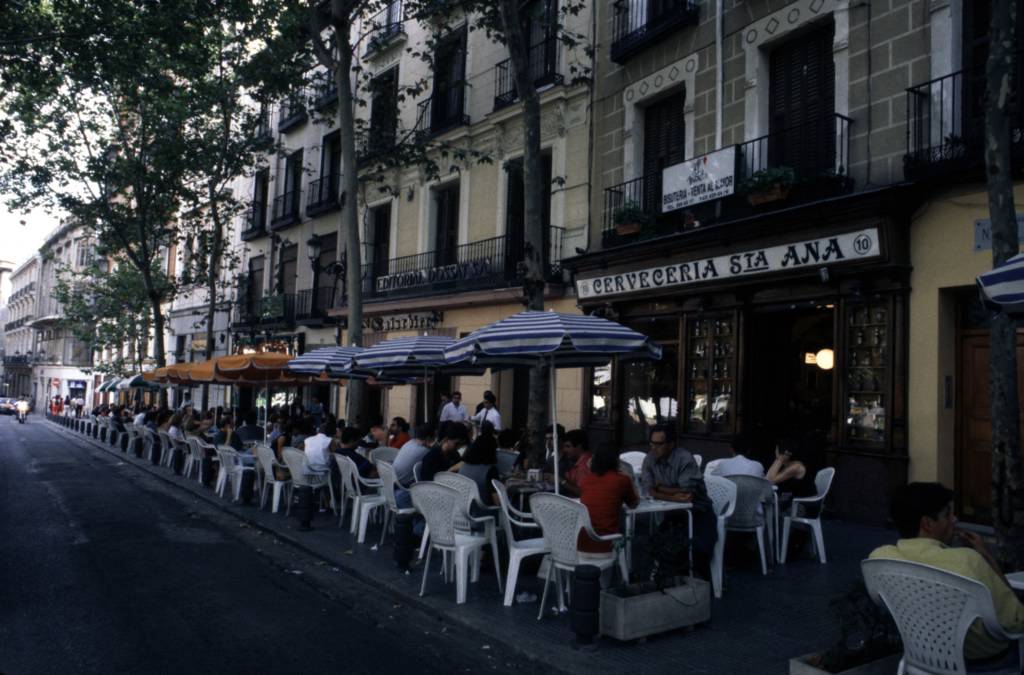
Plaza Santa Ana is bordered on the east by the Teatro Español (Spanish National Theatre) and on the west by the now modernized Hotel ME Reina Victoria, once the epicenter for the bullfight crowd during Madrid’s San Isidro festival each May. But it is the beer halls with their outdoor sidewalk seating along the south side of the plaza, which will get your attention since they are usually filled with attractive people from across the spectrum - - locals, students, tourists - - sampling tapas and sipping beer.

As you come west up Calle Prado from Plaza de las Cortes, where the Spanish parliament (or Cortes) is located, the first bar you will encounter on this row is the Cervecería Alemana, a colorful Madrid institution founded in 1904 and celebrated as an old Hemingway and bullfight hangout.

Cervecería Alemana - Tapas
Gerry Dawes copyright 2010

The marble-topped tables, crusty veteran waiters, and taurine photographs on the wall capture the atmosphere of old Madrid. Ask for una caña de cerveza (you will automatically be served a glass of draft beer) to go with a ración of almejas a la marinera (great Spanish Manila-style clams in a rich, savory sauce), calamares a la romana (deep-fried, battered squid rings), or ensaladilla rusa (“Russian”-style potato salad), all of which are classic Spanish tapas.

Just up the sidewalk is the much newer Naturbier, a fashionable cervecería, which brews its own beer in what was the cellar of an old convent and serves it on draft with tapas such as Galician empanadas (a pie-like pastry stuffed with meat or fish), excellent Catalan sausages, and cured anchovies on toast.

Cerveza y "gildas," anchovies, olives and guindilla peppers on a toothpick, San Sebastián.
Gerry Dawes copyright 2008

Naturbier’s next-door neighbor is another good beer bar, Cervecería Santa Ana, which also has sidewalk tables where you can drink cold draft beer with mostly delicatessen-like cold tapas—a tabla de embutidos (a platter of good Spanish cold meats such as chorizo, salami-like salchichón, jamón serrano [Spain’s superlative cured mountain ham], and cecina [a cured beef ham specialty from northern Spain]; a selection of Spanish cheeses; and such standards as delicious boquerones en vinagre (marinaded fresh anchovies). This cervecería also has a wide-ranging international selection of bottled beers.

A few feet further up the sidewalk towards Hotel Reina Victoria is La Moderna, which bills itself as a cervecería, but is also one of Madrid’s best wine and tapas bars. La Moderna does serve good draft beer, but it also specializes in Spanish wines and food items such as cheeses, olives, and sausages with specific denominaciones de origen (Spain’s equivalent of France’s appellation controlee system for guaranteeing authenticity and quality). La Moderna’s wine-bar style offerings include many difficult-to-find and up-and-coming wineries. They also serve a wide variety of creative single-portion tapas, not just racion-size portions, so you can sample of number of different dishes here.

The tapas bars of the Plaza Santa Ana will get you started. Making the rounds of Madrid’s cervecerías, is a fine introductory course in Spanish food, tapas, and Spanish and European beers. The cervecería scene in Madrid is great fun and the bites of food that accompany the good, cold Spanish beer fortifies you for a long evening of pub hopping and is of a very entertaining and civilized way to drink. Just off the Plaza Santa Ana in the surrounding calles (streets), Huertas and del Principe especially, are at least 30 or more cervecerías that also serve tapas. Just a few blocks east of Plaza Santa and a block west of the Prado Museum is the Plaza de Jesús, which has several more very colorful cervecerías (see listing). There are hundreds more scattered around Madrid (see listing for other selected cervecerías in Madrid and Barcelona).

The Gambrinus chain of cervecerías also offers a short list of international bottled beers, including Desperado, which is describing as having “the aroma of Tequila.” My advice is rather than be that desperado, just do what the average Spaniard does, order a cerveza de barril and take what comes out of the tap.

Cervecerías in Madrid and Barcelona

Literary District (near the Prado and major museums)

Cervecería Alemana, Plaza de Santa Ana 6. 91 429 70 33.

Cervecería Santa Ana, Plaza de Santa Ana 10. 91 429 43 56.

Cervecería Naturbier, Plaza de Santa Ana 9. 91 429 39 18.

Cervecería La Moderna, Plaza de Santa Ana 12. 91 420 15 82.

Cervecería Los Gatos, Plaza de Jesús 2, 91 429 30 67. A very colorful, cave-like, taurine motif hangout a couple of blocks from the Prado.

Las Gatos, Madrid
Gerry Dawes copyright 2004

Cervecería La Dolores, Plaza de Jesús 4. 91 429 22 43. A Madrid classic with a great tile façade, good tapas, and an attractive evening crowd.

Cervecería Cervantes, Plaza De Jesús 7. 91 429 60 93. Another in a string of good beer-and-tapas bars on this street.

Cañas y Tapas, Atocha 42 (and some 20 other Madrid area locations, see www.tapaspain.com; Nuestros Tabernas section for listing). Central reservations number: 902 18 09 18.

Central Madrid & the Barrio de Salamanca (shopping district)

Cervecería Correos, Alcalá 55. 91 578 21 31. Beer and tapas across from Madrid’s ornate main post office, between the Plaza de Cibeles and the Puerta de Alcalá.

Cervecería Santa Bárbara (Also Known as La Cruz Blanca), Goya 70. 91 575 00 52. A Madrid classic for oysters and draft beer. (There are two other related Santa Bárbara cervecerías.)

Cervecería El Barril, Goya 86. 91 578 39 98. A cervecería specializing in seafood tapas. In the Goya metro area near the northeastern side of Retiro Park.

Cervecería Los Clarines, Bocángel 2. 91 356 98 59. A taurine-motif beer bar near Las Ventas, Madrid’s bullring.

Cervecería Juan Bravo 25, Juan Bravo 25. 91 411 60 25. An excellent cervecería/tapas bar/restaurant with a wonderful curving bar, good beer, good tapas, and good ambience.

Cervecería Oldenburg, Alburquerque 13. 91 447 42 72. Guinness Book of World Records, most beers in the smallest space.

Gambrinus Carmen, Plaza del Carmen S/N (near the Puerta del Sol). 91 531 84 13. One of several in the Cruzcampo Gambrinus chain. (See article.)

Cervecería El Doble, José Abascal, 16. 91 448 20 33. A sign here says, “Beer Drawn by the Old System,” basically slow-drawn draft with good tapas and great bullfight pictures on the walls.

Barcelona

Cerveseria Tapa Tapa, Barcelona
Gerry Dawes copyright 2008

Cerveseria Tapa Tapa, Passeig de Gràcia 44. Two long curving bars, scores of tapas with a picture guide to identify them and good German beer on draft. In the Eixample on Barcelona’s Madison Avenue, Tapa Tapa is near some of the modernista architect Antoni Gaudí’s finest buildings.

Cerveseria Tapa-Tapa, Barcelona.
Gerry Dawes copyright 2008

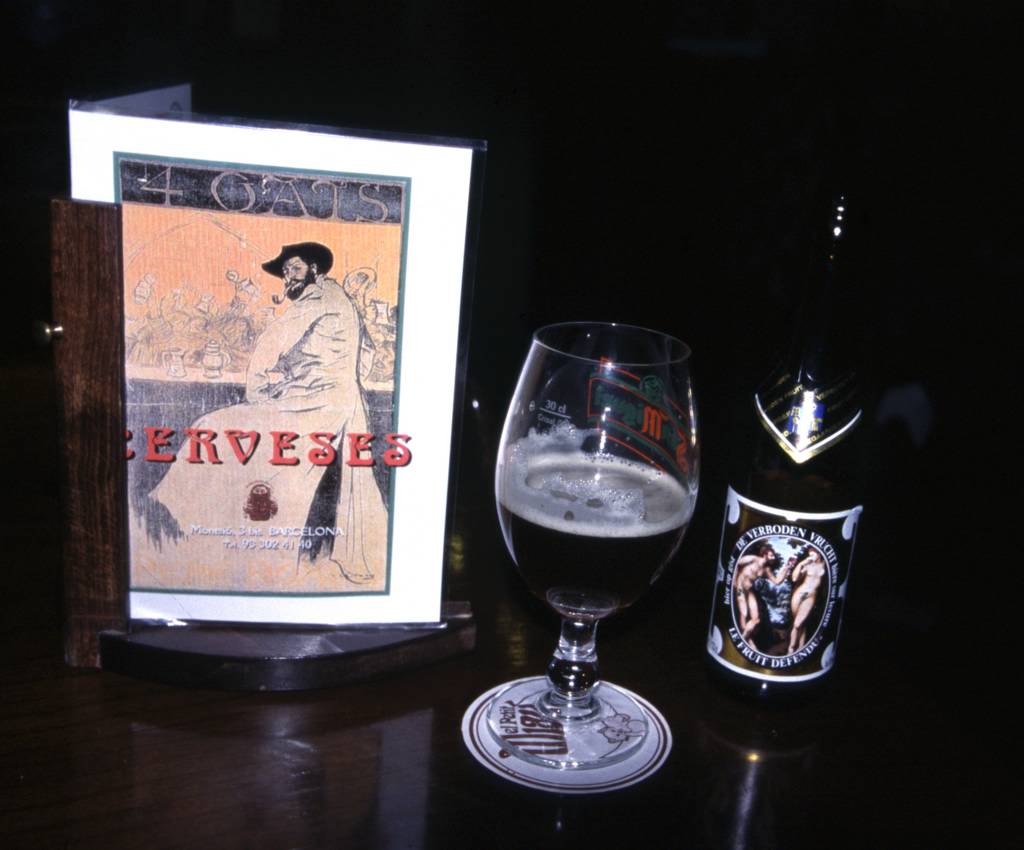
Els Quatre Gats (Cerveseria Modernista), Montsió, 3 bis. 93 302 41 40. Billed as a cerveseria modernista, this colorful, not-to-be-missed, turn-of-the-century bar-restaurant was an artist’s hangout where Picasso had his first exhibition.  (Warning: both management and waiters can be very unwelcoming, if you are not dining in their restaurant.)

Cerveseria 4 Gats, Barcelona.
Gerry Dawes copyright 2008

Cerveseria Gambrinus, La Rambla 140. 93 301 07 70. (See article.)
Related Posts with Thumbnails