Share This Gerry Dawes's Spain Post


Instagram

In 2026, ranked #7 in the Top 30 Gastronomy Blogs (and Websites for Gastronomists & Gastronomes by Feedspot. (Ranked in the top 50 since 2019). "The Best Gastronomy blogs selected from thousands of Food blogs, Culture blogs and Food Science. We’ve carefully selected these websites because they are actively working to educate, inspire, and empower their readers with . . . high-quality information.

More than 3,640,000 views since inception, 123,000+ views in August 2026.


Ranked #7. Gerry Dawes's Spain: An Insider's Guide to Spanish Food, Wine, Culture and Travel gerrydawesspain.com

"My good friend Gerry Dawes, the unbridled Spanish food and wine enthusiast cum expert whose writing, photography, and countless crisscrossings of the peninsula have done the most to introduce Americans—and especially American food professionals—to my country's culinary life. . .” - - Chef-restaurateur-humanitarian José Andrés, Nobel Peace Prize Nominee and Oscar Presenter 2019; Chef-partner of Mercado Little Spain at Hudson Yards, New York 2019

Showing posts with label Do Ferreiro. Show all posts

10/22/2011

The Chiarello Chronicles: Day One, October 3, Galicia. A Sublime Seafood Dinner at D'Berto Restaurant with Do Ferreiro Owner Gerardo Méndez

* * * * *


Gerardo Méndez of Do Ferreiro, Chef Ryan McIlwaith of Bottega Napa Valley, D' Berto owner 
Alberto “Berto” Domínguez and Chef Michael Chiarello at D'Berto Restaurante, O Grove, Galicia. 
Photo by Gerry Dawes©2011 / gerrydawes@aol.com.

* * * * *


D' Berto owner Alberto “Berto” Domínguez clowning around with a cigala (Dublin Bay prawn) at D' Berto, 
O Grove (Pontevedra), Galicia. Photo by Gerry Dawes©2011 / gerrydawes@aol.com.

 Restaurante d’Berto
O Grove (Pontevedra), Galicia


D’Berto specializes in simply prepared but sensational crustaceans, mollusks and fish from the beautiful Rías Baixas (lower fjords) of the northwestern region of Galicia: cigalas (Dublin Bay prawns), langostas (spiny, clawless lobsters), camarones (small, succulent shrimp), vieiras (scallops with their orange coral) and centollos (big spider crabs). Owner Alberto “Berto” Domínguez’s pristine selections are matched by his chef-sister Marisol’s spot-on cooking techniques, and the wine list features stellar picks, like Albariño Do Ferreiro “Cepas Vellas,” one of Spain’s best whites. Dinner, $70. 84 Avenida Teniente Domínguez, O Grove, Pontevedra, Galicia; 34-986/733-447. -- Gerry Dawes, Departures (on-line), May 2011.


Roe on a female cigala (Dublin Bay prawn) at D'Berto, O Grove, Galicia.  
Photo by Gerry Dawes©2011 / gerrydawes@aol.com.


Slide show on our dinner at D'Berto.
(Double click on the images to enlarge the slide show.)

  Where to Stay: Located roughly ten miles south of O Grove, the Gran Talaso Hotel Sanxenxo (rooms, from $175; 3 Paseo Praia de Silgar; 34-986/691-111) overlooks the Ría de Pontevedra. Nearby, two other options are the classic beachfront Gran Hotel La Toja (rooms, from $300; 34-986/730-025) and the Parador Nacional de Cambados (rooms, from $200; Plaza Calzada; 34-902/547-979), set in a 17th-century mansion. -- Gerry Dawes, Departures (on-line), May 2011.

We stayed at Hotel Casa Rosita in Cambados, a reasonably priced, comfortable hotel that looks out on the wetlands and fishing port of Cambados.  Casa Rosita has become one of my favorite road warrior hotels.  

Hotel Casa Rosita
Avenida de Vilagarcía, 8
36630 - Corvillón / Cambados (Pontevedra)
Phone: 986 543 477/986 542 878 


__________________________________________________________________________________  
About Gerry Dawes   

Gerry Dawes was awarded Spain's prestigious Premio Nacional de Gastronomía (National Gastronomy Award) in 2003. He writes and speaks frequently on Spanish wine and gastronomy and leads gastronomy, wine and cultural tours to Spain. He was a finalist for the 2001 James Beard Foundation's Journalism Award for Best Magazine Writing on Wine, won The Cava Institute's First Prize for Journalism for his article on cava in 2004, was awarded the CineGourLand “Cinéfilos y Gourmets” (Cinephiles & Gourmets) prize in 2009 in Getxo (Vizcaya) and received the 2009 Association of Food Journalists Second Prize for Best Food Feature in a Magazine for his Food Arts article, a retrospective piece about Catalan star chef, Ferran Adrià. 

 
Trailer for a proposed reality television series  
on wine, gastronomy, culture and travel in Spain.

12/20/2009

Escaping the Snow in New York by Fleeing to Images of Summer: A Slide Show of El Encontro de Viño de Autor (Artisan Signature Grower-Producers) in Galicia This July


* * * * *


* * * * *


* * * * *
Slide Show of El Encontro de Viño de Autor (Artisan Signature Grower-Producers)
(With captions and photos of winemakers, regional dishes, a pizza maestro who sings, and more.)


(Double click on image to go to larger image, once in Picasa web album push F11 for full screen view.)
____________________________________________________________________________

About Gerry Dawes

Gerry Dawes's Spain: An Insider's Guide to Spanish Food, Wine, Culture and Travel

Gerry Dawes was awarded Spain's prestigious Premio Nacional de Gastronomía (National Gastronomy Award) in 2003. He writes and speaks frequently on Spanish wine and gastronomy and leads gastronomy, wine and cultural tours to Spain. He was a finalist for the 2001 James Beard Foundation's Journalism Award for Best Magazine Writing on Wine, won The Cava Institute's First Prize for Journalism for his article on cava in 2004, was awarded the CineGourLand “Cinéfilos y Gourmets” (Cinephiles & Gourmets) prize in 2009 in Getxo (Vizcaya) and received the 2009 Association of Food Journalists Second Prize for Best Food Feature in a Magazine for his Food Arts article, a retrospective piece about Catalan star chef, Ferran Adrià.

In December, 2009, Dawes was awarded the Food Arts Silver Spoon Award in a profile written by José Andrés.

". . .That we were the first to introduce American readers to Ferran Adrià in 1997 and have ever since continued to bring you a blow-by-blow narrative of Spain's riveting ferment is chiefly due to our Spanish correspondent, Gerry "Mr. Spain" Dawes, the messianic wine and food journalist raised in Southern Illinois and possessor of a self-accumulated doctorate in the Spanish table.  Gerry once again brings us up to the very minute. . ." - - Michael & Ariane Batterberry, Editor-in-Chief/Publisher and Founding Editor/Publisher, Food Arts, October 2009. 


Mr. Dawes is currently working on a reality television series
on wine, gastronomy, culture and travel in Spain.


8/07/2004

Rias Baixas Wines

Rías Baixas Wines

Rías Baixas Wines On a ten-day tasting trip last spring through six wine growing regions of northwestern Spain, I got a crash course in just how promising Spanish native varietals can be in the Atlantic Ocean- influenced climates of Galicia (Rías Baixas, Ribeira Sacra and Valdeorras) and Castilla-León (Bierzo, Toro and Rueda). In this post I will cover Rías Baixa. In subsequent posts, I cover the others.

First, I flew from Madrid to Santiago de Compostela, the monumental destination city at the end of the Camino de Santiago, the medieval pilgrimage route that runs from France down into the Iberian Peninsula and then more than 600 miles across northern Spain. From Santiago, I began my visit to emerald-green Galicia's Rías Baixas, where I tasted some 50 wines, including some superb 100% Albariños. Pazo de Señorans, Fillaboa, Do Ferreiro, Lagar Pedregales, Palacio de Fefiñanes, Lusco, and Pazo de Barrantes, not only reinforced my belief in the excellence of this white native varietal, it alerted me to aspects of albariño's versatility and ageworthiness of which I was unaware.

From my tastings of barrel fermented Rías Baixas white wines, I re-confirmed my belief that new oak does not significantly enhance these fresh, fruity wines; in fact, it often obscures their fruit and charm. Most wineries are experimenting with barrel-fermented (a current fad) Albariños, but hardly any of them were better than the bodega's un-oaked Albariño.

I also discovered that two notable producers, Pazo de Señorans and Palacio de Fefiñanes, were making Albariños that see no new oak and are eminently ageworthy. Pazo de Señorans produced a stunning 1996 Albariño aged on the lees in stainless steel for three years, which is undoubtedly the greatest Rías Baixas wine I have tasted. Palacio de Fefiñanes showed a superb vertical lineup (from 2001 through 1996) of Albariños aged in large used oak vats. Another surprise was a luscious, sweet, complex, vendimia tardia (late harvest) Albariño made as an experiment at Pazo de Barrantes.


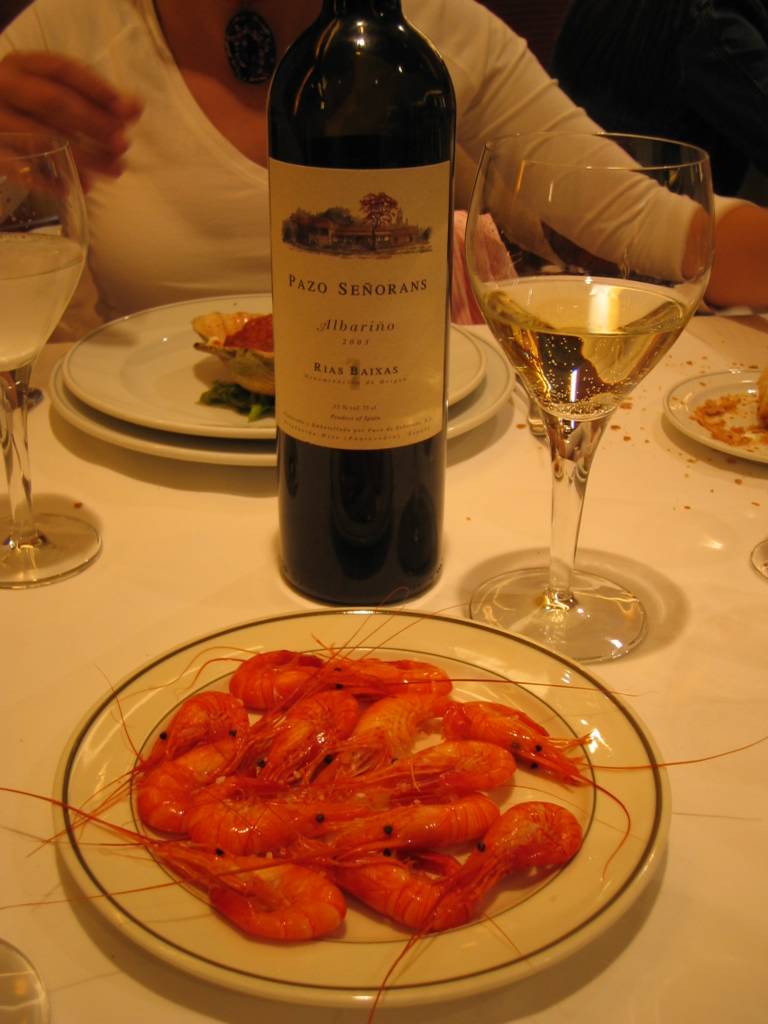
Galician Seafood & Albarino Posted by Hello


The Rías Baixas denominación de origen is composed of five subzones: Val do Salnés, Soutomaior, O Rosal, Condado de Tea, and Ribeira do Ulla, the newest of the designated wine growing areas. Surrounded on three sides by the Atlantic Ocean, the Ría de Arousa and the Ría de Pontevedra, the area known as Val do Salnés, with more than 60% of Rías Baixas's registered vineyards, is the most important of the five, followed by Condado de Tea and O Rosal, both along the Miño river. Because of Galicia's high rainfall and humidity, vines are trained on tall wire trellises, which are usually anchored by granite or concrete posts. The grapes are grown several feet off the ground to allow for maximum air circulation, which promotes even ripening and helps prevent rot and associated vine and grape afflictions.

To use the Albariño varietal designation on a label, in all five Rías Baixas subzones a wine must be 100% albariño. Since 94% of just over 5900 acres of registered vineyards in the Rías Baixas DO are albariño, this is often a moot point. By law, other white Rías Baixas-designated wines of must contain a minimum of 70% Albariño. The remaining 30% of the blend is usually composed of one or more of the other authorized, preferred grape varieties - - treixadura, loureira, and caiño blanco (some godello, torrontés, and marqués grapes are also authorized) - - which add different aromas, body, and often more complexity to the wines.

Although Albariños are among the world's finest single-varietal white wines, the Rías Baixas blends often match them in quality. In tasting albariño-treixadura blends such as Adegas Galegas's Veigadares, Valmiñor's Dávila, Marqués de Vizhoja's Señor de Folla Verde, in the Condado de Tea subzone of Rías Baixas, along the Miño River that is the Galicia's border with Portugal, and albariño, loureiro, and treixadura blends such as Terras Gauda, Santiago Ruíz, Pazo San Mauro, and in the O Rosal subzone, I also saw significant potential in loureiro and treixadura as blending grapes which add complexity to albariño-based wines.

It is not politically incorrect to call Rías Baixas wines of the most feminine in Spain, especially since the consejo regulador's president is María Soledad Bueno (the owner of Pazo de Señorans) and many top wines are made by women enologists, including Isabel Salgado (Granja Fillaboa), Cristina Mantilla (Adegas Galegas - Veigadares), Angela Martín (Castro Martín- Casal Caiero), María del Pilar Jiménez (Pazo de Barrantes), Ana Martín (Salnesur - Condes de Albarei), Ana Oliveira (Terras Guada), Ana Quintela (Pazo de Señorans), and María Luisa Freire (Santiago Ruíz).

Rías Baixas Albariños and albariño-based blends are some of the most versatile, delicious, food-friendly, and least intimidating wines in the market. They usually are a lovely green-tinged straw color and their fruity albariño aromas are reminiscent of white peaches, pears, apricots or pineapple. On the palate they are fruity and often luscious, but finish dry. The fruit is usually beautifully balanced by a fine-edged underpining of acidity and the wines exhibit lovely, complex, mineral-laced flavors in the finish. These qualities make them ideal matches for a wide variety of modern and traditional dishes, as well as delicious wines for sipping as an aperitif or to accompany tapas, Spain's wide variety of little dishes.


Galician Seafood & Pazo de SenoransPosted by Hello


Albariño blends are also supernal companions to the splendid seafood that Galicia was known for before the criminal actions of the Prestige single-hull oil tanker, which sank off the coast of Spain in November 2002, destroyed the most important source of prime shellfish in Europe, and ruined the livelihoods of hundreds of thousands of hard-working Spaniards and Portuguese, including those who work in the superb marisquerías, or seafood restaurants of these two maritime countries. I am happy to say in this update on August 7, 2004, the Galicians, through a Herculean effort have recuperated much of their fishing grounds. --Gerry Dawes©2003
Related Posts with Thumbnails