Share This Gerry Dawes's Spain Post


Instagram

In 2026, ranked #7 in the Top 30 Gastronomy Blogs (and Websites for Gastronomists & Gastronomes by Feedspot. (Ranked in the top 50 since 2019). "The Best Gastronomy blogs selected from thousands of Food blogs, Culture blogs and Food Science. We’ve carefully selected these websites because they are actively working to educate, inspire, and empower their readers with . . . high-quality information.

More than 3,640,000 views since inception, 123,000+ views in August 2026.


Ranked #7. Gerry Dawes's Spain: An Insider's Guide to Spanish Food, Wine, Culture and Travel gerrydawesspain.com

"My good friend Gerry Dawes, the unbridled Spanish food and wine enthusiast cum expert whose writing, photography, and countless crisscrossings of the peninsula have done the most to introduce Americans—and especially American food professionals—to my country's culinary life. . .” - - Chef-restaurateur-humanitarian José Andrés, Nobel Peace Prize Nominee and Oscar Presenter 2019; Chef-partner of Mercado Little Spain at Hudson Yards, New York 2019

Showing posts with label El Bulli. Show all posts

2/09/2021

Ferran: The Inside Story of El Bulli and the Man Who Reinvented Food by Colman Andrews, a book review

* * * * *
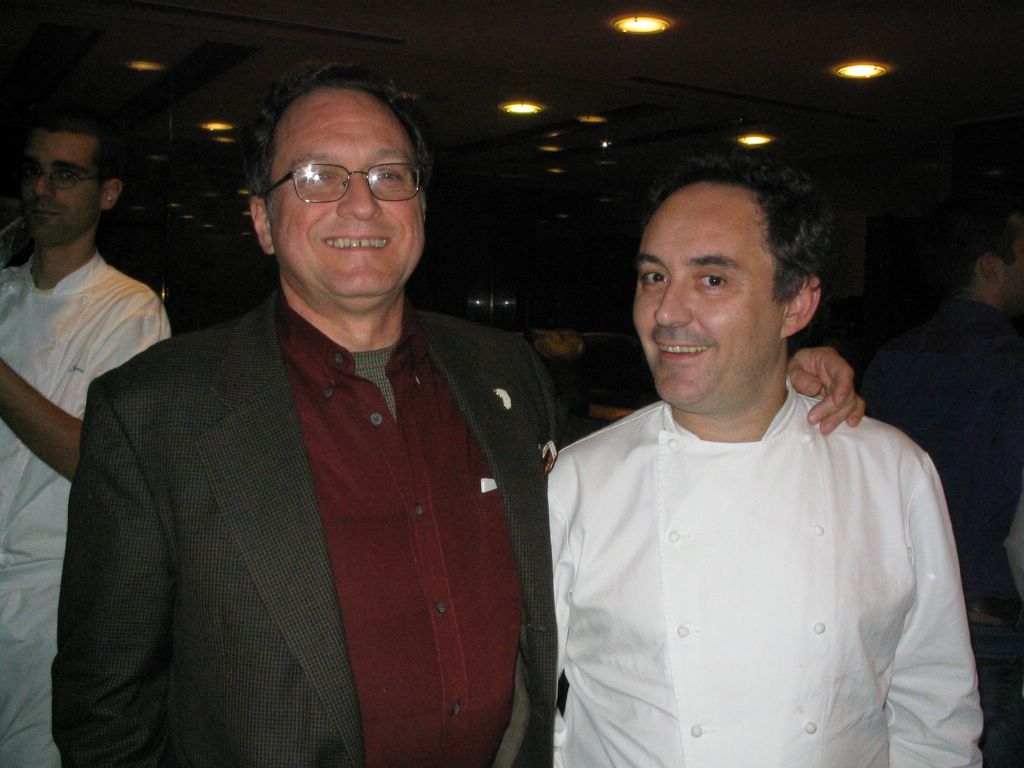
Ferran Adrià  and Tim Zagat at the book launch at the International Culinary Center in NYC on Oct. 12, 2010.   Photo by Gerry Dawes©2010.

Ferran: The Inside Story of El Bulli and the Man Who Reinvented Food by Colman Andrews, a book review excerpted from my article on Ferran Adrià in the October issue of Food Arts. 

(All photographs by Gerry Dawes copyright 2010.)


Colman Andrews, author of Ferran: The Inside Story of El Bulli and the Man Who Reinvented Food.   Photo by Gerry Dawes©2010.

"Colman Andrews first began thinking about writing a book about Ferran Adrià at the historic Culinary Institute at Greystone's "Spain and the World Table," conference in November, 2006. At that conference there was a particular poignant moment that was the climax of what Andrew's calls "a hugely ambitious, highly successful . . . program," when The French Laundry's Thomas Keller introduced Ferran Adríà to tumultuous applause. 

Thomas Keller at the Culinary Institute of America - Greystone
during his introduction of Ferran and the Spanish chefs during
the 2006 Worlds of Flavor Conference dedicated to Spain.
Photo by Gerry Dawes©2010.

Ferran Adríà and the all-star lineup of Spanish chefs 
at the CIA Worlds of Flavor Conference 2006. 
Photo by Gerry Dawes©2010.

Coming after the 2003 The New York Times Sunday Magazine article, Arthur Lubow article that posed the question, "Is Spain the New France?", the French-trained, Francophile Keller's introduction was something very much like the passing of the torch to Spain and to Adrià, who for nearly a decade now has been called "the world's greatest chef" and his restaurant, elbulli, "the world's greatest restaurant." That moment at the CIA-Greystone well may have been the greatest event in Spain's long culinary history.


Ferran Adrià and Arthur Lubow at the book launch 
at International Culinary Center in New York. 
Photo by Gerry Dawes©2010.

Andrews-with the help of elBulli (the official name of the restaurant) alumni, Ferran Adrià confidant and chef-restaurateur José Andrés "kept after" Ferran for nearly a year. At one point, Andrés told Andrews, "If he thinks this is my idea or your idea, he will maybe not be so eager to say yes. He has to think it is his idea." They both persisted until Ferran told Andrews, "the next time you are Barcelona, we'll talk." Andrews quickly booked a flight to Barcelona, where he long felt at home since he spent a lot of time there two decades ago writing his seminal book on the food of Catalunya, Catalan Cuisine: Europe's Last Great Culinary Secret (Atheneum, 1988).


Ferran Adrià at Inopia. 
Photo by Gerry Dawes©2010.


Andrews managed to pin Ferran down over dinner at Inopia, Ferran's brother Albert's happening tapas bar (he just sold it; see accompanying article). At the end of a meal that featured traditional Spanish tapas-white asparagus , five kinds of olives, jamón Ibérico from Salamanca, esquiexada (Catalan shredded raw salt cod salad), fried artichokes, fried boquerones (anchovies), pa amb tomaquet (Catalan grilled bred rubbed with tomato and garlic) and small grilled shrimp, washed down with a crisp Catalan white wine, Andrews asks himself about whether he had the green light to do this book, "Was this (Ferran's) capitulation?"


Boquerones en vinagre with olives and raf tomatoes, Inopia.
Photo by Gerry Dawes©2010.

All those who needed a book on Ferran-I am one of them, even though I have known him for nearly fifteen years-that tells you everything you need to know, but were always afraid to ask, about the man, his restaurant, his dimension-bursting food, his partner Juli Soler and the truth and mythology that surrounds elBulli, this fine, eminently readable treatment is a blessing. Colman Andrews has done a brilliant job with this nearly 300-page book, despite what the misguided review in The New York Times claimed.


Ferran Adrià at the International Culinary Center in NYC on Oct. 12, 2010.     
Photo by Gerry Dawes©2010.

Readers will come away from Ferran: The Inside Story of El Bulli and the Man Who Reinvented Food with an infinitely greater understanding of the "world's greatest chef," who indeed reinvented (and continues to reinvent) food in the 21st Century. The only negative in the American edition is that there are no photographs; the European edition apparently has them." 


12/01/2009

Memories of the Superb 2005 Salvador Dalí Exhibition at the Philadelphia Museum of Art

.
* * * * *

Gerry Dawes's Persistence of Memory* (Salvador Dalí) Melting Watch Awards.

* * * * *

A Look Back at a Stunning Show in 2005

The Depth & Excellence of the Salvador Dalí Exhibition 
at the Philadelphia Museum of Art Was Astounding!

Commentary on the exhibition by Gerry Dawes.

Spanish Wine Dinners Featured at
Restaurant Associates Museum Restaurant
During the Exhibition


Postscript on Catalan Super-Star Chef Ferran Adrià of elBulli.

Dalí Museum, Figueres (Girona).  
Those "knobs" (as described by one travel writer) on the building 
are representative of a typical style of Catalan bread called pa de crotons
Gerry Dawes©2004

The depth and excellence of the Advanta-sponsored Salvador Dalí exhibition at the Philadelphia Museum of Art, which ran from February 15 - May 15, 2005 was nothing short of astounding.

Dalí Gala 2005 - Philadelphia Museum of Art
Gerry Dawes©2005

Dalí Gala 2005 - Philadelphia Museum of Art
Gerry Dawes©2005

Although I have travelled in Spain for more than 40 years, visited Dalí's incredible casa-museo on the lovely cove at Port Lligat (Girona), his over-the-top museum in Figueres (his birthplace) and Gala's castle at Pubol, none of that prepared me for the depth, quality and evocative power of this exhibition.

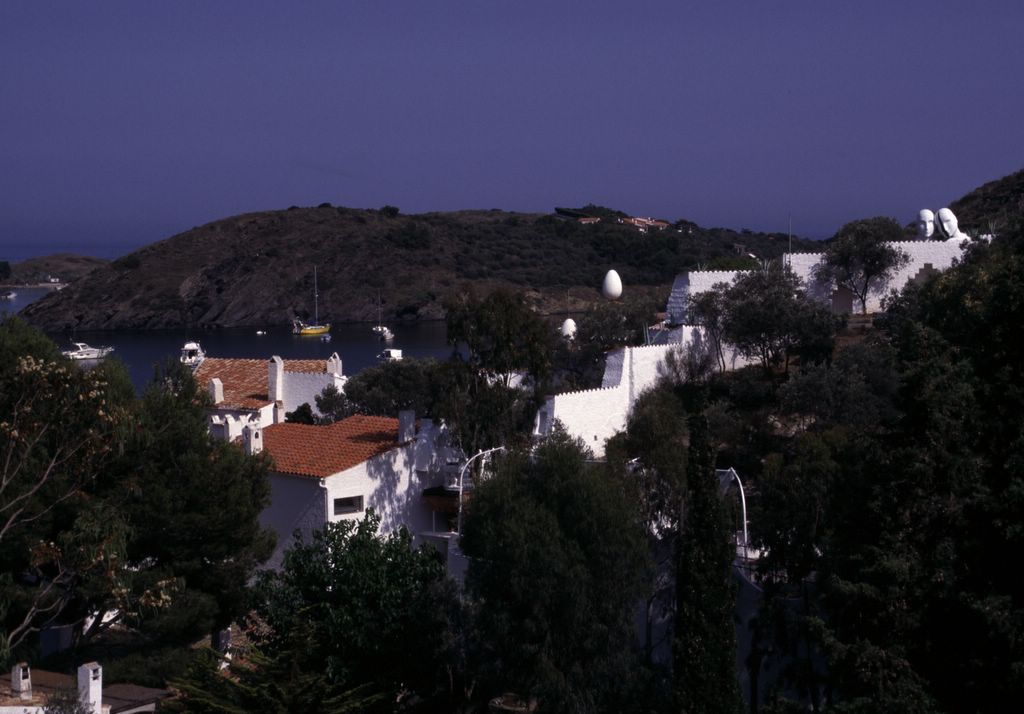
Dalí's House, Port Lligat (Girona)
Gerry Dawes©2004

Port Lligat cove, From above Dalí's house
Gerry Dawes©2004

In the past, I tended to dismiss Dalí as a very talented, very difficult-to-understand surrealist and a mad publicity hound who lived up to André Breton's anagram "Avida Dollars." But, after seeing the 200-piece Philadelphia exhibition twice (and partially at least three-four more times), I am convinced that Dalí--dead since 1989 and long-since stripped of the smoke screen of his outrageous publicity-seeking antics--was the real deal, a unique talent and one of the greatest artists ever.

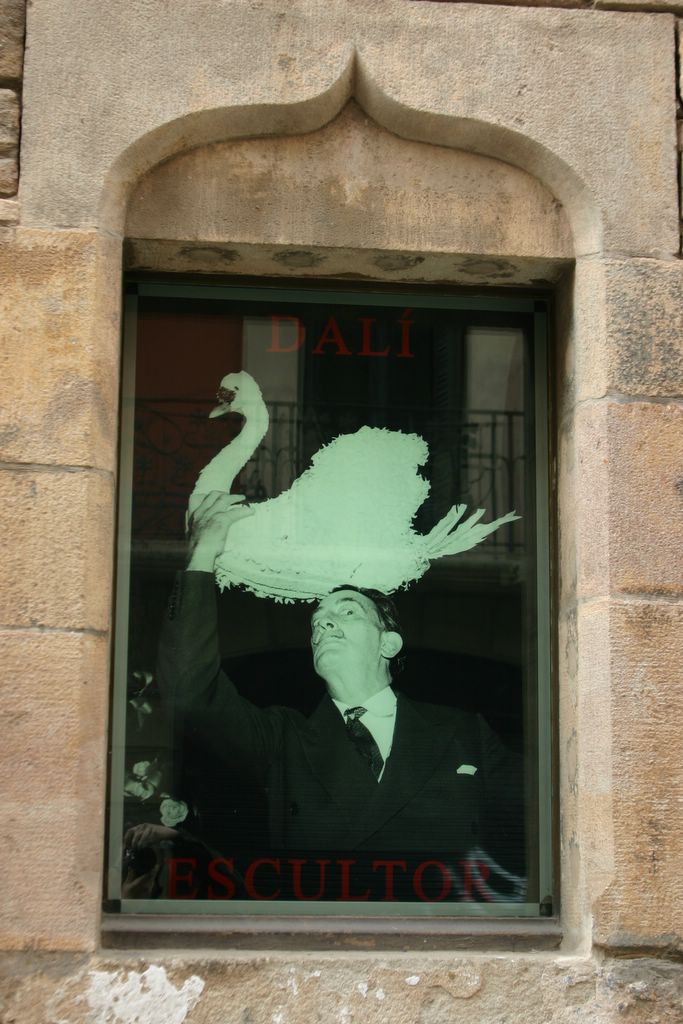
Dalí, Barcelona
Gerry Dawes©2004

Don't let all those photos of a wild-eyed lunatic fool you.  Dalí was a tormented genius and like many of the inhabitants of his native Empordá, no doubt was affected for days on end by the tramuntanas, the wild cyclones in northern Cataluña which not only bend trees and grape vines, sculpt rocks and leave beaches and plains swept clean, they seriously torque the minds of the region's inhabitants, leaving them just a little loco.  These wild winds have even been known to have toppled a train.  In Dalí's case, the wind doesn't quite explain everything, because he was also infected with a world-class locura (madness) that manifested itself in often outrageous social behavior, but his manias were also the driving force behind a phenomenal artistic talent.

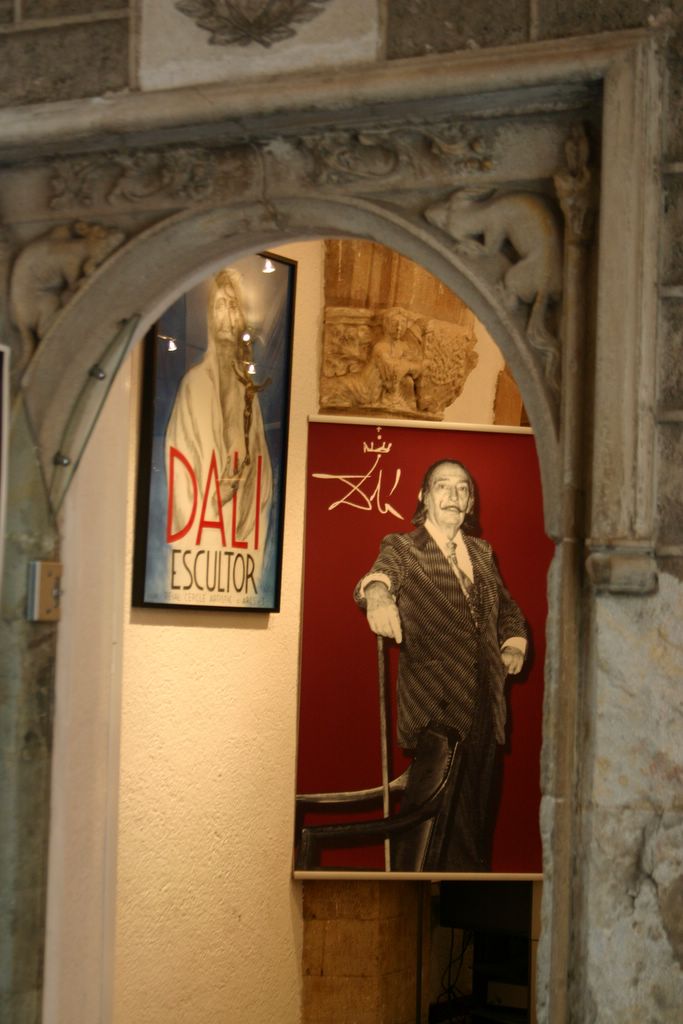
Dalí, Barcelona
Gerry Dawes©2004

But, undeniably a genius Dalí was, the likes of which we have never seen in art. He was endowed with a prodigious technical talent--equal to that of any of the great masters (Velasquez, Goya, Zurbarán, Bosch) that one sees in the Prado--along with vision, originality and the ability to project his deepest psychological demons onto the medium like no one ever has (not even the great Hieronymus Bosch could equal Dalí in such visions).  In a mano a mano with Picasso, Dalí would likely win out.

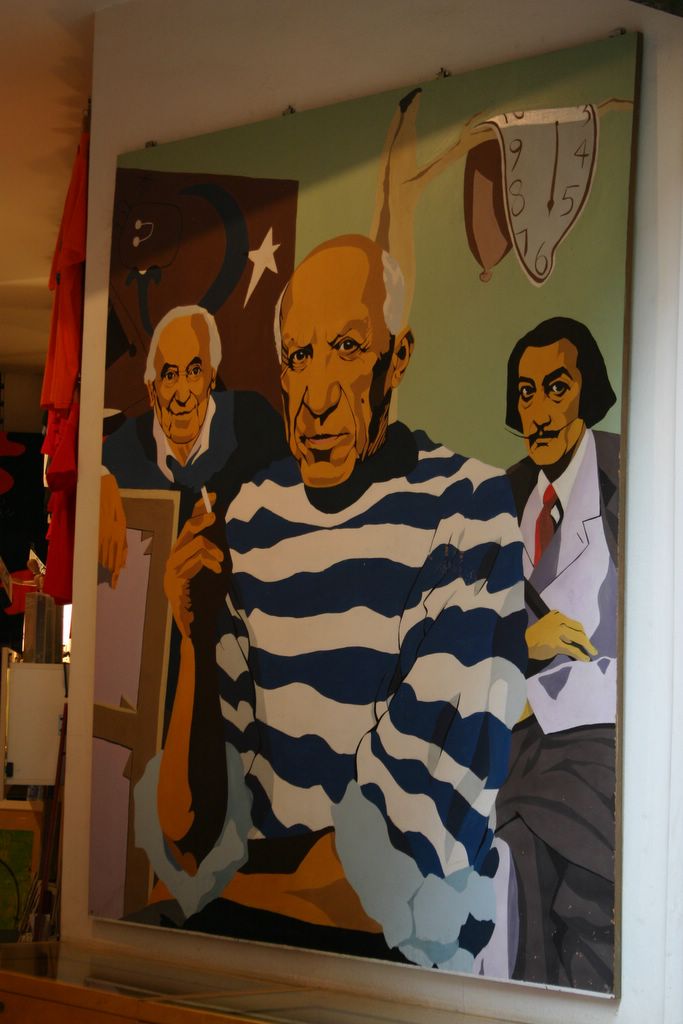
Picasso, Dalí, Miró. 
In this picture in a Barcelona tourist shop, Picasso dominates, 
but after the Dalí exhibition in Philadelphia, one wonders if it should be the other way around.
Gerry Dawes©2004

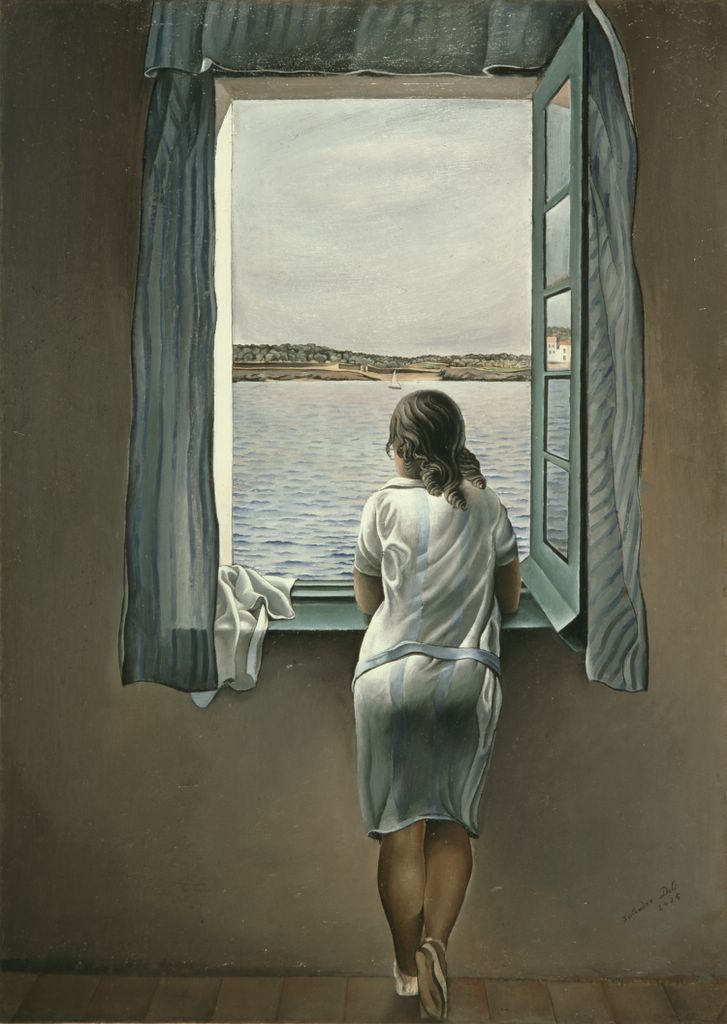
In the Philadelphia exhibition, the haunting, unforgettable Portrait of My Father, a picture of Dalí's imposing, overbearing father dressed in a heavy black bourgeois clothes dominating the wildly colorful backdrop of the legendary Costa Brava village of Cadaqués (where the Dalí family spent their summers) and the lovely impressionistic Lane to Port Lligat with View of Cap Creus, both painted in 1921, are alone enough to establish Salvador Dalí as an artist (at 17!) with a major talent.  In 1924, at 20, Dalí's Portrait of Luís Buñuel is further proof, as are another powerful Portrait of My Father and, in 1925, the compelling Figure at a Window (Dali's sister Ana María gazing out the window, painted from behind).


Figure at a Window, 1925 
Courtesy Philadelphia Museum of Art

The same goes for several other portraits painted in 1925 and Woman at the Window at Figueres, painted the following year (1926).  Also in 1926, with The Basket of Bread, Dalí showed he could paint still-lifes as well as Velàsquez, Francisco de Zurbarán and the great 18th-century master of bodegones, or still lifes, Luís Meléndez.


Basket of Bread, 1926 
Courtesy Philadelphia Museum of Art

Then, in 1929, began an incredible series of psychologically charged and quite disturbing surrealist paintings (they gave André Breton nightmares) that are among Dalí's most famous works: The First Days of Spring, The Great Masturbator, The Enigma of Desire and The Accommodations of Desire, followed by several pornographic drawings, the castration nightmare of William Tell (1930), the erotically charged The Font (1930) and his famous The Persistence of Memory (with the melting watches).
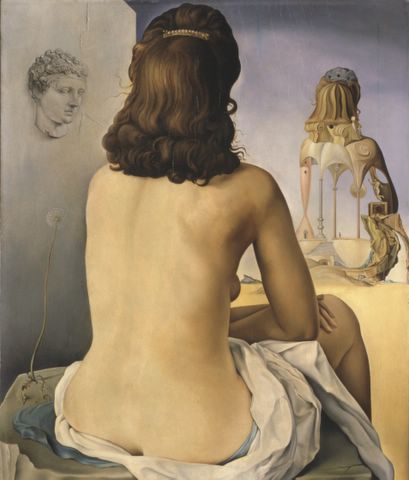

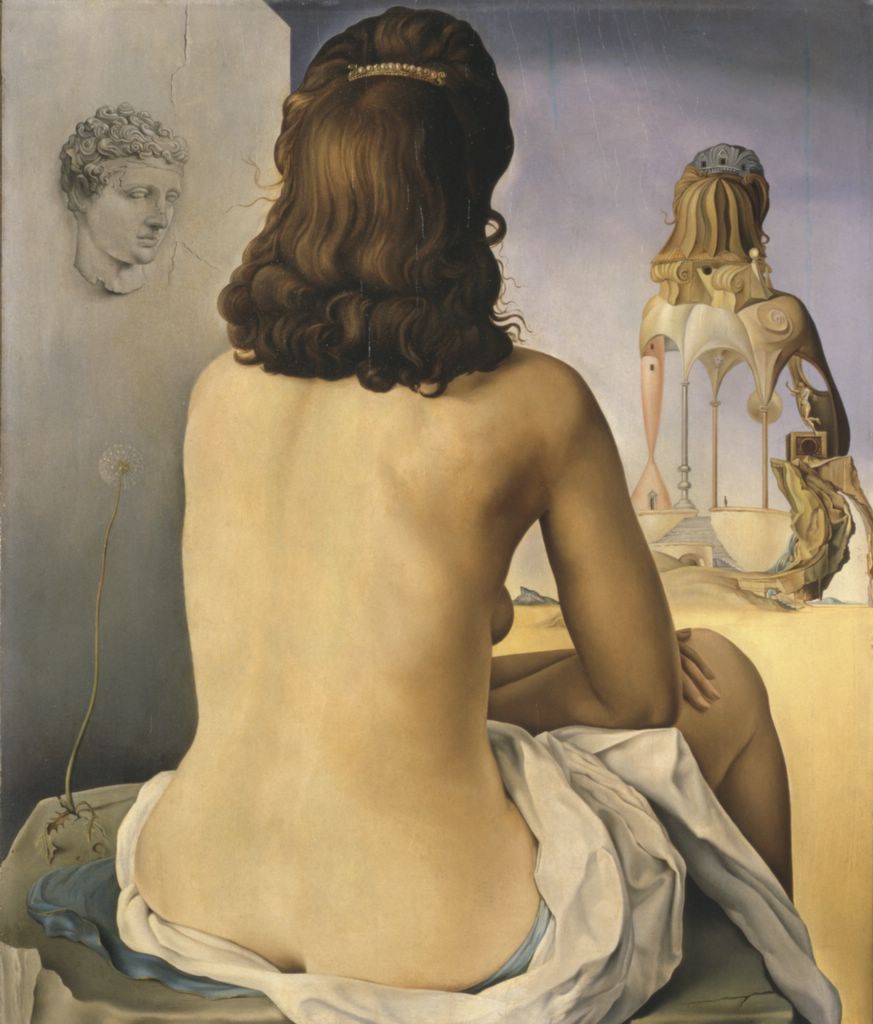
"My Wife, Nude, Contemplating Her Own Flesh Becoming Stairs,
Three Vertebrae of a Column, Sky and Architecture, 1945
 
Courtesy Philadelphia Museum of Art


There are a number of paintings in the Philadelphia exhibition from the period when Dalí was obsessed with the legend of William Tell, a metaphor for his relationship with his domineering father, and, even more so, there are numerous riffs on the Jean-Françoise Millet's The Angelus (1857), both of which were deeply imbedded with a castration complex according to Dalí's "paranoic-critical" way of seeing the world. In 1935, he painted the classical, powerful Angelus of Gala, which depicts his muse and wife, Gala, in a brocade jacket simultaneously facing the viewer with a version of the Angelus on the wall behind her and from the back showing the design of the brocade jacket (on the back of her skirt are wrinkles that look like a large hand on her ass, undoubtedly one of Dalí's "in" jokes). So important are Dalí's Angelus paintings that The Architectonic Angelus of Millet was chosen as the cover for the Philadephia exhibition catalogue.


Madonna of Port Lligat 
Courtesy Philadelphia Museum of Art

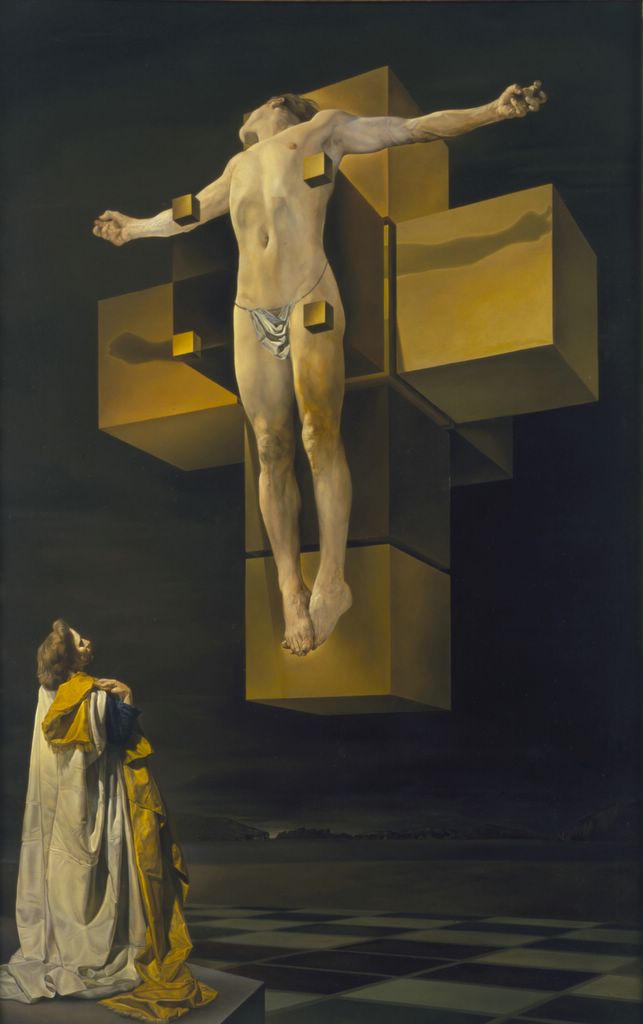
Much as I would like to, I won't go through the whole catalogue here, but by the end of the collection, when you see Dalí's later religious paintings--Gala as the Madonna of Port Lligat, The Christ of Saint John of the Cross, Nuclear Cross, Crucifixion (Corpus Hypercubicus) and Ascension--you realize that this wild mind was the driving force behind one of the greatest painters in history and that you have to come back and see this mystical exhibition again before it disappears forever.

Suffice to say that it takes a good two hours just to peruse the incredible works in this collection, which was curated by Dalí expert Dawn Adis and by Michael R. Taylor. After lingering fascinated by the whole show at the gala opening, I realized I had barely scratched the surface, but, because I had a consulting gig at the museum with Restaurant Associates (set up by my friend, Dana Madigan of R.A.), I was lucky enough to see the exhibition twice. I designed Spanish regional-themed wine dinners at the Restaurant Museum during the exhibition and spoke about Spanish food and wine at the dinners, so I got to see the exhibition several times. That and the half dozen books I bought on Dalí allowed me to begin to understand this extraordinarly complex artist.  (My participation at these events was pre-destined; since 2002, I had been wearing on my lapel a Dalí melting watch pin--like the ones you see at the beginning of this piece-- that I bought in Barcelona 
long before I heard about this show.)


Crucifixion (Corpus Hypercubicus), 1953-54
Courtesy Philadelphia Museum of Art


Ouefs Sur la Plat (Fried Egg on the Plate without the Plate).

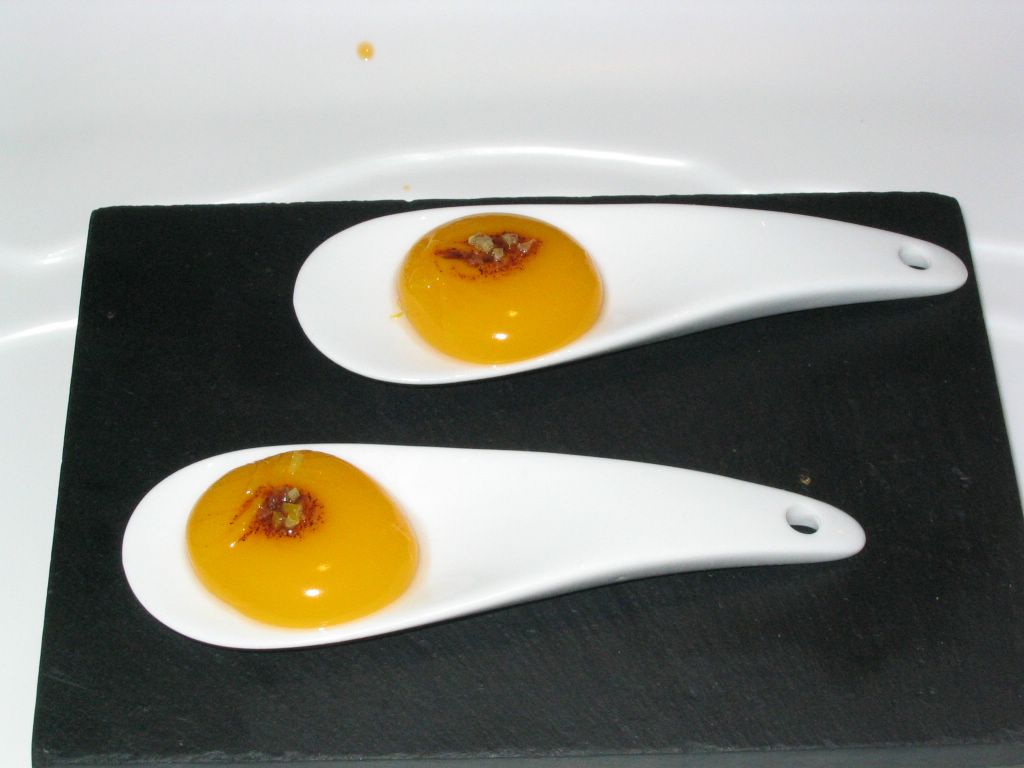
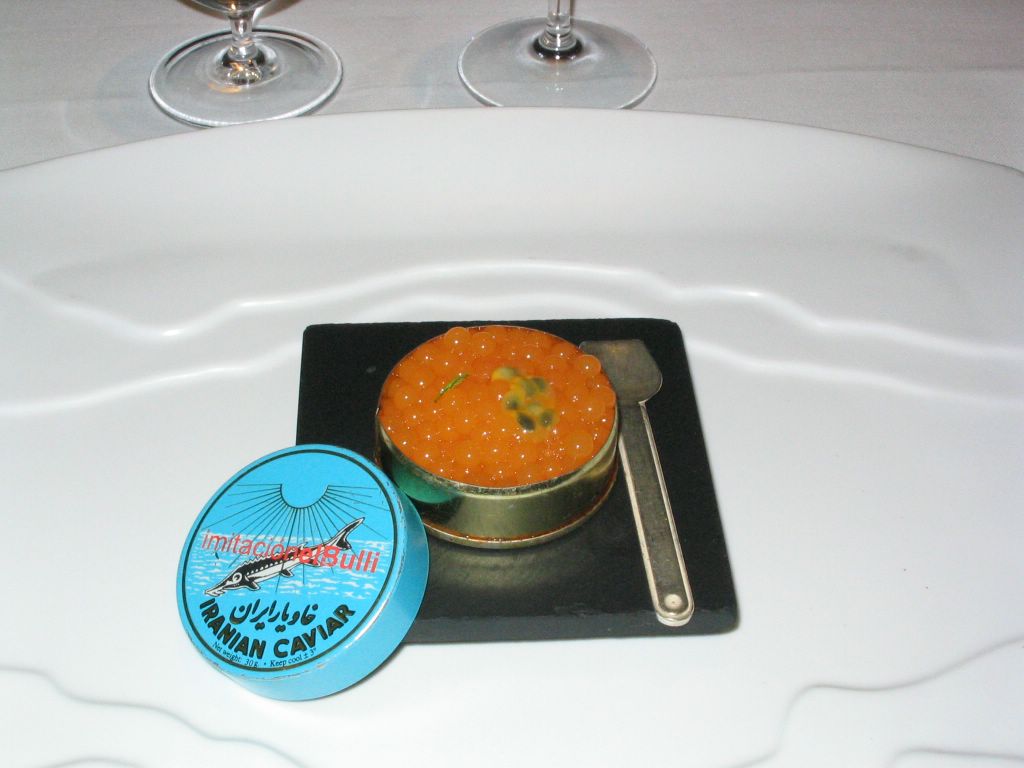
From Dalí's Ouefs Sur la Plat (Fried Egg on the Plate without the Plate), we may be seeing a painting that could have inspired Catalan super-star chef, Ferran Adría, to pass over into a new dimension of food with such dishes as a mango "egg yolk" served on a Chinese spoon, ravioli de mango, melón caviar (a ringer for samon caviar, made from melón puree dropped into a calcium chloride solution), spaghetto de parmesano (two yards plus of spaghetto made from Parmesan cheese), etc., all dishes that Dalí would have understood instantly.


Mango "egg yolks," El Bulli by Ferran Adrià 
Gerry Dawes©2004


The famous "espuma de zanahorias," carrot foam, featured in a New York Times
cover story about Ferran Adrià and El Bulli.
 
Gerry Dawes©2004


Melon "Caviar" - El Bulli 
Gerry Dawes©2004


Philadelphia Museum of Art Friday night Dinner Series celebrating the Salvador Dali exhibition at the Museum, Philadelphia, Pennsylvania.Featured Speaker on the Cuisines & Wines of Spain:
Gerry Dawes


Gerry Dawes with Ferran Adrià of El Bulli at Cala Montjoi,
which is a short distance for Cadaqués and Dalí's home at Port Lligat.
George Semler©2004


February 18 (Catalan Cuisine & wines)

March 11 (Book and Cook Catalan Dinner with author Colman Andrews
speaking on Catalan Cuisine and GD on Catalan wines)

March 18 (Basque Country Cuisine & Wines with Executive Chef Santi Zabaleta of Washington, D.C.'s top-rated La Taberna del Alabardero)

April 22 (Food and Wines of Valencia & the Spanish Levante)

May 13, 2005 (Castilian Cuisine & the Greatest Red Wines of the Ribera del Duero).


Dalí-inspired lobster dish by Chef Tracey Hopkins,
Museum Restaurant, Philadelphia Museum of Art
Gerry Dawes©2005


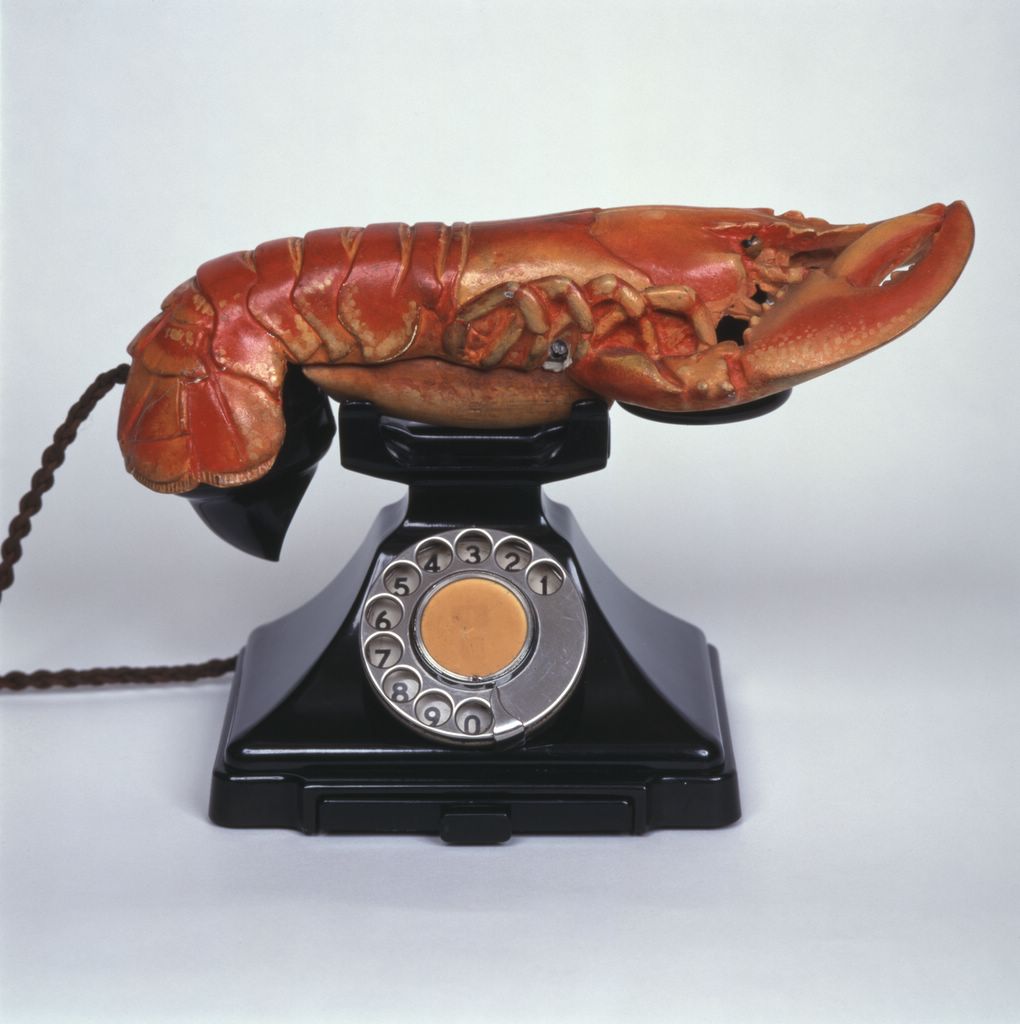
Lobster Telephone, 1936, Chichester, West Sussex, The Edward James Foundation
Courtesy Philadelphia Museum of Art

Postscript

At every stage of his career, even at his most commercial, Dalí showed his unique, singular talent and creative genius. Few artists consistently break the mold and few still can invent entirely new ways of seeing life, death, love, sex, childhood (and adult) fears and the infinite depths of the psyche and can paint them as powerfully with such emotional impact married to such artistic and technical ability.

 * * * * *


10/01/2009

Spain's Chemical Reaction Food Arts October 2009

 * * * * *


About Gerry Dawes

Gerry Dawes was awarded Spain's prestigious Premio Nacional de Gastronomía (National Gastronomy Award) in 2003. He writes and speaks frequently on Spanish wine and gastronomy and leads gastronomy, wine and cultural tours to Spain. He was a finalist for the 2001 James Beard Foundation's Journalism Award for Best Magazine Writing on Wine, won The Cava Institute's First Prize for Journalism for his article on cava in 2004, was awarded the CineGourLand “Cinéfilos y Gourmets” (Cinephiles & Gourmets) prize in 2009 in Getxo (Vizcaya) and received the 2009 Association of Food Journalists Second Prize for Best Food Feature in a Magazine for his Food Arts article, a retrospective piece about Catalan star chef, Ferran Adrià.

". . .That we were the first to introduce American readers to Ferran Adrià in 1997 and have ever since continued to bring you a blow-by-blow narrative of Spain's riveting ferment is chiefly due to our Spanish correspondent, Gerry "Mr. Spain" Dawes, the messianic wine and food journalist raised in Southern Illinois and possessor of a self-accumulated doctorate in the Spanish table. Gerry once again brings us up to the very minute. . ." - - Michael & Ariane Batterberry, Editor-in-Chief/Publisher and Founding Editor/Publisher, Food Arts, October 2009.


Mr. Dawes is currently working on a reality television

series on wine, gastronomy, culture and travel in Spain.


Experience Spain With Gerry Dawes: Culinary Trips to Spain & Travel Consulting on Spain

Gerry Dawes can be reached at gerrydawes@aol.com; Alternate e-mail (use only if your e-mail to AOL is rejected): gerrydawes@hotmail.com

9/23/2008

Ferran Adrià Debunks the Myth of Molecular Cuisine

* * * * *

(From an interview by Gerry Dawes with Ferran Adrià in June 2008)


The term “molecular cuisine” is often used in conjunction with Spanish cocina de vanguardia, but Ferran Adrià, often proclaimed "world's greatest chef" objects to using this description to describe his style of cooking at El Bulli.
 
“I would like to use this occasion to debunk the myth of molecular cuisine. I am aware that in many countries they say that at El Bulli we practice molecular cuisine. But the truth is there are few qualifiers that define with such preciseness the cooking that we practice, because molecular cuisine is not a style of cooking. First off, the term comes from molecular gastronomy, which at the same time only describes the dialogue between cooks and scientists who are trying to understand the chemical and physical processes that are produced in the kitchen. But, as I have said many times, understanding what happens when a steak is cooking or how to make a mayonnaise, does not bring anything into the evolution of the history of cooking in the stylistic sense. 

All knowledge is good for those who are cooking, but that is not the reason in itself that a new style is created. To draw a parallel, it is not necessary for a great architect to know how to make metal alloys to create a work that is important in architectural history. But, in any case, this knowledge, which I will readily admit is always positive, has nothing to do with what an architect brings to the style. What appears absurd to us is that the architecture of a creator who knows about metal alloy is called “molecular architecture.”

The way the theme (molecular cuisine) is being presented, it appears that the kitchen is a place basically to carry out scientific experiments. And this is not the case. I would like to make clear that science for a chef has great value, although, I repeat, always so that he can understand the processes, to know more, to enrich our knowledge. In the same way it helps to understand the processes of other disciplines.” 

Because of this misconception about the use of science in the kitchen, Ferran says, “the name ‘cocina molecular' is being used as the name to define the cocina de vanguardia that we do at El Bulli and, in general, many restaurants everywhere. And with that they want to define a cuisine ‘based in science’ when in reality all that vanguard cuisine is trying to do is to try to open up new fields, understand more about everything, but only from a scientific standpoint. Our contacts have been established not only with scientists, but artists, industrial designers, nutrition experts, the food industry, etc. All this is done to procure the best knowledge, but all this is only tools at the service of the philosophy of style and of the way that each chef sees his cooking.”


About the author

Gerry Dawes was awarded Spain's prestigious Premio Nacional de Gastronomía (National Gastronomy Award) in 2003. He writes and speaks frequently on Spanish wine and gastronomy and leads gastronomy, wine and cultural tours to Spain. He was a finalist for the 2001 James Beard Foundation's Journalism Award for Best Magazine Writing on Wine.


Experience Spain With Gerry Dawes: Culinary Trips to Spain & Travel Consulting on Spain

Gerry Dawes can be reached at gerrydawes@aol.com Alternate e-mail (use only if your e-mail to AOL is rejected): gerrydawes@hotmail.com

9/01/2008

Food Arts Over the Foaming Wave Article on Ferran Adriá

* * * * *


About the author

Gerry Dawes was awarded Spain's prestigious Premio Nacional de Gastronomía (National Gastronomy Award) in 2003. He writes and speaks frequently on Spanish wine and gastronomy and leads gastronomy, wine and cultural tours to Spain. He was a finalist for the 2001 James Beard Foundation's Journalism Award for Best Magazine Writing on Wine.

Mr. Dawes is currently working on a reality television series on wine, gastronomy, culture and travel in Spain.

Experience Spain With Gerry Dawes: Culinary Trips to Spain & Travel Consulting on Spain

Gerry Dawes can be reached at gerrydawes@aol.com Alternate e-mails (use only if your e-mail to AOL is rejected): gerrydawes@optonline.net or gerrydawes@hotmail.com

5/08/2008

The Ferran Adrià & Santi Santamaria Brouhaha: A Personal Chronicle of the Strange Occurrences Leading Up to the Star Chefs Fight of the Century

* * * * *

All photographs copyright by Gerry Dawes 2007
Publication without permission strictly prohibited.

* * * * *
On the surface it all seemed innocent enough at Grupo Gourmets Salón Internacional de Gourmets at the Casa del Campo, Madrid in May, 2006 . . . .


Santi Santamaría seemed jovial.

The normally pensive and serious Ferran even seemed happy. . . . . .There was much alegría --or is often said, "musha, musha alegría"-- in the espuma, er, air. . . . 
Hell, Santi and Ferran even seemed happy even though they were sitting together.

Arzak was amusing Bocuse, or trying to amuse Bocuse.
What a crew it was at the Salón de Gourmets Annual Gourmet Restaurant Awards that fine May day in 2006. . . . .as I said there was musha, alegría. . . . .musha

Santi, Bocuse, and Toño & José of Átrio, their superb restaurant in Cáceres, all got awards, mas musha alegría. . . .
. . . . . Santi stilled seemed jovial, José Polo seemed half-jovial, but Toño Pérez, José's partner in Átrio and in life, didn't seem jovial, maybe because José had his arm around Santi- -well, part of the way around Santi.
. . . . . Ferran got an award and Arzak got an award, each the size of a doorstop. Juan Mari then amused Grupo Gourmets Presidente Paco López Canís. . . . and the musha, musha alegría continued without pause, flowing like Torta del Casar (also from Cáceres) . . . . .
. . . . well, except maybe for Toño, whom Arzak provided some much needed amusement and way too much pacharán later on at Julián de Tolosa restaurant on Cava Baja. . . .but that's a story for another day, back to this one:

And then, and then, and then the trouble started on "Killer's Row. . . .
 
. . . . Santi, Ferran, Bocuse & Juan Mari were all seated together . . . . .Then Ferran whispers to Santi, "My espumas (foams), mango caviar, encapsulated 'olives' and olive oil drops and nitrogen cocktails are the work of a genius." What have you got to match that? 


Ferran, now pensive again, lets that soak in. Santi is no longer jovial, he is also now pensive. . . .

"So, you think that unhealthy, additive-laced mierda you do is cooking, eh?

Then Santi leans to the right, smiles and says, "How about something really creative, say aromatheraphy. How do you like my hot, smoky espuma laced with the terroir of Montseny?"
 
Ferran, momentarily stunned, tries to steady himself.

Sacre bleu! Bocuse is incredulous!
Juan Mari, not into aromatherapy, is not amused and tries to protect his air supply. 
 
Ferran, stunned and reeling, can't believe what just happened.

 
Ferran, contemplating a retort in his native Cartagena-inflected Catalan-Andaluz (guaranteed to piss Santi off since it is not pure Catalan), turns pensive again. . . .thinking, "Jodé, yo zoy genio y Santi no é. ¿Como es posible que el cabrón hizo esto antes de que me ha ocurrido a mi?". . . . ."F..k, I am a genius and Santi ain't. How is it possible that this cabrón did this before it occurred to me?"
 

Santi, once again jovial, enjoys a moment of musha, musha alegría.

Now, 800 chefs are pissed off at Santi, all over a little hot air!!

Fin de una triste historia.
Related Posts with Thumbnails