Share This Gerry Dawes's Spain Post


Instagram

In 2026, ranked #7 in the Top 30 Gastronomy Blogs (and Websites for Gastronomists & Gastronomes by Feedspot. (Ranked in the top 50 since 2019). "The Best Gastronomy blogs selected from thousands of Food blogs, Culture blogs and Food Science. We’ve carefully selected these websites because they are actively working to educate, inspire, and empower their readers with . . . high-quality information.

More than 3,640,000 views since inception, 123,000+ views in August 2026.


Ranked #7. Gerry Dawes's Spain: An Insider's Guide to Spanish Food, Wine, Culture and Travel gerrydawesspain.com

"My good friend Gerry Dawes, the unbridled Spanish food and wine enthusiast cum expert whose writing, photography, and countless crisscrossings of the peninsula have done the most to introduce Americans—and especially American food professionals—to my country's culinary life. . .” - - Chef-restaurateur-humanitarian José Andrés, Nobel Peace Prize Nominee and Oscar Presenter 2019; Chef-partner of Mercado Little Spain at Hudson Yards, New York 2019

Showing posts with label Cervantes. Show all posts

3/10/2024

Valladolid: Castilla y León's Capital & Historical Treasure Trove

* * * * *

 (Parts of this chronicle first appeared in the Penguin Guide to Spain & in the Berlitz Travellers Guide to Spain.)

In early May, 2007, I stayed in Valladolid while attending the Premios Zarcillo, an annual judging of wines ostensibly drawn from around the world by an international panel of wine experts, but primarily from the host region of Castilla y León. I had not really had a chance to explore the city since more than fifteen years ago, when I was working on guide books to the region for Penguin and Berlitz.

Valladolid (from the Arabic Belad-Walid, meaning land of the governor), located 193 km (120 miles) northwest of Madrid and 90 km (55 miles) east of Zamora, an eponymous provincial capital with a population of about 330,000, is also the seat of the government of the Comunidad de Castilla y León. The city of Valladolid sits at the confluence of the Pisuegra and Esgueva rivers on a high plain (more than 2,100 feet above sea level) and is surrounded by wheat fields and vineyards. 
 Valladolid is smack in the middle of four Castilla y León wine regions–Rueda (to the south, white wines), Ribera del Duero (to the east, famous for reds, including Vega Sicilia, Pesquera, Mauro, Dominio de Pingus and others, all in Valladolid province), Cigales (to the north, long famous for rosado, now making a name for red wines) and Toro (to the west, shared with Zamora and famous for powerful red wines). The area is in the middle of the famous Castilian plateau, the Meseta Central, which also means that the climate of Valladolid is subject to the same extremes–bitterly cold in winter, blazing hot in summer - - as the rest of Castile.

In addition to being the center of Castile's vital agricultural region - - the breadbasket and wine pitcher of this part of Spain - - and a major university town, in the post-Franco years, Valladolid became industrialized. As new factories such as a giant Renault factory were built, the population of the city expanded rapidly and, for a while, it less than visionary traffic patterns and city planning made it a difficult place to get around and it. But, during the past decade, a new prosperity and a new civic outlook has fostered the creation of a number of zona peatonales, pedestrian-only streets that have become prime shopping, dining and tapas hopping areas, so Valladolid has taken on a fresh new look, which belies its colorful and checkered past.

Compared to many other Spanish, and even old Castilian cities, Valladolid– which was founded by Count Pedro de Ansurez in 1084, one year before Toledo was captured from the Moors–was a latecomer. For centuries this area, including the valley of the Duero, was a no man's land, a buffer between the warring Moorish and Christian forces. But this former capital of Old Castile made up for lost time during the 15th and 16th centuries, Valladolid’s greatest period, during which it proved fertile ground for a number of Spain's most important artists and architects and was the site of a number of significant events in Spanish history, including the wedding of Isabel and Ferdinand; the death of Christopher Columbus; the births of Philip II, Philip IV, and Anne of Austria (mother of Louis XIV of France); and a three-year sojourn by Cervantes, during which Don Quixote was published (1605). Later, in the 19th Century, Valladolid had the unfortunate distinction of having served as Napoleon's headquarters during the Peninsular War.

Historically, Valladolid has suffered from a somewhat unsavory reputation. William Byron, author of a splendid biography, Cervantes, tells of a 16th-century Dutchman, who claimed that the city was full of "picaros, putas, pleytos, polvos, piedras, puercos, perros, piojos, pulgas - - rogues, whores, lawsuits, dust, stones, swine, dogs, lice, and fleas." And 20th-century wayfarers have not upgraded the city's reputation much. Nikos Kanzantzakis wrote that the city, the correct pronunciation of which is a test of proper Castilian (Vye - yah - doh - leeth), "is like a fallen princess whose lovers all have died, and so she has had to take to industry and commerce in order to survive."

Alastair Boyd, who wrote a book detailing the artistic and cultural treasures of Castile, confessed to being "prejudiced against Valladolid for years," but pointed out that there are few places in Spain without some redeeming qualities, Valladolid included. Still, he said, "it is difficult to give a coherent account of a no longer coherent city." In many Spanish cities, the great tourist treasures are set like jewels in a necklace of old and restored buildings that accentuate an overall atmosphere of antiquity. In Valladolid the necklace was broken by modern highrises; incongruity and incoherence reign and the jewels - - many of them less than crown jewels at that - - are scattered about. (This has changed a lot in the past twenty years.  Pedestrian walking areas now link most the major monuments and Valladolid has become a delightful walking city.  The new AVE high-speed train from Madrid now takes only about 50 minutes to reach Valladolid.)

Be aware, too, that the majority of the the sights here are architectural, since Napoleon's troops, headquartered here during the Peninsular War, either stole, burned, or wantonly hacked up a great number of artworks in the interiors of churches and other buildings. But, if you are seriously interested in Spanish history, architecture, art, and culture, many of Valladolid's remaining treasures are well worth searching out.

The old quarter, the core of Valladolid where most of the city's attractions are located, is a warren of narrow streets that twist and turn, and change names every couple of blocks. Consequently, it is best to walk to the many historical and architectural monuments in this town - - the Museo Nacional de Escultura in the remarkable pre-Plateresque Colegio de San Gregorio, the Isabeline Gothic facade of the church of San Pablo, the Romanesque-and-Gothic church of Santa Maria la Antigua, the unfinished Herreran Cathedral, Columbus' house, Cervantes' house, and the multitude of low priority sights considered important enough to be listed by the Valladolid tourist office.

Leave your car at your hotel, or, if you are staying outside the city and driving in for the day, put your car in one of the carparks on the west side (one in the plaza Mayor, and two more north of plaza del Poniente near rio Pisuegra. River). Explore the old quarter on foot, and use taxis, if you are not up for the trek, to get to the Oriental Museum in the southern part of town. Valladolid is well-served by bus service and by train from Madrid, which, by 2008, will be only an hour away by high-speed AVE train (the route via Segovia is currently under construction). Both the stations are located south of the Campo Grande park, which is not to be missed because of its scores of semi-wild peacocks, geese, ducks, other birds and semi-tame red squirrels, who like to perch on the "Please don’t feed the animals signs" and munch on the contraband offerings of both locals and tourists alike, while mugging for cell phone photos. )

To find your way around this city, it is important to choose a proper map. At one point, the tourist office brochure map had the Pisuerga river on the top of the page; a popular commercial Spanish guidebook series put it on the bottom of the page; and the Michelin Guide had it on the left, or western, side of town, where it should be. Beginning in the morning and using the 16th-century arcaded Plaza Mayor with a statue of the Count de Ansurez in the middle and the Ayuntamiento, or City Hall, as a reference point on your map, you can then decide which of the monuments you want to visit, perhaps starting with the Cathedral to the east; then detouring past a number of buildings of primarily architectural interest near the Cathedral; going on to visit the Museo Nacional de Escultura in the Colégio de San Grégorio and nearby San Pablo; and finishing at the church of San Bénito before returning to the Plaza Mayor and the many tapas bars in the area.

From the south side of the Plaza Mayor, walk east for a few blocks until you come to the Cathedral, which was originally intended to be one of the largest churches in the world. Construction started on this still unfinished edifice in the early 16th century, but over fifty years passed before Juan de Herrera, the famous architect of the Escorial and many other outstanding buildings in Spain, got the project going in earnest and put the Herreran stamp on it. However, Herrera's design was only partially completed - - the west front and the tower - - then construction languished again, this time until the 18th century when Alberto de Churriguera, with his unique vision of Baroque, added that portion of the facade above the main portal, a touch that, strangely enough, meshed very well with Herrera's austere style. This church sorely needs at least one more tower (among the four originally planned) for symmetry, and the interior was never finished; for instance, the Latin Cross floor plan never even reached the crossing. The high altar, by Juan de Juni, who is well represented in the Museo Nacional de Ecultura, was originally carved in 1572 for the church of Santa Maria la Antigua.

Because work on the Cathedral was stopped, several sections of the existing collegiate church from early periods still exist. The fine Museo Diocesiano is installed in these remaining sections of the old church; you can see Mudejar designs, Romanesque tombs, and Gothic doors in the Chapel of San Llorente. The sacristy contains one of the Toledan silversmith Juan de Arfe's major pieces, a huge four-tiered silver monstrance from the late 16th century. Southeast from the Cathedral is the Universidad, whose Baroque facade surrounding the main portal was done by Narciso Tomé in 1715. As Alastair Boyd points out, during this period Spanish architects such as Tome, who did the Transparente in Toldeo, and the Churrigueras, with their wildly extravagant altarpieces, were still relatively sober in their decoration of exteriors.

Artists such as Tomé were in transition, still restrained by the power, weight, and conservatism of Herrera's influence, but in the end, just as florid Gothic gave way in Spain to Plateresque, and what was once confined to altarpieces, as Boyd puts it, "moved cheerfully outwards from the retablos to the facades." Spanish decoration would eventually degenerate into Rococo, but not yet.  The facade of the Universidad de Valladolid would like to take off, but it is anchored firmly, by four unadorned columns set on square pedestals, to the no-nonsense conservative building it decorates.


Around the corner to the southeast of the University, the Colegio de Santa Cruz represents the late 15th-century Renaissance style of Enrique de Egas, and just northeast, along calle del Cardenal Mendoza, which becomes calle Colon, is Christopher Columbus's house. In 1506 Columbus died in Valladolid a broken man, "If I had stolen the Indies and given them to the Moors, Spain could not have shown me greater enmity." The house where he died was demolished in the 1960s, then completely rebuilt to house the Casa de Colón, whose most interesting displays are the maps of the great Admiral's three voyages, and some artifacts from his new world discoveries.

Just behind the Cathedral to the north is the early 14th-century Gothic Church of Santa María la Antigua with a Romanesque portico and an exceptional 11th-century Romanesque tower. This conjunto works beautifully; Santa María la Antigua is one of the finest buildings in the city. A block northwest is the early 17th-century Church of Las Angustias (Anguish), which contains Juan de Juni's celebrated Virgen de los Cuchillos (Virgen of the Knives), a polychrome statue of the Virgin Mary clutching her breast, into which enough silver daggers have been plunged to cause anguish indeed.

The Colegio de San Gregorio

Located northeast of the Plaza Mayor are two of Valladolid's main attractions: The Colegio de San Gregorio, the remarkable, incredibly ornate (Jan Morris called it "almost edible"), late 15th-century Isabeline-Gothic building in which the Museo Naciónal de Escultura is housed and, next to it, the equally ornate, Isabeline Iglesia de San Pablo. Both these pre-Renaissance buildings are often called Plateresque, but they are not. 

They preceded Plateresque and obviously contributed to its development, but they were executed by foreign architects and stonemasons inspired–according to Professor Denning of Trinity College in Dublin– by the kind of decoration commonly used in the title-pages of books and by the wood carvings done for the altarpieces of the period. It is to this, not to the silversmiths who inspired Plateresque decoration, that we owe the remarkable style of these two structures. The 15th-century Iglesia de San Pablo, which preceded San Gregorio and is even more detailed (if that is possible), was added to in the early 17th century by the ever-present duke of Lerma, whose coat-of-arms can be seen on the facade. The French looted and destroyed the original interior during the Peninsular War, but a striking pair of Isabeline doorways remains in the since-restored church. 

San Gregorio, commissioned by the prelate of Palencia, Bishop Alonso de Burgos, confessor to Queen Isabella, was built between 1488 and 1496. The facade, like that of San Pablo, looks like a giant florid Gothic altarpiece, except that the figures, including the huge heraldic emblem of Castile and León, are largely secular. The delicacy and intricacy of much of the stonework, obviously an exceptionally laborious accomplishment, is amazing. San Gregorio's architect was Juan Guas, but the decoration of the facade has been attributed variously to Enrique de Egas; Simón de Colonia, who planned the splendid La Cartuja de Miraflores and Capilla de los Condestables in Burgos, and executed the facade on the church of San Pablo; and to the great Gil de Silöe, believed to have been a native of Antwerp, who worked on both Miraflores and the Cathedral of Burgos with Simón, and is believed to have worked on the church at Aranda de Duero with him as well. Opt for a collaboration between these foreign artists, for whom, as Sacheverell Sitwell describes, "It is the 'Espagnolade' of a foreigner, as much so as the drawings of Gustave Doré or the music of Carmen."

The great patio of San Gregorio is exceptionally rich. Beautifully turned barley-sugar columns support a second-floor gallery of archways filled with profusely-decorated, intricately-carved stone balconies, each with three short columns supporting a double-arched, heavily-decorated panel. Running below the gargoyle-studded roofline is a frieze decorated with a repetitive yoke-and-arrows (the symbol of Isabel and Ferdinand) motif that is broken at each corner by the coat-of-arms of the unified kingdoms of Castilla, León, and Aragón. 

Museo Nacional de Escultura

The Museo Nacional de Escultura in San Gregorio is filled with polychrome wood statues (many with meticulously detailed bleeding wounds); complete tableaux representing Biblical scenes; Holy Week processional pasos (floats): entire altarpieces; paintings; and even an entire set of carved wooden choir stalls, done by Gil de Silöe, Alonso Berruguete, Juan de Juni, Gregorio Fernández, Pedro de Mena, and others, is to Valladolid, as one book put it, "what the Prado is to Madrid." 

One of the masterpieces in the Museo Nacional de Escultura 's collection is the early 16th-century altarpiece by Alonso Berruguete, who Alastair Boyd claims, was "the only inspired artist of the Spanish Renaissance." Berruguete spent five years working in Florence and was greatly influenced by Michaelangelo (he was mentioned in the master's letters), Leonardo da Vinci (he was in Florence when Leonardo was painting the Mona Lisa), and Raphael; he returned to Spain to become the greatest Spanish sculptor of the 16th century. Originally built for Valladolid's Iglesio de San Benito, Berruguete's retablo, now dismantled and displayed in three rooms on the ground floor of the museum, measured over 50 feet high. 

The museum also displays another exceptional altarpiece taken from the Convent of La Mejorada in Olmedo, several first-rate pieces including the superb statues of San Sebastián and the Sacrifice of Isaac, and a fine Nativity painting, all by Berruguete, whose talents did not stop here: He also did part of the woodcarving on the upper parts of the magnificent choirstalls in Toledo Cathedral. The Frenchman from Champagne, Juan de Juni, whose work can also be seen in the Cathedral and in Las Angustias church here, is represented in this museum by one of his most highly-regarded works, the Entombment of Christ, and a good John the Baptist. 

Gregorio Fernández, who in the early 17th-century carried Juni's Illusionism even further by using human teeth, glass eyes, and graphically depicted bleeding wounds to get his point across, is very well represented here, but a little bit of Fernández goes a long way. His Cristo Yacente (Christ reclining) here is just one of a number of profusely bleeding Cristos - - shown reclining, in Pieta tableaux, and hanging from the Cross - - done by this prolific artist, and scattered throughout Valladolid.

Other notable works in this museum, where the pieces are beautifully displayed and well lighted, are Pedro de Mena's fine 17th-century statue of Mary Magdalene; the bronce statues of the duke and duchess of Lerma kneeling, whose models were done by Pompeo Leoni and cast by Juan de Arfe; and the richly-detailed, carved wooden choirstalls by Diego de Silöe, son of Gil de Silöe, and creator of the great golden staircase in the Burgos cathedral. 

There are also two fine Hispano-Flemish paintings from the 15th century: one of San Jerónimo, which was in the Convento de La Mejorada in Olmedo, and the other of Santiago, dressed as a pilgrim with his staff and a scallop shell on his hat, and San Andrés, with an X-shaped St. Andrew's cross.

Also facing the plaza de San Pablo, besides the San Pablo church and San Gregorio, is the Palacio de Pimentel, where Phillip II was born. Around the corner, northeast of San Gregorio, is the Casa del Sol, with a 16th-century minor Plateresque facade. Also in this area, but not worth detours unless you are a very serious student, are the Vivero Palace (rebuilt in the 16th century), where Isabel and Ferdinand were married in 1469; the home of the 19th-century poet and playwright Jose Zorilla, author of Don Juan Tenorio; and further west, past the plaza de San Miguel, the massive facade of the 15th-century church of San Bénito. This church is only a couple of blocks from the plaza de Poniente to the west, and the Plaza Mayor to the south.

South of the Plaza Mayor is calle de Santiago, the major shopping street of Valladolid with its own special twist, a place called Las Francesas, which has a number of good shops surrounding the cloister of an old former nunnery. The Iglesia de Santiago on this street contains a fine retable by Alonso Berruguete. At the southern end of Santiago street is the plaza de Zorilla, which forms the northern tip of the triangular-shaped Campo Grande park, an oasis of trees, fountains, flower gardens, and pleasant walks. Located at the southern end of the park, the convent of the Order of the Phillipines houses the interesting Museo Oriental, which has a fine collection of Oreintal art put together by Augustinian missionaries stationed in the Far East. 

Casa de Cervantes

Valladolid was the capital of Spain for five years (1601-1606) under Phillip III after the city bribed the Duke of Lerma, the royal favorite, 400,000 ducats to move the court from Madrid. Miguel de Cervantes Saavedra, spent three years in Valladolid during this period in a house on the calle del Rastro. William Byron, author of the definitive biography of Cervantes, describes what the building was like in those days, "one of five new houses jerry built by a small-bore speculator hoping to cash in on an influx of riffraff into the city. It was an instant slum." Cervantes, along with more than 20 of his relatives, friends, and perhaps a down-at-heel servant or two, crowded into 13 rooms above an old tavern that was the hangout for butchers from the nearby slaughterhouse. 

The Casa de Cervantes is located two and a half blocks southeast of Plaza de Zorilla at calle del Rastro 7. Don't expect to moved by the spirit of the great writer in today's contrived surroundings, however; the house is more interesting as a refurbished 17th-century dwelling, certainly in better shape now than it was in those days, than as a Cervantes museum. Besides, by the time Cervantes moved here, Don Quixote was already finished and in the hands of his publisher, Francisco de Robles, who had moved to Valladolid from Madrid to be close to the real money - - in this epoch certainly - - around the supremely corrupt duke of Lerma and the court of Phillip III. 

Cervantes was arrested in this house, though, after the mysterious death from sword wounds of a nobleman killed in the dangerous streets of this quarter. Cervantes and his family helped the man into their apartments, where he died two days later, and when no one could put a finger on the man's assailant, Cervantes and several members of his family were arrested, albeit briefly, thus adding Valladolid to list of jails - - Algiers, Castro del Rio, and Sevilla - - that the great writer had graced with his presence - - most unjustly. 


________________________________________________________________________________

About Gerry Dawes
 

Gerry Dawes was awarded Spain's prestigious Premio Nacional de Gastronomía (National Gastronomy Award) in 2003. He writes and speaks frequently on Spanish wine and gastronomy and leads gastronomy, wine and cultural tours to Spain. He was a finalist for the 2001 James Beard Foundation's Journalism Award for Best Magazine Writing on Wine, won The Cava Institute's First Prize for Journalism for his article on cava in 2004, was awarded the CineGourLand “Cinéfilos y Gourmets” (Cinephiles & Gourmets) prize in 2009 in Getxo (Vizcaya) and received the 2009 Association of Food Journalists Second Prize for Best Food Feature in a Magazine for his Food Arts article, a retrospective piece about Catalan star chef, Ferran Adrià.

". . .That we were the first to introduce American readers to Ferran Adrià in 1997 and have ever since continued to bring you a blow-by-blow narrative of Spain's riveting ferment is chiefly due to our Spanish correspondent, Gerry "Mr. Spain" Dawes, the messianic wine and food journalist raised in Southern Illinois and possessor of a self-accumulated doctorate in the Spanish table. Gerry once again brings us up to the very minute. . ." - - Michael & Ariane Batterberry, Editor-in-Chief/Publisher and Founding Editor/Publisher, Food Arts, October 2009.


Mr. Dawes is currently working on a reality television

series on wine, gastronomy, culture and travel in Spain.

Experience Spain With Gerry Dawes: Culinary Trips to Spain & Travel Consulting on Spain

Gerry Dawes can be reached at gerrydawes@aol.com; Alternate e-mail (use only if your e-mail to AOL is rejected): gerrydawes@gmail.com

11/18/2016

Madrid Classics: Five Dalí POM (Persistence of Memory) Melting Watches to Casa González, founded in 1931, is a high quality bar-deli-gourmet food and wine shop with a wonderful old-fashioned air in Madrid's Literary Quarter.


 * * * * *

Persistence of Memory* (Salvador Dalí) Five Melting Watch Rating


Casa González, Barrio de las Letras, Madrid.
Photograph by Gerry Dawes©2013. Contact gerrydawes@aol.com.

Madrid Classics: Casa González, founded in 1931 and still run by Paco Carmona, a descendant of the original owners, is a type of bar-deli-wine shop known as a colmado (still very common in Barcelona).  Casa González has a wonderful old-fashioned air and is a good place to stop for a vino, some ham and cheese, tapas, pick up some excellent gourmet products or even have a Ben & Jerry's ice cream.  


Or you can just read your newspaper over a relaxing cup of café con leche and a pastry at Casa González or watch the world go by on Calle León, across the street from Cervantes's house in the Literary Quarter of Madrid.
Photograph by Gerry Dawes©2013. Contact gerrydawes@aol.com.

 
O Trobo Mel do ValaDouro Mel de Flores (wildflower honey from the Valadouro in the wilds of Galicia), Purchased at Casa González.  One of the best jars of honey I have ever encountered.  It is now empty and the contents missed.  

Casa González
Calle León, 12
28014 Madrid
Tel: 91 429 56 18
Email: casagonzalezmadrid@gmail.com


More photographs to come soon.

* * * * * 

“The American writer and town crier for all good Spanish things Gerry Dawes . . .the American connoisseur of all things Spanish . . .” – The Telling Room: A Tale of Love, Betrayal, Revenge and The World’s Greatest Piece of Cheese

* * * * *

"Gerry Dawes, I can't thank you enough for opening up Spain to me." -- Michael Chiarello on Twitter. Chef Chiarello toured northern Spain with me in October 2011 and was just in Barcelona again in January 2013.  He is preparing to open his new Spanish inspired restaurant, Coqueta, at San Francisco's Pier 5 in April.

* * * * *

"In his nearly thirty years of wandering the back roads of Spain," Gerry Dawes has built up a much stronger bank of experiences than I had to rely on when I started writing Iberia...His adventures far exceeded mine in both width and depth..." -- James A. Michener, author of Iberia: Spanish Travels and Reflections

 * * * * *
 _________________________________________________________________________________________________  
About Gerry Dawes  


Gerry Dawes was awarded Spain's prestigious Premio Nacional de Gastronomía (National Gastronomy Award) in 2003. He writes and speaks frequently on Spanish wine and gastronomy and leads gastronomy, wine and cultural tours to Spain. He was a finalist for the 2001 James Beard Foundation's Journalism Award for Best Magazine Writing on Wine, won The Cava Institute's First Prize for Journalism for his article on cava in 2004, was awarded the CineGourLand “Cinéfilos y Gourmets” (Cinephiles & Gourmets) prize in 2009 in Getxo (Vizcaya) and received the 2009 Association of Food Journalists Second Prize for Best Food Feature in a Magazine for his Food Arts article, a retrospective piece about Catalan star chef, Ferran Adrià. 

 In December, 2009, Dawes was awarded the Food Arts Silver Spoon Award in a profile written by José Andrés. ". . .That we were the first to introduce American readers to Ferran Adrià in 1997 and have ever since continued to bring you a blow-by-blow narrative of Spain's riveting ferment is chiefly due to our Spanish correspondent, Gerry "Mr. Spain" Dawes, the messianic wine and food journalist raised in Southern Illinois and possessor of a self-accumulated doctorate in the Spanish table. Gerry once again brings us up to the very minute. . ." - - Michael & Ariane Batterberry, Editor-in-Chief/Publisher and Founding Editor/Publisher, Food Arts, October 2009. 
 
Mr. Dawes is currently working on a reality television series  
on wine, gastronomy, culture and travel in Spain.
 
Experience Spain With Gerry Dawes: Customized Culinary, Wine & Cultural Trips to Spain & Travel Consulting on Spain  

Gerry Dawes can be reached at gerrydawes@aol.com.

11/10/2005

Don Quixote Rides Again - The Wines of Castilla - La Mancha

* * * * *


Don Quixote Mural at Bodegas Aresan, La Mancha

Castilla-La Mancha: Don Quixote Rides Again
(Published in Santé Magazine September 2005, with minor revisions in this version. http://www.santemagazine.com)

Text & Photographs By Gerry Dawes

Spain is celebrating the 400th anniversary of the publication of Don Quixote, Miguel de Cervantes’s immortal novel of the Man of La Mancha. Cervantes himself was quite a wine lover, and throughout the book there are references to wine. Historically, however, scorching summers in central Spain’s vast Castilla-La Mancha wine region have contributed to flabby, low-acid, quick-to-oxidize white wines and rustic, acid-deficient red wines that were often four parts Airén-based white wine blended with one part red Cencibel (the traditional Manchegan name for Tempranillo) macerated with the red grape skins to pick up color. The wine was warm-fermented in upright baked-clay tinajas, a king-sized version of ancient amphorae, which used to transport and store wine, water, olives and other commodities all over the Roman Empire. The Manchegan idea of vino tinto was and in some wineries still is, a pale purplish-red wine, which was usually served chilled to mask its crude rusticity.


Industry Modernization

All that has changed within the past few years. The wines of Castilla-La Mancha have become fresher, fruitier, and, in some cases, quite sophisticated. The region’s vanguard red wines, like many of their international-style counterparts, are well-built, rich, ripe, sometimes impenetrably dark, and lashed with new French oak. Fledging efforts to make quality white wines are showing flashes of promise in cold-fermented Airén and Viura, sometimes blended with Chardonnay or Sauvignon Blanc (Ercavio); Chardonnay from Manuel Manzaneque; and Viognier from Finca Vallegracia. Spurred by the successes of warm-country wines such as those from Napa Valley and Australia, quality standards in Castilla-La Mancha (indeed, in all of Spain) have evolved rapidly over the past decade. Although quality is still a relative term, the massive production of wines in this intemperate region has changed substantially for the better.

Enormous resources have gone into modernizing the La Mancha wine industry. Existing wineries have made serious investments in upgrading their equipment, vinification techniques, and vineyard management. New wineries have sprouted like the saffron crocus flowers which color parts of the Manchegan landscape in the fall, and new wire-trained, irrigated vineyards have become common throughout the area.

Airèn and Other Grapes

The La Mancha DO (Denominación de Origen, the equivalent of France’s Appellation d’Origine Controlée) rules were relaxed in 1996 to officially allow the inclusion of foreign grapes such as Cabernet Sauvignon, Merlot, Sauvignon Blanc, and Chardonnay, which were only “experimental” varieties up until the revision. The white native grapes, Viura (or Macabeo) and Pardilla, and the red grapes, Garnacha Tintorera and Moravia, are also approved varieties. But the overwhelming majority of La Mancha wines are still made from either the white Airèn or, increasingly, the red Tempranillo, Spain’s greatest native red wine grape. Although there are more La Mancha red wines in the American market, there is so much Airén in La Mancha that the acreage makes it the most planted white grape on the planet, outdistancing the prolific Ugni Blanc/Trebbiano of France and Italy. The grower-members of Tomelloso’s Cooperativa Virgen de las Viñas, the largest cooperative in Europe, alone have cultivated a staggering 45,000-plus acres of Airén, which---as preposterous as it may seem in a country known for red wines---is more than double the vineyard acreage of the entire Ribera del Duero DO.

Because of its Airén production, Tomelloso makes more wine than any town in the world. According to Miguel Angel Valentín, Director of Bodegas Centro Españolas (producers of the well-made Allozo red wines and some surprisingly good brandy), Tomelloso harvested 275,600 tons of grapes in 2002. The cooperative’s prodigious production highlights the massive dimensions in both size and production capacity of Castilla-La Mancha, which includes five provinces (Ciudad Real, Toledo, Cuenca, Albacete and Guadalajara). The region boasts half the vineyard land in Spain (1.5 million acres) and produces half of Spain’s wine (500 million gallons annually).

Dry Climate

In My Fair Lady, “The rain in Spain falls mainly on the plain.” But what rain really falls on La Mancha’s high plains (manxa was the Moorish word for dry land) is less than an annual average of 16 inches. La Mancha averages 3,000 hours of sunlight per year (eight hours per day) and, during the relatively short but very hot, nearly rainless summers, temperatures can and do soar to more than 110ºF, causing Manchegans to pray for “rain on the plain.” Temperatures sometimes dip below 0ºF and bone-chilling winds sweep across the high plateau called the Meseta (“tabletop”) during the long cold winters.

The intense summer heat prevents the grapes from ripening evenly, a recurring malady underscored by Guadalupe Valdes, enologist at Casa de la Viña, who explains, “Due to the high temperatures in this region, the grape pulp ripens much faster than the grapeskins and seeds. This means that the alcohol levels and total acidity are in equilibrium before the skins and pips are ripe.” Traditionally, vines in La Mancha have been grown low to the ground and en vaso (goblet-pruned) to provide a thick canopy of leaves to protect the grapes from the fierce sun. In recent years, however, almost all new vineyards in this region are trained en espaldera (on wires) and use drip irrigation. class=Section2>

There are benefits to this dry climate. The extreme conditions are so inhospitable to insect pests, for instance, that there are still large numbers of old vineyards on pie franco, or pre-phylloxera French rootstock. The vines of La Mancha normally have few humidity-related fungal diseases. Labor costs are reduced because the vineyards need almost no chemical treatments; their upkeep requires only about half as many work days (about 20 per year) as most French vineyards. Many vineyards are essentially organically farmed.

Appellations and Producers

Just one of several DOs in Castilla-La Mancha, the La Mancha DO, which sprawls across all the region’s provinces except Guadalajara, is larger than some countries, occupying nearly 12,000 square miles. Its 475,000 acres under vines make it the largest wine region in the world. The other Castilla-La Mancha DOs are Almansa, Manchuela (where Spanish wine writer Victor de la Serna’s Finca Sandoval is the prominent fine wine to date), Méntrida, Mondéjar, Ribera del Júcar, Valdepeñas, and parts of Jumilla. The increasingly more important designation, Vino de la Tierra de Castilla, is one that many wineries are using for often top-quality wines that do not strictly conform to the DO regulations in their regions. For example, many of them contain the not-yet-approved Syrah.

The producers in the most important designations---La Mancha, Valdepeñas, and Vinos de la Tierra de Castilla---fall into several categories. In the Valdepeñas DO, an overwhelming majority of the production is still dedicated to inexpensive, quaffable wine turned out by some of the largest wineries in Spain. While several wines, including the Félix Solis Viña Albali reservas, the J. A. Megia e Hijos Corcovo line, Bodegas Los Llanos Pata Negra’s Videva Aniversario, and the wines of Casa de la Viña are palatable and generally inexpensive, none of them are worthy competitors to the elite wines of La Rioja, Ribera del Duero or Priorato.

The huge La Mancha DO has a number of wineries, many of them newcomers working within the regulatory council’s guidelines, that are a notch above Valdepeñas both in the quality of their vinification facilities and wines. These commercial ventures make plenty of reasonably priced good wine to compete on the world market with wine from Chile, Australia, and South Africa. The majority of these wineries have been established recently by outsiders from La Rioja, Jerez, and Ribera del Duero, and some of their wineries and plantations are impressive.

Ribera del Duero’s renowned Alejandro Fernández (Tinto Pesquera) founded El Vínculo in the windmill-crowned town of Campo de Criptana in Cuidad Real Province and is turning out some very good La Mancha DO red wines from contract grapes. In a remote, high-altitude site (2,854 feet) near Los Hinosojos in Cuenca Province, La Rioja’s Martínez Bujanda family (Conde de Valdemar, Finca Valpiedra) has established a large, ultra-modern, James Bond movie set of a winery and a wire-trained, 618-acre vineyard on a 2,412-acre site called Finca Antigua. The inexpensive Finca Antigua wines---a Tempranillo-Cabernet Sauvignon-Merlot crianza, a Cabernet, and a Tempranillo---are delicious bargains. Near Finca Antigua is Finca Los Trenzones, a 1,477-acre, high-altitude estate, which was purchased by the Rioja’s Bodegas Faustino Martinez group. They replanted the Tempranillo vineyards (including an experimental 100-acre organic vineyard), installed modern vinification equipment, and purchased new American oak barrels for ageing the wines. The clean, fruity, Condesa de Leganza 100 percent Tempranillo crianza and a reserva are quite inexpensive but with perhaps too much showy oak.

Several other DO La Mancha wineries making a palatable, moderately priced range of wines include Allozo from Bodegas Centro-Españoles, Fontal (Bodegas Fontana), Vega Moragona (S. Coop. La Magdelena), Torre de Gazate (Vínicola de Tomelloso), Señorío de Guadianeja (Vínicola de Castilla), and Veronés (Santa Rita).

Vanguard Wines

For many modern palates, the most interesting wines in this vast region are the Vinos de la Tierra de Castilla, a wine designation that was established in 1999 to allow wineries experimenting with alternative varieties (e.g., Chardonnay, Viognier, Syrah, and Petit Verdot) and using vinification and aging techniques that were outside the approved DO regulations to produce and market such wines as they see fit. Some of the most powerful and unique producers in the region bottle Vinos de la Tierra de Castilla wines. Many other producers market some of their wines under the DOs La Mancha, Valdepeñas, and so forth, but label their flagship wine as Vino de la Tierra de Castilla.
Vitis Terrarum

Among the top wines under this designation are the two Castilla-La Mancha self-proclaimed Pagos DOs (single vineyard DO properties similar to France’s Château Grillet in the Rhône Valley): the Marqués de Griñon Carlos Falcó’s Dominio de Valdepusa near Toledo, which makes a Cabernet Sauvignon, a Syrah, and the top Petit Verdot in Spain); and Finca Elez, theatrical producer Manuel Manzaneque’s high-altitude vineyards in the Sierra de Alcaraz in Albacete Province. Other standout wines include Ercavio from Mas Que Vinos, Gran Calzadilla (Uribes Madero), La Estacada Syrah (Finca La Estacada), Avalón (Arva-Vitis), Quercus (Bodegas Fontana), Pago Florentino (from the producers of Ribera del Duero’s Arzuaga Navarro wines), Vega Ibor (Bodegas Real), plus Dehesa Carrizal and Vitis Terrarum from eponymously named wineries. Sherry producer Osborne has made a huge investment in its new 2,500-acre estate and 270,000-square-meter bodega near Malpico de Tajo, where three Vino de la Tierra de Castilla red wines are produced: Dominio de Malpica (100 percent Cabernet Sauvignon); an Osborne Selección Solaz{ital] blend of Syrah and Tempranillo; and the bargain-priced Solaz, a blend of Tempranillo (80 percent) and Cabernet Sauvignon (20 percent).

While Don Quixote’s wine-loving creator, Miguel de Cervantes, would certainly not recognize the wines of La Mancha today, many of the world’s top wine critics have begun to discover the potential of the world’s largest wine region. Restaurant wine buyers would be wise to taste La Mancha’s exciting new high-value wines and introduce the best of them to their guests.

What is a Castilla-La Mancha Wine?

General Characteristics
Although some of the region’s white wines---mainly Chardonnay and Viognier---are beginning to show some promise, the real interest lies in the explosion of red-wine contenders. They resemble California and Australia wines with very ripe extracted fruit, lush berry-cherry flavors, and plenty of new oak. The best of these wines can be lush, silky, sweet, and delicious, but with a kick that can hit 14.5 percent alcohol and higher.

Aging

The majority of Castilla-La Mancha’s reds should be consumed within a year or two of purchase. But a number of producers make wines that need 2-5 years to open up and to integrate some of the surfeit of new oak that many carry. Wines such as Dominio de Valdepusa, Gran Calzadilla, and El Vínculo will improve in bottle and need time after release.


Recent Vintages

In La Mancha, more than just the vintage, as indeed everywhere in the wine world, it is more important to follow the best producers, who must turn out the best wine possible every year to guard their bodega’s reputation.

2004 –-- Hailed as very good vintage in most of Spain, Castilla-La Mancha included.

2003 --– One of the hottest years on record. Massive, fat, very ripe, early-maturing wines.

2002 --– A cool rainy year in many parts of Spain, but better in hot and dry Castilla-La Mancha.

2001 –-- Some very good, rich, easy-drinking wines were made.

2000 –-- Good to very good. Ripe, easy-drinking wines. The best are balanced and ready to drink.

Reviewer’s Choice

By Gerry Dawes

Bodegas Alejandro Fernández Tinto Pesquera El Vínculo 2002 La Mancha
100% Tempranillo

Gutsy nose of crushed ripe berries and violets. Powerful, warm country wine with strawberry compote, licorice, dark chocolate, coffee, and new oak. Roast chicken with potatoes, roast meats, pasta, pizza.


Bodegas Vitis Terrarum Tempranillo Vitis Terrarum 2001
Vino de la Tierra de Castilla
100% Tempranillo

Deep, ripe, fruity nose. Round, soft, and easy-drinking with very rich black fruit and chocolate flavors and a tannic new-oak finish. Grilled or roasted meat, especially lamb, Manchego cheese, chorizo.

Mas Que Vinos La Plazuela 2001 Vino de la Tierra de Castilla
88% Tempranillo, 12% Garnacha

Deep, ripe black and red fruit and restrained oak aromas. Ripe and balanced with velvety, rich black fruit, chocolate, and cola flavors. Lamb, game, steaks, soft cheeses.


Mas Que Vinos: Margarita Madrigal & Alexandra Schmedes

Dominio de Valdepusa Petit Verdot 2002 / Dominio de Valdepusa
100% Petit Verdot

Vivid black fruits, licorice, and violets. Very rich and ripe with plum, strawberry, currant, and mineral flavors. Game, rack of lamb, refined upscale modern meat dishes.

Tasting Notes (When no price is available, the wine may not have a U. S. importer.)

Bodegas del Muni Corpus del Muni 2003 V. T. de Castilla
75% Tempranillo, 20% Syrah, 5% Garnacha

Clean, ripe compote nose. Gutsy, warm, pleasant ripe black fruits flavors with prominent new oak. Drink now, but would benefit from some more cellaring. Manchego cheese, paella, steaks. Fran Kysela et Fils, Ltd., 540-722-9228, $48/case of 6.

Bodegas del Muni Corpus del Muni Viña Lucía 2001 V. T. de Castilla
100% Tempranillo

Dark black cherry. Toasty, funky nose. Heady and very ripe, but juicy and decently balanced with jammy red currant and strawberry flavors liberally laced with new French oak. Lamb, sheeps’ milk cheeses, beef. Drink now, cellar for a few years.
Fran Kysela et Fils, Ltd., 540-722-9228, $60/case of six.

Conde de Leganza Finca Los Trezones Crianza 1999 D. O. La Mancha
(Owned by Bodegas Faustino Martínez, La Rioja) 100% Tempranillo

Dark, plummy blackberry. Rustic nose of with vanilla, cloves, compote. Facile, easy drinking, balanced with juicy, sweet fruit flavors and vanilla American oak that needs food. Good by the glass. Chicken, spinach pasta with tomato sauce, grilled mushrooms. Drink now, 2-3 years.
Palm Bay Imports, 800-872-5622, $80/case. Value selection.

Bodegas Fontana Mesta Tempranillo 2004 V. T. de Castilla
Tempranillo

Medium black cherry. Clean, fruity nose. Nice, quaffable, strawberry compote with cloves and cinnammon, some chocolate flavors and no oak. Good by the glass (available in magnums). Pizza, pasta, lamb dishes, tuna. Drink now, 1-2 years.
Winebow - VinEspaña Selections, 212-255-9414, $64/case

Fontana Tempranillo Roble 2003 D. O. La Mancha
Tempranillo

Deep black cherry. Clean, ripe fruit, light new oak nose. Spices, cloves, ripe crushed berries, a little jammy, but rich, round, inviting. Drink now. Pizza, pasta, lamb, tuna, swordfish.
Winebow - VinEspaña Selections, 212-255-9414, $84/case

Bodegas Alejandro Fernández Tinto Pesquera El Vínculo 2002 D. O. La Mancha
Tempranillo

Deep black cherry color. Gutsy nose of crushed ripe berries and violets. Big, powerful, warm country wine with strawberry compote, licorice, dark chocolate, coffee and new oak. Roast chicken with potatoes, roast meats, pasta, pizza. Drink now, hold two-four years.
Classical Wines, 800-257-7225, $200/case.

Bodegas Alejandro Fernández Tinto Pesquera El Vínculo Reserva 2001 D. O. La Mancha
Tempranillo

Black cherry. Licorice, ripe fruit, oak. Big, gutsy, tarry, licorice and ripe berry flavors with a liberal lashing of oak. Roast pork loin, lamb, cheese pizza, pasta with Mediterranean sauces. Drink now, hold several years.
Classical Wines, 800-257-7225, $320/case

Osborne Selección Solaz Tempranillo-Cabernet Sauvignon 2003 V. T. de Castilla
50% Tempranillo, 50% Cabernet Sauvignon

Deep plummy red. Ripe fruit, new American oak. Balanced, easy-drinking, versatile with ripe cherry, plum and berry fruit, brassy new oak bite. Good by the glass. Pizza, pasta, hamburgers, grilled vegetables. Near-term drinking.
W. J. Deutsch & Sons, 914-251-9463 $64/case

Osborne Selección Solaz Shiraz-Tempranillo 2003 V. T. de Castilla
50% Shiraz, 50% Tempranillo

Medium pie cherry color. Light oak, spices, red fruit compote. Ripe fruit, warm, noticeably peppery, strawberry, cherry, brassy oak. Good by the glass. Manchego/Zamorano cheeses, grilled beef, pork chops, pizza, hamburgers. Near-term drinking.
W. J. Deutsch & Sons, 914-251-9463 $64/case

Osborne Selección Dominio de Malpica Vendimia Seleccionada 2001 V. T. de Castilla
100% Cabernet Sauvignon

Dark blackberry. Spicey oak, ripe fruit nose. Smooth, easy, fat, round, very ripe with coffee, carob, dark chocolate and licorice flavors. Pork cutlets with leeks, mushrooms and peppers, pasta with cheese, game dishes. Drink now, 2-4 years
W. J. Deutsch & Sons, 914-251-9463, $120/case

Finca Antigua Tempranillo 2002 D. O. La Mancha
(owned by Familia Martínez Bujanda, La Rioja) 100% Tempranillo

Deep black cherry. Pleasant oaky, strawberry compote nose. Bright, ripe strawberry, red currant and chocolate braced with firm oak tannins. Good by the glass with food. Grilled meats, aged cheeses, pizza, barbecue fare. Drink now, 1-2 years.
CIV - USA, 800-669-1972, $80

Finca Antigua Reserva 2001 D. O. La Mancha
75% Merlot, 20% Cabernet Sauvignon, 5% Syrah

Deep, plummy blackberry. Ripe fruit, mature coffee, tobacco nose. Heady, very ripe black fruit compote, tarry licorice, dark chocolate and new oak. Roast chicken, grilled meats, pork roast, mushrooms. Drink now, 2 years.
CIV - USA, 800-669-1972, $144.

Bodegas Vitis Terrarum Vitis Terrarum Tempranillo 2001 V. T. de Castilla
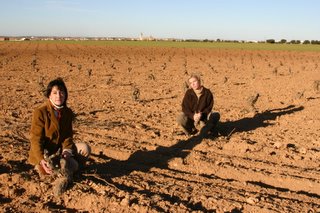
100% Tempranillo (ungrafted single vineyard)

Deep black red. Big, deep, ripe, fruity nose. Big, round, soft, low acid, very rich black fruit and chocolate flavors. Smooth, easy drinking with a tannic new oak finish. Drink now to 5 years. Grilled or roasted meat, especially lamb, Manchego cheese, chorizo.
Boca Wine Imports, 561-212-6095, $320 / case of 6.

Cooperativa Nuestra Señora del Pilar Almedo 2003 V. T. de Castilla
(Special American cuvee) 60% Tempranillo, 25% Syrah, 15% Syrah

Murky plum red. Big, grapey, toasty nose. Strawberry and toast, soft and grapey up front, but with sherry-like flavors and a hot finish that belies the announced 13% alcohol. Pizza, pasta, barbecue grill food. Good value. Drink up.
VinLozano Imports, Inc., 978-297-5477, $60.

Bodega Ecologica Bruno Ruíz Villanueva Roble 2001 V. T. de Castilla
75% Cencibel (Tempranillo), 15% Cabernet Sauvignon, 10% Syrah (organically grown)

Med pie-cherry red. Pie cherries and new oak. Pleasant, easy-drinking mix of spices (cloves, cinnamon and vanilla), strawberry-red cherry fruit and new oak. Good by the glass. Grilled chicken, tuna steaks, pasta, tapas.
VinLozano Imports, Inc., 978-297-5477, $60.

Cruzares, S.A. Marqués de Moral Crianza 2000 Valdepeñas
(Owned by Félix Solís)100% Cencibel (Tempranillo)

Deep black-red. Tanky, rustic, baking spice nose. Rustic, with volatile acidity, but a pleasant, if rough-edged country wine (true to the region) with a core of chocolate-red berry fruit. Grilled food, Italian pasta dishes, cured cheeses. Good value, drink now.
Fran Kysela et Fils, Ltd., 540-722-9228, $48/case of 12


Topping bottles with hot wax at Finca la Estacada

Finca la Estacada Selección Varietal 2001 V. T. Tierra De Castilla
Tempranillo, Cabernet Sauvignon, Merlot, Syrah, Mazuelo (Carignane)

Dark plum-cherry. Violets, licorice, toast, black and red fruits. Cola, cherries, red currants, licorice, spices, good acid and firm new oak (18 months). Upscale modern cuisine dishes, pasta, roast chicken, steaks, pork, lamb. Drink now to 3-5 years.
Grapes of Spain, Inc., 703-249-8028, $84/case of 6.

Mas Que Vinos Ercavio Tempranillo Roble 2003 V. T. de Castilla
Tempranillo (usually with some Cabernet Sauvignon)

Deep plum-red. Very ripe black fruits, licorice, baking spices. Rich, very ripe, sweet black currants, black raspberry, cloves, and licorice. Drink now, 1-2 years. Great value. Barbecues, grilled food, sheeps’ cheeses.
European Cellars/704-358-1565 / $80
Mas Que Vinos Ercavio Reserva 2000 V. T. de Castilla
90% Tempranillo, 10% Merlot

Dark plum-red. Ripe black currants, restrained oak. Delicious, rich, but not overripe, soft black cherry, currants and chocolate flavors with oak in harmony. Grilled lamb, game dishes (quail, rabbit), dishes with chorizo. Drink now to five years.
European Cellars, 704-358-1565, $?

Mas Que Vinos La Plazuela 2001 V. T. de Castilla
88% Tempranillo, 12% Garnacha

Dark black cherry. Deep, ripe black and red fruit nose, restrained oak. Ripe, but again not overripe, velvety, rich black fruit, chocolate and cola flavors with oak in balance. Lamb, game, steaks, soft cheeses. Drink now to five years.
European Cellars, 704-358-1565, $360 / case

Bodegas Hermanos Arenas Sánchez Aresan Crianza 2002 V. T. de Castilla
65% Tempranillo, 35% Cabernet Sauvignon

Deep plum-red. Ripe, sweet, jammy nose. Simple, easy-drinking, ripe blackberry and currant flavors with firm oak tannins. Charcuterie, cured cheeses, grilled meats. Drink now, 1-2 years.
$?

Pago Florentino Pago Florentino 2002 V. T. de Castilla
(owned by Ribera del Duero’s Arzuaga-Navarro) 100% Tempranillo

Deep, thick black plum. Pleasant, very ripe blackberry-black cherry nose. Very concentrated, incredibly rich, powerful (14.5%) black cherry, chocolate and cola flavors. Cheese ravioli, grilled tuna, rack of lamb. Drink now, 3-4 years. $160 / case

Pago del Vicario Agios 2002 V. T. de Castilla
80% Tempranillo, 20% Garnacha Tintorera

Thick, dark blackberry. Intense blackberry jam, licorice. Incredibly concentrated, powerful, rich, extracted with licorice, chocolate and jammy black fruits. Venison, roasted meats, Mediterranean pasta dishes, enchiladas. $220 / case

Arva Vitis Avalon de Arva Vitis 2001 V. T. de Castilla
100% old vines Tempranillo

Med-deep plum-cherry red. Sweet red fruit, light new oak. Good balance, easy-drinking, sweet plum, cherry, strawberry fruit and baking spices. Chicken dishes, tuna, game. $?

Bodegas Real Vega Ibor Tempranillo Barrique Crianza 2001 V. T. de Castilla
100% Tempranillo

Dark blackberry. Cola, cherry jam, ripe strawberries. Rich, soft, round, low acid with strawberry-cherry, cola and tannic oak finish. Pasta, game dishes, charcuterie, sheeps’ milk cheeses. Drink now, 1-2 years. Grape Expectations Wine Imports, 919-781-1655 $56 / case


Bodegas Real Finca Marisánchez Roble 2001 V. T. de Castilla
80% Tempranillo, 15% Cabernet Sauvignon, 5% Merlot

Opaque, thick, black plum. Nice, concentrated nose, new oak. Very concentrated, rich, blackberry-cherry, plum, chocolate, and carob flavors. Deceptively drinkable, but packs a punch
Grape Expectations Wine Imports, 919-781-1655, $176 / case


Dominio de Valdepusa Syrah 2002 D.O. Dominio de Valdepusa
100% Syrah

Deep black plum. Big, concentrated, stewed black fruit. Big, but well-balanced with rich, round, blackberry fruit and licorice. Drink now to five years. Pates, charcuterie, venison, grilled meats.
$300 / case

Dominio de Valdepusa Emeritus 2000 D.O. Dominio de Valdepusa
Cabernet Sauvignon, Petit Verdot, Syrah

Medium deep black-red plum. Big, ripe, modern Bordeaux-esque nose. Very powerful (14.5%), but smooth with intense stewed black fruit, cola, carob and espresso. Drink now to seven years. Venison, country pates, charcuterie, cheese selections, mushrooms. $520 / case

Dominio de Valdepusa Petit Verdot 2002 D.O. Dominio de Valdepusa
100% Petit Verdot

Thick, dark black cherry. Deep black fruits, licorice, violets. Very rich, ripe, delicious with plums, strawberries, red currants and minerals. Drink now to 7-8 years. Game, rack of lamb, refined upscale modern meat dishes.  $440 / case

Pagos de La Familia, S.A. Summa Varietalis 2001 Vino Tinto de Mesa Tinto de Toledo
(Made at Domino de Valdepusa) Cabernet Sauvignon, Petit Verdot, Syrah

Deep plum red. Big, ripe plummy, herbaceous. Very ripe, concentrated, delicious black currant and cherry fruit. Game, mushroom sauces, Spanish cheese selections, serrano ham. $320 / case

Bodegas y Viñedos Uribes Madero Gran Calzadilla 1998 V. T. de Castilla
75% Tempranillo, 25% Cabernet Sauvignon

Deep black raspberry. Big, ripe wild fruit nose, violets, perfume, licorice, oak. Ripe, intense, sweet fruit with loads of strawberries, red cassis, smoke, licorice, violets with tannic new oak finish. Now to 10 years. Great Napa Cabernet / Bordeaux food.
Charmer Industries, 800-794-9615, $93 / case of 6.

Bodegas y Viñedos Uribes Madero Calzadilla 1998 V. T. de Castilla
60% Tempranillo, 15% Cabernet Sauvignon, 12.5% Garnacha, 12.5% Syrah

Deep black cherry. Great, sweet, ripe wild fruit nose, licorice, chocolate. Wonderful, sweet fruit with wild strawberries, currants, black raspberry, coffee and licorice with prominent new oak. Now to 10 years. Napa Cabernet / Cru Classe Bordeaux food. 
Charmer Industries, 800-794-9615, $93 / case of 6.

Finca Sandoval 2001 La Manchuela
93% Syrah (Petit Syrah) / 7 % Monastrell (Mourvedre)

Thick, black as coal. Powerful, deep, ripe black fruits nose. Very sweet, smooth blackberry, black cherry, and cassis flavors with hints of black pepper and firm, but not overwhelming new French oak. Now to 5-7 years. Hermitage food, roasted and grilled meats, wild duck, goats’ and sheeps’ milk cheeses. Jorge Ordoñez - Fine Estates From Spain, 781-461-5767, $240 / case

Finca Sandoval 2002 La Manchuela
93% Syrah (Petit Syrah) / 7 % Monastrell (Mourvedre)

Deep black cherry. Deep, ripe plummy, black fruits and licorice nose. Big, ripe, round, silky with easy-drinking, sweet, black fruits flavors and minerals. Perhaps will develop more complexity with cellaring. Now to 5 - 8 years. Hermitage food, roasted and grilled meats, wild duck, goats’ and sheeps’ milk cheeses. Jorge Ordoñez - Fine Estates From Spain, 781-461-5767, $240 / case

Bodegas Martúe Martúe Syrah 2001 V. T. de Castilla
100% Syrah

Thick, deep black raspberry. Ripe, sweet black fruits, black pepper, oak. Very concentrated with bright black cherry, clove and pepper flavors and a sweet cola and oak finish. Now to 3-5 years. Duck, roast pork, sheeps’ cheeses, steak with peppercorns. $160 / case

Dehesa del Carrizal Selección Privada 2002 V. T. de Castilla
40% Cabernet Sauvigon, 30% Syrah, 30% Merlot

Murky black plum. Spicey nose, new French oak. Cassis, blackberry and minerals, dominated by new oak. Big Napa style, corresponding dishes, venison, grilled meats, goats’ and sheeps’ milk cheeses. 3-5 years. $?

Bodegas Pago de Vallegarcía Syrah 2001 V. T. de Castilla
100% Syrah

Deep black raspberry. Ripe fruit, minerals, coffee, new oak. Sweet, ripe, intense dark black fruits, some pepper, but bound in new oak. Game terrines, roast pork, lamb rib chops, grilled tuna. Needs 3-5 years. $320 / case
Related Posts with Thumbnails