Share This Gerry Dawes's Spain Post


Instagram

In 2019, again ranked in the Top 50 Gastronomy Blogs and Websites for Gastronomists & Gastronomes in 2019 by Feedspot. "The Best Gastronomy blogs selected from thousands of Food blogs, Culture blogs and Food Science. We’ve carefully selected these websites because they are actively working to educate, inspire, and empower their readers with . . . high-quality information. (Last Updated Oct 23, 2019)

Over 1,150,000 views since inception, 16,000+ views in January 2020.


36. Gerry Dawes's Spain: An Insider's Guide to Spanish Food, Wine, Culture and Travel gerrydawesspain.com

"My good friend Gerry Dawes, the unbridled Spanish food and wine enthusiast cum expert whose writing, photography, and countless crisscrossings of the peninsula have done the most to introduce Americans—and especially American food professionals—to my country's culinary life. . .” - - Chef-restaurateur-humanitarian José Andrés, Nobel Peace Prize Nominee and Oscar Presenter 2019; Chef-partner of Mercado Little Spain at Hudson Yards, New York 2019

1/03/2024

"An instant classic and an absolute beaut of a book." A Stupendous Review by London writer Tim Pinks of Sunset in a Glass: Adventures of a Food and Wine Road Warrior in Spain Volume I Enhanced Photography Edition

 
* * * * * 


I have never met Tim Pinks, who was born in Tripoli (Libya), lived in Scotland, now lives in London, is a gifted writer and has been attending the Fiestas de San Fermín in Pamplona since 1984.
 
 * * * * *
 
Tim Pinks running with the bulls at Pamplona.
 
Tim Pinks wrote this stupendous review of Sunset in a Glass: Adventures of a Food and Wine Road Warrior in Spain Volume I in a post on the Amigos de Pamplona FB page.
 
SUNSET IN A GLASS – by Gerry Dawes
 
"Dear Soulsters of Spain, Adiskideak of Euskadi, and Enamorados de Navarra…
 
Covid has kicked the cubo! For the last few days I’ve travelled the length and breadth of Spain, and seen and tasted things the like of which I have never experienced in my life.
 
A bit like the famous old Hank Snow, ‘I’ve been everywhere’ song – of which Johnny Cash does a great version - I’ve been to Sanlucar de Barrameda, Sevilla, Chinchon, Ribera del Duero, Pamplona, Roncesvalles and Barcelona too… And La Rioja and Granada and the Cradle of Castille and many other places also… Heck, I even travelled back in time and joined Gerry and some soldiers for many trips on a train in late Franco era Spain…
Yup, all from that book by a certain Señor Gerry Dawes!
 
I was going to wait until I’d finished the book…but I just can’t. When I have I’ll write a review for Amazon…but Amigos gets the world exclusive!
 
To all who love Spain, to aficionados of its wines, lovers of its food, and revellers in its regions…or just those who like a terrific travel tale…this is the book for you.
 
 
Sunset In A Glass. Isn’t that just one of the best titles ever?
 
I so, so wanted to like this book…but I don’t. I love, love, LOVE this book. Now I haven’t finished it yet as I’m only up to chapter twelve, a little over halfway but I know enough now that I will love the whole thing. Actually, I knew that after just a couple of chapters.
 
Oh my goodness what a beautifully written, wonderfully told and hugely entertaining book this is. The prose is so easy to read yet as poetic as it comes and the words slip by like the proverbial fine wine slides down. And I don’t mean to gush or sound sycophantic here…it just really is a superb book.
 
It’s also informative, funny and packed full of superb photographs. Gerry recommended I get the ‘enhanced photography edition’ so I did, and although not cheap at 25 Guineas in old money, old things, it is very much worth it. It’s a beautiful book to feel, hold, open and read…pure quality. And big, too, at eight and a half inches by eleven.
 
I could write a review of each chapter and pick out poetic quotes from the beautiful writing, but here are just a couple. From chapter one, where the book gets it title from. Describing an alternative and romantic version of where the Mediterranean town Sanluca de Barrameda gets it’s name from:
 
‘Several ships bearing treasure from the New World were wrecked and sunk after running on to the sandbar, so maybe part of the gold leaf laid down on the sea by the setting sun could be reflections of sunken Aztec or Inca gold bullion…’ Isn’t that beautiful?
 
Or this, Amigi, from the Pamplona chapter, talking about some of the people he met on his first visit to the fiesta capital of the world in 1970:
 
‘…the Pamplona regulars – that international group of spiritual descendants of Ernest Hemingway’s and Gertrude Stein’s Lost Generation who return to San Fermin each July to revel in the light of a sun that for them still rises.’ To revel in the light of a sun that for them still rises…isn’t that just perfect?
This is a book to revel in.
 
He takes us from the Franco era of the country where he wonderfully evokes an ‘old’ Spain that so many people fell in love with, to the modern Spain we all know today. He even mentions, in a nano typing of brevity, the country of my birth, Libya.
 
It’s funny to think that as my brother and I were playing at the Tripoli Yacht Club while mum and dad shared drinks with friends at the bar…Gerry Dawes could have been in one of those US military planes flying off the coast. (Did you ever land at Wheelus, Mr. Dawes?!) Well I never…
 
Now, it is time to bring James Michener in here, because it was thanks to him that I first went to Pamplona in ’84. A few years later the fantastic Ike del Rosario, who I met in the square that same first year, (and who died way, way too young in October) gave me a copy of Michener’s Iberia. And I don’t care what anyone says about Michener, his writing, or indeed Iberia…I love that book.
 
And do you know what? In a strange, yet very fitting way, this wonderful book in some way compliments Iberia. In a completely different way it somehow comes across to me as an updated – but very different – version of Michener’s classic. And that is a huge compliment.
 
Actually, I’ll include another classic in this little set – Hemingway’s ‘The Dangerous Summer.’ All three criss-cross Spain in very different ways…but all three are classics. Because Gerry has already written a classic with ‘Sunset’ of this I am in no doubt whatsoever.
 
Like Ernest’s grandson John Hemingway did with his modern take on The Sun Also Rises, with ‘Bacchanalia’…these books go with their illustrious predecessors like, well, wine and cheese. Actually, wine and anything…
 
Hopefully this is the first in five of a trilogy. (Don’t worry, GD and I know what that means!) It’s actually volume one, folks, so we know there is more to come. Like at a fine dinner when you know that when one bottle is done another one will be coming along…
 
I’m now over half way through ‘Sunset’ but it’s great to know that like a departing excellent wine another one will be arriving…
 
Honestly, Fiesteros, it is just the most fantastic book. After every chapter I’m either smiling, laughing, saying something to myself like, ‘’It’s just so brilliantly bloody good!” or all three at the same time.
 
I do waffle on so now it’s time to shuffle off. If I was to attempt a super-shortened ‘back blurb’ style version of the above it would be this:
 
At one point, describing Ferran Adria of El Bulli (I’m using the original spelling) and his internationally influencing, cuisine changing inventions, he uses the term ‘a culinary Krakatoa.’ Well this book is a literary love letter. Literally a love letter to a land that Gerry loves. Thanks to him I’ve travelled the length and breadth of Iberia. I’ve drunk it, tasted it and even travelled back in time to it. To a Spain long gone…but also wonderfully still here.
 
Congratulations Gerry, you have written an instant classic and an absolute beaut of a book."--Tim Pinks, London.  
 
Tim Pinks was given the "Guiri of the Year" Award by Señor Testis, the blue bull with the yellow horns, an image made famous world-wide by my friend Mikel Urmeneta* and his crew at Kukuxumusu, the Drawings and Ideas Factory that Urmeneta founded.  (Mikel Urmeneta has since moved on and now runs
Katuki Saguyaki, another innovative drawings and ideas studio.)
 
(*I am currently in conversations with Mikel Urmeneta about translating into Spanish, designing and publishing Sunset in a Glass in Spain.)
 
 
* * * * * 
 
 
(Available at Amazon, Despana (NYC), LaTienda.com, La Boca Restaurant (Santa Fe, NM) and at Kitchen Arts & Letters bookstore (NYC). 
 
Comments are welcome and encouraged.
 
Text and photographs copyright by Gerry Dawes©2021.  Using photographs without crediting Gerry Dawes©2021 on Facebook.  Publication without my written permission is not authorized.
 
Help Support Gerry Dawes's Spain & Its Content

If you enjoy these blog posts, please consider a contribution to help me continue the work of gathering all this great information and these photographs for Gerry Dawes's Insider's Guide to Spanish Food, Wine, Culture and Travel. Contributions of $5 and up will be greatly appreciated. Contributions of $100 or more will be acknowledged on the blog.

Please click on this secure link to Paypal to make your contribution.
 

* * * * *
  Shall deeds of Caesar or Napoleon ring
More true than Don Quixote's vapouring?
Hath winged Pegasus more nobly trod
Than Rocinante stumbling up to God?
 
Poem by Archer M. Huntington inscribed under the Don Quixote on his horse Rocinante bas-relief sculpture by his wife, Anna Vaughn Hyatt Huntington,
in the courtyard of the Hispanic Society of America’s incredible museum at 613 W. 155th Street, New York City.
 ______________________________________________________________________________________
 Gastronomy Blogs

In 2019, again ranked in the Top 50 Gastronomy Blogs and Websites for Gastronomists & Gastronomes in 2019 by Feedspot. (Last Updated Oct 23, 2019) 

"The Best Gastronomy blogs selected from thousands of Food blogs, Culture blogs and Food Science blogs in our index using search and social metrics. We’ve carefully selected these websites because they are actively working to educate, inspire, and empower their readers with frequent updates and high-quality information."  

36. Gerry Dawes's Spain: An Insider's Guide to Spanish Food, Wine, Culture and Travel


About Gerry Dawes

My good friend Gerry Dawes, the unbridled Spanish food and wine enthusiast cum expert whose writing, photography, and countless crisscrossings of the peninsula have done the most to introduce Americans—and especially American food professionals—to my country's culinary life." -- Chef-restaurateur-humanitarian José Andrés, Nobel Peace Prize Nominee and Oscar Presenter 2019


Gerry Dawes is the Producer and Program Host of Gerry Dawes & Friends, a weekly radio progam on Pawling Public Radio in Pawling, New York (streaming live and archived at www.pawlingpublicradio.org and at www.beatofthevalley.com.)

Dawes was awarded Spain's prestigious Premio Nacional de Gastronomía (National Gastronomy Award) in 2003. He writes and speaks frequently on Spanish wine and gastronomy and leads gastronomy, wine and cultural tours to Spain. He was a finalist for the 2001 James Beard Foundation's Journalism Award for Best Magazine Writing on Wine, won The Cava Institute's First Prize for Journalism for his article on cava in 2004, was awarded the CineGourLand “Cinéfilos y Gourmets” (Cinephiles & Gourmets) prize in 2009 in Getxo (Vizcaya) and received the 2009 Association of Food Journalists Second Prize for Best Food Feature in a Magazine for his Food Arts article, a retrospective piece about Catalan star chef, Ferran Adrià. 


". . .That we were the first to introduce American readers to Ferran Adrià in 1997 and have ever since continued to bring you a blow-by-blow narrative of Spain's riveting ferment is chiefly due to our Spanish correspondent, Gerry "Mr. Spain" Dawes, the messianic wine and food journalist raised in Southern Illinois and possessor of a self-accumulated doctorate in the Spanish table. Gerry once again brings us up to the very minute. . ." - - Michael & Ariane Batterberry, Editor-in-Chief/Publisher and Founding Editor/Publisher, Food Arts, October 2009. 
 
Pilot for a reality television series on wine, gastronomy, culture and travel in Spain.
 

Sevilla, Retracing Steps Part Two: Iglesia de San Gil A Remarkable Walk From El Arco de la Macarena to the Cathedral Featuring a Half Dozen Mudéjar-and-Gothic Churches Built on the Sites of Former Mosques in the 14th Century

 
* * * * * 


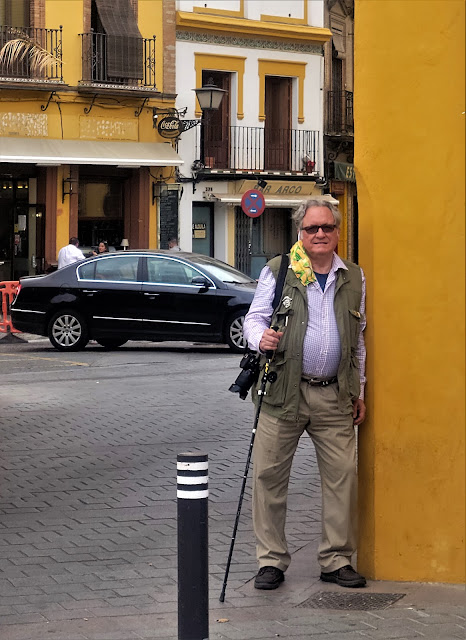
Gerry Dawes, Road Warrior, El Arco de la Macarena, Sevilla, June 2021.


El Arco de la Macarena, Sevilla.   

Since my first entry into Sevilla through El Arco (or La Puerta) de la Macarena in 1968, I have gone back to retrace my steps partially, in April 2016 and again in June 2021 and April 2022, always beginning with breakfast in Bar Plata, one of my favorite places in Sevilla. 


I love to begin my explorations from the north end of Sevilla at Bar Plata, whose wonderful mural in azulejos shows how the northern walls of the city and the Macarena gate entrance looked in the past. 

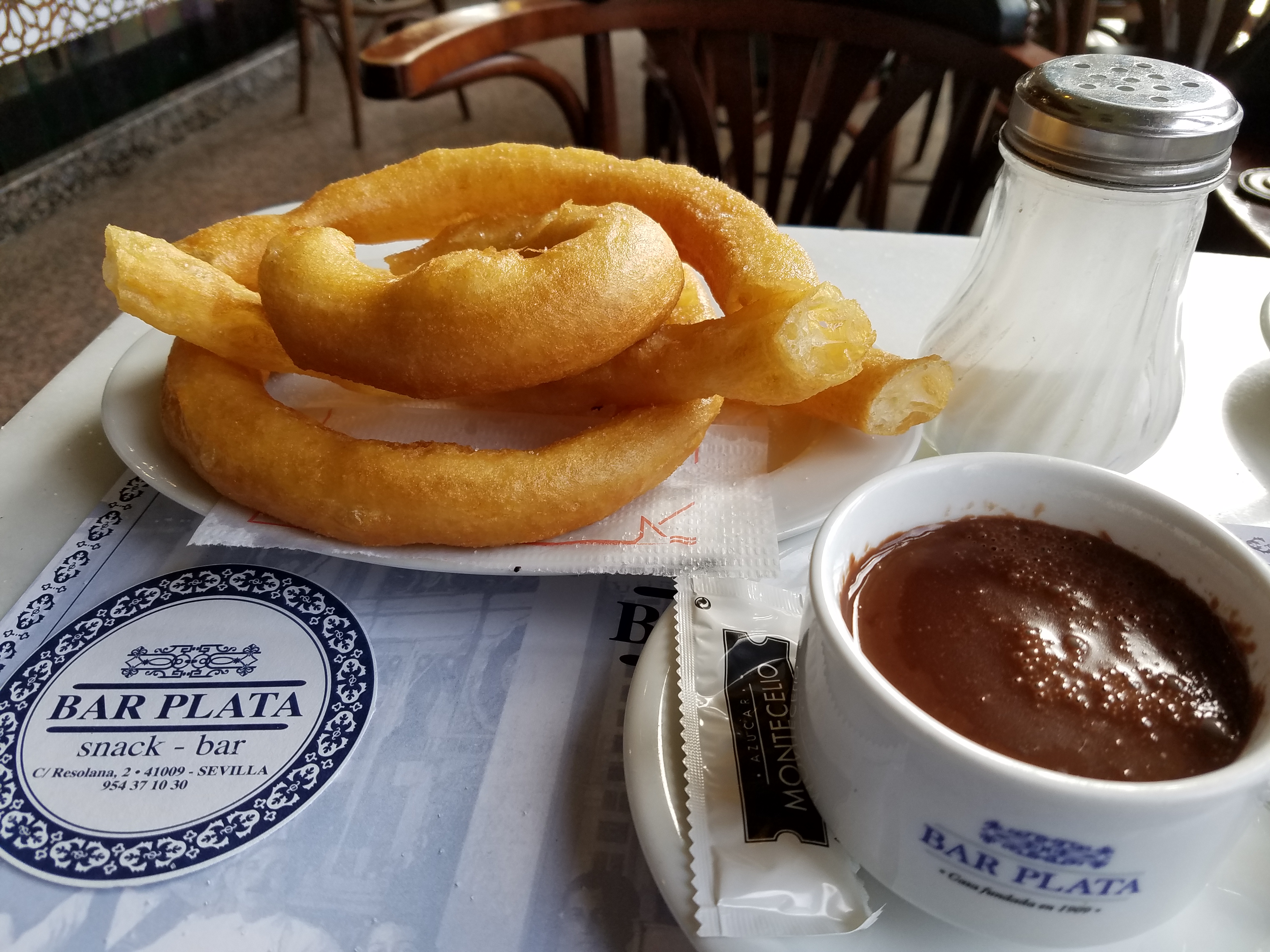
Sometimes I start with a plate of churros and a cup of thick hot chocolate to dip the churros in, often spiked with a shot of Spanish Brandy de Jerez.

The first of the gótico-mudéjares churches on the modern-day calle San Luís—the old Roman cardo maximo, the main north-south calzada or roadway through, also the city´s main road in the Moorish epoch, is the 13th century la Iglesia de San Gil Abad. It was likely an important mosque just inside the Moorish gate (In Arabic, Bab Macarana; now la Puerta de la Macarena or El Arco de la Macarena) that was the northern entrance to Sevilla and is the gate where I made my unlikely entrance into the city with my Navy buddy and errant navigator Tom Sims for the first time in 1968.  

Iglesia de San Gil Abad, Sevilla.

From 1643 until 1949, San Gil was the seat of the Brotherhood of la Virgen de la Macarena, until the much newer (1949) Basilica de la Macarena was built to be the home of the most venerated Virgen of Sevilla. San Gil is the main church, the more famous basilica is connected to it by a passageway.  San Gil dates from the second half of the 13th Century and was one of the first Christian churches built after the conquest of Sevilla (in 1248) by Fernando III de Castilla (el Santo). It is one of several so-called alfonsino Gothic-Mudéjar churches built under Fernando’s son, Alfonso X El Sabio, after his father died in the Alcázar in 1252. 
 

 Iglesia de San Gil Abad, Sevilla.
 
Since the Moorish architecture pre-dates Gothic, maybe the description should be Mudéjar-Gothic. Many of these churches still have the minarets that belonged to the mosques that they were built under 12th & 13th centuries Almohade rule, with La Giralda tower (built 1184–1198) of the Cathedral of Sevilla being the most prominent example. Though Gothic architecture pre-dominates as a style in these churches, it is the Moorish remnant that make them distinguished. When Fernando I conquered Sevilla after a 16-month siege, he expelled the entire Moorish population of the city, allowing them to leave only with the possessions they could carry.  The complete expulsion did not last long and Moorish craftsmen and other skilled workers begin to return to the city. 
 
Some the Islamic architecture along this route show the remnants of former mosques, others were built by conquered Moorish builders, thus are Mudéjar, i. e. built by Moorish architects, builders and masons working under Christian rule. Further complicating this mélange of Islamic, Mudéjar and Christian Gothic styles are later Renaissance and Baroque additions, which make some of the conglomerate buildings seem as if they were built by Rube Goldberg-esque designers. A powerful earthquake in 1356 hit the remaining Islamic structures hard, destroying several of them. Some were rebuilt in the same style, thus they are truly Mudéjar and not purely Almohade Islamic in origin. San Gil’s architectural origins as a mosque can be seen at the base of the Mudéjar tower. The rest of the tower, which dates to the 13th century mosque, was remodeled and restored in the 18th century, which left it with little of its original Islamic character.
 
San Gil Abad, Sevilla.
 
* * * * * 
 
 
(Available at Amazon, Despana (NYC), LaTienda.com, La Boca Restaurant (Santa Fe, NM) and at Kitchen Arts & Letters bookstore (NYC). 
 
Comments are welcome and encouraged.
 
Text and photographs copyright by Gerry Dawes©2021.  Using photographs without crediting Gerry Dawes©2021 on Facebook.  Publication without my written permission is not authorized.
 
Help Support Gerry Dawes's Spain & Its Content

If you enjoy these blog posts, please consider a contribution to help me continue the work of gathering all this great information and these photographs for Gerry Dawes's Insider's Guide to Spanish Food, Wine, Culture and Travel. Contributions of $5 and up will be greatly appreciated. Contributions of $100 or more will be acknowledged on the blog.

Please click on this secure link to Paypal to make your contribution.
 

* * * * *
  Shall deeds of Caesar or Napoleon ring
More true than Don Quixote's vapouring?
Hath winged Pegasus more nobly trod
Than Rocinante stumbling up to God?
 
Poem by Archer M. Huntington inscribed under the Don Quixote on his horse Rocinante bas-relief sculpture by his wife, Anna Vaughn Hyatt Huntington,
in the courtyard of the Hispanic Society of America’s incredible museum at 613 W. 155th Street, New York City.
 ______________________________________________________________________________________
 Gastronomy Blogs

In 2019, again ranked in the Top 50 Gastronomy Blogs and Websites for Gastronomists & Gastronomes in 2019 by Feedspot. (Last Updated Oct 23, 2019) 

"The Best Gastronomy blogs selected from thousands of Food blogs, Culture blogs and Food Science blogs in our index using search and social metrics. We’ve carefully selected these websites because they are actively working to educate, inspire, and empower their readers with frequent updates and high-quality information."  

36. Gerry Dawes's Spain: An Insider's Guide to Spanish Food, Wine, Culture and Travel


About Gerry Dawes

My good friend Gerry Dawes, the unbridled Spanish food and wine enthusiast cum expert whose writing, photography, and countless crisscrossings of the peninsula have done the most to introduce Americans—and especially American food professionals—to my country's culinary life." -- Chef-restaurateur-humanitarian José Andrés, Nobel Peace Prize Nominee and Oscar Presenter 2019


Gerry Dawes is the Producer and Program Host of Gerry Dawes & Friends, a weekly radio progam on Pawling Public Radio in Pawling, New York (streaming live and archived at www.pawlingpublicradio.org and at www.beatofthevalley.com.)

Dawes was awarded Spain's prestigious Premio Nacional de Gastronomía (National Gastronomy Award) in 2003. He writes and speaks frequently on Spanish wine and gastronomy and leads gastronomy, wine and cultural tours to Spain. He was a finalist for the 2001 James Beard Foundation's Journalism Award for Best Magazine Writing on Wine, won The Cava Institute's First Prize for Journalism for his article on cava in 2004, was awarded the CineGourLand “Cinéfilos y Gourmets” (Cinephiles & Gourmets) prize in 2009 in Getxo (Vizcaya) and received the 2009 Association of Food Journalists Second Prize for Best Food Feature in a Magazine for his Food Arts article, a retrospective piece about Catalan star chef, Ferran Adrià. 


". . .That we were the first to introduce American readers to Ferran Adrià in 1997 and have ever since continued to bring you a blow-by-blow narrative of Spain's riveting ferment is chiefly due to our Spanish correspondent, Gerry "Mr. Spain" Dawes, the messianic wine and food journalist raised in Southern Illinois and possessor of a self-accumulated doctorate in the Spanish table. Gerry once again brings us up to the very minute. . ." - - Michael & Ariane Batterberry, Editor-in-Chief/Publisher and Founding Editor/Publisher, Food Arts, October 2009. 
 
Pilot for a reality television series on wine, gastronomy, culture and travel in Spain.
 

12/05/2023

Sunset in a Glass: Adventures of a Food and Wine Road Warrior in Spain Volume I, Chapter I Sevilla: Arrival in Spain (in 1968) Soldiers on a Train (Excerpt protected by copyright)

 
* * * * * 
 

 Gerry Dawes in 2021 standing at La Puerta (El Arco) de la Macarena, the gate through which he first entered Sevilla in 1968, quite by accident, the same entry point used by numerous Spanish Kings on their first visit to Sevilla.

Sevilla: Arrival in Spain

Soldiers on a Train

Chapter 2

(This content may not be copied or re-transmitted without the written consent of author Gerry Dawes.) 

 Before I was stationed in Spain in the US Navy, my knowledge of Spain and wine, which subsequently became a career for me in New York City, was nonexistent. Spain and my Spanish wine expertise would follow later, but my fledgling wine knowledge began its journey in California when I was stationed in Monterey in the mid-1960s. (I don’t count plying girlfriends back in Illinois with the occasional bottle of pink “Champagne.”) On week- ends at the mystical white beach at Carmel with my buddies—all of us students at the Defense Language Institute at the Presidio of Monterey—I shared jugs of cheap California wines, along with bread and cheese from the Mediterranean Market in Carmel village. One night under a decaying old Monterey wharf, I helped two Navy buddies polish off a gallon jug of Mountain Red—with miserable results.

Occasionally on a payday weekend, I would splurge on abalone and a bottle of Almaden Emerald Riesling or some such at a restaurant on Monterey’s then-not-so-touristy Fisherman’s Wharf or have spaghetti and a wicker-wrapped, aptly named fiasco of Chianti on Cannery Row, which at that time still had vestiges and whiffs of John Steinbeck’s era. And one June weekend in 1967, I watched and listened in wine-soaked reverie at the Monterey Pop Festival as Janis Joplin, Jimi Hendrix, Canned Heat, The Who, Jefferson Airplane, Otis Redding and others became international stars right before our mesmerized eyes and ears and passed into legend.

Before I entered the Navy, at Southern Illinois University, I had sporadically pursued a Journalism major until 1965 when the Lyndon Johnson-led US government—opting first, of course, for those “who had not worked continuously towards a degree”—decided they needed even more carrion candidates for Vietnam. I volunteered for the Navy as soon as I felt the hot breath of my local draft board breathing down my neck. To avoid the possibility of two years of infantry duty and possible (certain in my mind) death, I enlisted for four years in the Navy, astutely calculating that aircraft carriers didn’t normally invade Vietnamese rice paddies.

Ironically, I damn near died from a bout with spinal meningitis that I contracted during basic training at Great Lakes Naval Station, where recruits were allowed some four hours sleep a night, which greatly contributed to a meningitis epidemic among recruits during that epoch. (In the middle of the night, we took turns guarding a laundry room, just in case, we surmised, the Viet Cong somehow managed to penetrate the heartland in the dead of a Lake Michigan winter to stage a surprise laundry raid.)

After a four-month stay in the hospital and after schmoozing the Great Lakes Naval Station personnel bureau with boxes of donuts, they put me on the telephone with Navy bureaucrats in Washington, whom I pestered until they gave me an assignment to the Defense Language Institute at Monterey, where I miraculously graduated as a poor-to-mediocre linguist. I left Monterey barely conversant in Russian, much of which was military terminology, but I did learn to sing a transliterated version of “Dixie.”

After graduation, we were transferred for several months to the Defense Department’s Top Secret Security School in San Angelo, Texas, a training assignment made memorable by a monumentally ignorant Boatswain’s Mate Chief Petty Officer, who lined up our mostly col- lege-educated crew of linguists and threatened to charge us with mutiny for failing to show up for a useless meeting after an all-night class. He punctuated his blustering by proclaiming the “ignorance in boatswain’s mates went out with the sailing ships,” which caused the in- credulous officers watching this absurd, worthy-of-a-M*A*S*H episode performance to stifle guffaws. The mutiny squelched, we survived to graduate, but the Chief was not done spreading his wisdom.

On graduation day, he graphically told the men in our unit, several of whom were married, how to avoid contracting venereal disease after having sex with women they might meet in bars. My classmates, fearing imprisonment for mutiny or insubordination, strained mightily, as in near hernia-inducing strain, to keep from laughing in the chief’s face. Some of the officers attending our graduation rushed from the room to keep from doing the same.

One day in class, when field assignments were being announced, my unit commander blurt- ed, “Dawes, you lucky bastard. You are going to Rota, Spain.” As it turned out, life’s lottery handed me a winning ticket. As soon as class was over, I went straight to the base library and checked out the few books I could find on Spain.

On January 2, 1968, not long after daylight, our military plane, near the end of an overnight flight from McGwire Air Force Base in New Jersey, banked near El Puerto de Santa María and I got my first glimpse of Spain. Below, I saw whitewashed buildings amid palm trees set in a sea of stubby vines—now bare of leaves in mid-winter—surrounded by stark white soil. As I would learn later, the Navy base at Rota was near the sherry vineyards between Jerez de la Frontera and Sanlúcar de Barrameda. As the plane circled before landing, I also could not help noticing circular enclosures which I would learn were bullrings, including the big one at El Puerto de Santa María and a couple of smaller ones which I would one day find first-hand are used to test young fighting cows for bravery. Spain was already beginning to fascinate me and I had not even touched the ground.

The plane landed in Spain, but on the US Navy base, an American enclave where I would stay for the next week, eager to discover my first foreign country. New arrivals were not allowed off the base until they had attended the don’t-drink-the-water, don’t-eat-the-food, don’t-get-in- fights-with-the-natives, don’t-molest-the-señoritas lecture, which was held once a week. For our group, the indoctrination lecture was not held for nearly a week. All I saw of Spain during my first week in Rota were the glimpses I got on the daily bus rides to my work assignment at a large white security building, surrounded by a huge antennae field—derisively known to the enlisted men as the “hum locker,” because of the constant humming sound made by the anten- nas. It was where Navy linguists in French, Arabic, and Russian clandestinely eavesdropped on radio conversations from around the Mediterranean.

Tom Sims, a tall, shy, sardonic, totally eccentric French linguist, with whom Gerry Dawes first came to Sevilla.

From the perimeter road, across the strands of barbed wire that encircled the base, I saw men plodding along on burros past scrappy-looking farms with cottages, some of which still had thatched roofs and in whose sparse environs grew cactus and palm trees. I saw little of the greenery that I knew from my native Midwest; this part of Spain was more like parts of Cali- fornia, perhaps even more barren. Still, those few glimpses seemed exotic and were tantalizing. Finally, along with other new arrivals, we were given the indoctrination lecture and allowed off the base. I went to downtown Rota with a fellow sailor for my first meal in Spain: spaghetti with meat sauce, served in an “American” bar, where Spanish and foreign girls, very few of whom were prostitutes, tried to keep lonesome young men engaged in conversation, thus

keeping the wheels hot on the trucks that delivered San Miguel beer to the bars of Rota.

The latest American rock music blared from a jukebox, continually reminding my compa- triots of the girls they had left behind, perpetuating their homesickness and underlining their determination to get out of “Mother Nav” and away from Spain. Some of my fellow Navy men contemptuously referred to the local Spaniards as “Moes,” a name used by sailors who had been transferred from previous assignments in Kenitra, Morocco, where they called the Moroccans “Moes,” then used it in Rota as a moniker for Spaniards in general.

I knew men who spent two years at Rota and never got more than a few kilometers from the base. Once I lured one of them as far away as Cádiz, that wonderful, ancient, exotic seaport city across the bay from Rota, to see the sights but he became so uncomfortable after a couple of hours that he demanded we return to Rota to drink in the American bars.

I too joined the daily post-shift migration to the bars of Rota, drinking my share of drinks, playing my share of pool, telling my share of jokes, and trying, like hundreds of other enlist- ed men and officers, to woo the too-many-times-wooed, often hardened, young women who served drinks. But gnawing away at my insides was the thought that Spain was my chance to see Europe, maybe my only chance before returning to small-town Illinois where, with the help of the GI Bill, I would resume the pursuit of my teacher’s degree at Southern Illinois University.

In addition to hanging out in the bars, I continued reading about Spain and like many others before and since, became enamored of Ernest Hemingway’s books, especially the ones set in Spain: For Whom the Bell Tolls and The Sun Also Rises, especially the latter, which drew on the author’s experiences with the Paris-based “Lost Generation.”

During my first months in the Navy at Rota, I met Tom Sims, a tall, shy, sardonic, totally ec- centric French linguist, whose father was a prominent geologist and whose sister Charlotte was crowned Miss Minnesota in 1967. One of the quirkiest of many quirky people I have known in my life, Sims became my friend and, eventually, my housemate in an off-base apartment.

Sims arrived in Rota several months before I did and had been to Sevilla once. How Sims managed to get there and back, I still wonder, since his skills as a navigator, or anything else involving the use of logic applied to everyday problems, seemed non-existent. Sims, whose whole life revolved around reading good literature while listening to classical music, is a man to whom I would never loan even a screwdriver without a serious interrogation, nor would I turn him loose in any kitchen unless I wanted it to become a toxic waste site. His idea of cooking in those days consisted of dumping a box of Kraft Macaroni & Cheese—bought from the Rota Navy Exchange—into a pan of water, turning the fire on under it and reading until he smelled it burning. Sims also seemed to revel in a peculiar habit that made him, say, order steak in some of the best seafood restaurants in Spain such as those in Sanlúcar de Barrameda, and then choose fish in landlocked Ecija, a Córdoba province town which gets so hot it is known as la sartén de España, the frying pan of Spain.

In early spring of 1968, Sims and I took the train from El Puerto de Santa María to Sevilla. When we arrived at what even a novice like me knew had to be the main train station in Sevilla, then the Estación de San Bernardo, Sims claimed that there was another station where we were supposed to get off. After a 15-minute stop, the train began to move. I kept questioning Sims about this “other” station, since I was convinced that we were on our way to Madrid. As the train was rambling out of the suburbs of Sevilla, it slowed down for a track-switching maneuver and I insisted that we jump off before it picked up speed again.

We got off the train while it was moving and ended up in San Jerónimo, then a suburban village near Sevilla’s San Fernando cemetery, where later I would learn that Joselito and Belmonte, the two great hero matadors of Sevilla, were interred. It was market day in San Jerónimo, so we strolled along the street listening to the foreign sounds of peddlers hawking the cheap produce of a working-class barrio. When we asked using sign language how we could get to Sevilla, a woman at a vegetable stand pointed to a bus stop across the street. The bus was just arriving and we rode four kilometers to Sevilla, where we got off at a stop across the street from one of the old Moorish gates to the city.


El Arco de la Macarena, one of the remaining ancient gates left in Se- villa and one of the most important because it leads to La Basilica de la Macarena. But since it is off the main routes leading into Sevilla, it is unlikely that any foreigner would enter Sevilla this way for the first time. This was my very first photograph of Sevilla. Note the traffic jam of bicycles, motorbikes, small trucks and cars and a donkey pulling a cart.

 The gate was the Arco de la Macarena, the ancient archway through which one of the most iconic Virgin figures of Andalucía, La Virgen de la Macarena, a jewel-bedecked, richly robed Madonna statue of legendary beauty, is carried out each Holy Thursday to the hosannas of thousands of Sevillanos. The Macarena gate is flanked by the ruins of Sevilla’s old Roman walls and is one of the city’s most revered spots, but it was not a place directly linked to any main roads, so it was next to impossible for a foreigner to enter the city this way. I have long thought, given this auspicious entrance into Sevilla, that my fate was somehow inextricably intertwined with this marvelous Andalucian city from that first moment. My future wife and I eventually lived in Sevilla for nearly four years; the best man at our wedding was a Sevillano, and it was Sevilla that, 25 years later— through a pivotal rekindled friendship and the discovery of a prodigiously talented young bullfighter/media star, Francisco Rivera Ordoñez—would draw me ever more deeply back into Spain.

On that wondrous spring day in 1968, Sims and I wandered through the back streets for hours, emerging from Sevilla’s narrow urban canyons on calle Francos to find the La Giralda tower soaring above us. Once the minaret of the main mosque when the Moors ruled Sevilla seven centuries earlier, La Giralda was later capped with a Renaissance structure and became the bell tower of the Cathedral and Sevilla’s symbol, its Eiffel Tower. The statue of Faith, called El Giraldillo, crowning the top of the structure, has a metal protrusion that allows it to swivel in the wind so that it acts as a weathervane. The shield-like protrusion resembles a mu- leta, the small red cloth that a bullfighter uses during la faena, the main act of a corrida— there is even a pass called the giraldilla.

Sims and I had finally arrived at the center of the city, but our meanderings were worth it. From our impromptu entrance through the Macarena arch that is sacred to Sevillanos and our serendipitous exploration of the labyrinthine streets of the working-class quarters of Sevilla with their strange sights, smells, and sounds, I got a taste of the city’s true alma, its soul, one that I have never lost. In subsequent months, now enchanted with this beautiful and exotic city, I returned again and again. My Navy linguist’s unit worked in shifts that were similar to what nurses work in hospitals. The schedule was crucial to being able to really immerse myself in Spanish culture. Our work cycle began with two evening shifts from 5 p.m. to midnight, then two day shifts, followed by two midnight shifts.

On the last morning of each cycle the shift ended at 8 a.m., then we had the rest of that day free, the following two days and until 5 p.m. the last day when the cycle began again. During each nine-day cycle I had 81 hours off in a row, the equivalent of a four-day weekend, which allowed me to go to Sevilla and play civilian, or in my case, Sevillano. Not insignificant in my nascent love affair with Sevilla was the fact that there was a continual flow of young American, Canadian and English-speaking European women backpacking or touring around Spain and on their obligatory stop to see the quintessential Andalucian city of Carmen. This made Sevilla an infinitely more attractive place for me to spend free time than in Rota, with its very highly competitive, seldom fruitful bar scene with its jaundiced women.

Early on during my hitch in Rota, on a train from El Puerto de Santa María to Sevilla, I met an American backpacker whose name I no longer remember. He was carrying the indispensable guidebook, Spain on $5 a Day, which recommended a cheap pensión in the old Jewish Quarter, the Barrio de Santa Cruz. It cost about a dollar a day, he said, and asked me if I would like to share a room with him to save money. We found the Pensión Santa Cruz in the narrow back streets of the Barrio and it became my home away from Rota. The Juan Alonso family who owned it became my Spanish mamá and papá and their son Juan, mi hermano, my Spanish brother, who subsequently came to America sponsored by my friend Edwin Mullens and was the best man at our wedding in Michigan. I was hooked on Sevilla.

Because of the military’s infinite wisdom and logic-defying precision, I, a Russian linguist, was assigned for two years to the Rota Naval Base in Spain, from which periodically I was sent out riding (facing backwards) in the plane captain’s seat of antiquated 1950s-vintage, unarmed airplanes, including the great swept-wing “whale,” the A-3 Skywarrior, a converted fighter-bomber. Staging from Rota to aircraft carriers in the Mediterranean and to land bases in Greece and West Germany, we flew on electronic eavesdropping missions off the coasts of Egypt, Libya, East Germany, Poland, and the Soviet Union. It was my job to listen on a radio receiver and tape Russian military conversations. While flying off the coasts of the Soviet Union bloc countries, the first time I heard a MIG on our tail pretending to lock on with a missile that would have turned us to toast in a few seconds, I momentarily longed even for a Vietnamese rice paddy. Nevertheless, during my two-year tour of duty in Rota, between


A street scene on calle San Luís in La Macarena quarter during my first hour in Sevilla.

flying missions, I had time to begin discovering Spain and I began to develop an afición, a passion, for the country that has continued to grow for more than 50 years. I was happy, deliriously happy, to be in Europe and not in Vietman.

By August of 1968, a year after that momentous Monterey Pop Festival, after a weekend in Sevilla I found myself in a steamy second-class train car rattling south through Andalucía toward El Puerto de Santa María. I was with a group of Spanish Army conscripts, whom I had met on the train and who would become my friends over the course of that summer as we traveled back-and-forth between our respective military assignments in Cádiz province and weekend R&R in their beautiful, mystical Sevilla, the quintessential city of southern Spain, a place that was rapidly becoming my adopted hometown.


On that wondrous spring day in 1968, Tom Sims and I meandered through the back streets of Sevilla for two hours, emerging from the city’s narrow urban canyons at the end of calle Francos to find the La Giralda tower soaring above us. Once the minaret of the main mosque when the Moors ruled Sevilla seven centuries earlier, La Giralda was later capped with a Renaissance structure and became the belltower of the Cathedral and Sevilla’s symbol, its Eiffel Tower.

On that slow rocking train in southern Spain, Roberto, one of my new Spanish soldier friends—most of whom came from La Alameda de Hércules, a Sevilla working class barrio— taught me how to cut a V-shaped wedge out of either side of a cork pulled from the label-less bottles of ice-cold coarse red vino corriente that I purchased when the train stopped at the sta- tion in heat-baked Utrera, south of Sevilla. Roberto would shove the cork back in the bottle and pass the wine around for all to share bota-style, each in turn tilting up the bottle and allowing the wine to flow in a stream into the drinker’s mouth without allowing the bottle to touch his lips. During the summer of 1968, I nearly mastered the art of hitting my mouth with a stream of red wine while standing in the passageway at the end of the swaying train car, through whose open doors gushed blasts of Spanish summer air, considerably increasing the degree of difficulty.

Wine-stained shirts, the accompanying foul-mouthed invectives and the cost of a few bottles of wine were a small price to pay for the conviviality of these fun-loving Spanish soldiers. In addition to learning a modicum of unorthodox wine-drinking etiquette from Roberto and his friends, I picked up some Spanish by osmosis and was treated to impromptu flamenco sing- ing accompanied by the staccato rhythms of my friends clapping palmas (which they also taught me). I was also given a share of Roberto’s mother’s superb tor- tillas españolas, Spain’s classic potato omelettes that are sliced into wedges and eaten cold—a traveler’s staple in Spain.

Each week, when we arrived in Sevilla, Roberto and his friends told me which train they would be taking back to their base in San Fernando, so I could meet up with them for the trip back south. No matter what shape we were in after drinking multiple bottles of wine on the two-hour train ride, my new amigos always made sure I got off at El Puerto de Santa María, the great sherry town on the bay of Cádiz, where I would catch the shiny little local train to nearby Rota. There were big abrazos (embraces), waves, and good wishes from my new- found friends as I disembarked, then they were back to clapping and singing flamenco as their train creaked to life and rolled on to San Fernando, two stops down the line.

The sharp metallic chilled wine, which tasted far better with the good tortilla, Spanish olives, and rough country bread, was never more than poor to mediocre, but it was the camaraderie and conviviality of Roberto and his Sevillano friends sharing their food, songs, jokes and sto- ries with me that made those train trips so memorable and the ordinary wine and food a feast. On those wonderful “wild and weary” train rides through tawny summertime Spain, I also learned an indispensable rule about drinking vino—the most important thing about any bottle of wine is the people surrounding it—and in the process I developed a passion for Spain, Span- iards and Spanish wine and food that has endured to this day.

 
* * * * * 
 
 
(Available at Amazon, Despana (NYC), LaTienda.com, La Boca Restaurant (Santa Fe, NM) and at Kitchen Arts & Letters bookstore (NYC). 
 
Comments are welcome and encouraged.
 
Text and photographs copyright by Gerry Dawes©2021.  Using photographs without crediting Gerry Dawes©2021 on Facebook.  Publication without my written permission is not authorized.
 
Help Support Gerry Dawes's Spain & Its Content

If you enjoy these blog posts, please consider a contribution to help me continue the work of gathering all this great information and these photographs for Gerry Dawes's Insider's Guide to Spanish Food, Wine, Culture and Travel. Contributions of $5 and up will be greatly appreciated. Contributions of $100 or more will be acknowledged on the blog.

Please click on this secure link to Paypal to make your contribution.
 

* * * * *
  Shall deeds of Caesar or Napoleon ring
More true than Don Quixote's vapouring?
Hath winged Pegasus more nobly trod
Than Rocinante stumbling up to God?
 
Poem by Archer M. Huntington inscribed under the Don Quixote on his horse Rocinante bas-relief sculpture by his wife, Anna Vaughn Hyatt Huntington,
in the courtyard of the Hispanic Society of America’s incredible museum at 613 W. 155th Street, New York City.
 ______________________________________________________________________________________
 Gastronomy Blogs

In 2019, again ranked in the Top 50 Gastronomy Blogs and Websites for Gastronomists & Gastronomes in 2019 by Feedspot. (Last Updated Oct 23, 2019) 

"The Best Gastronomy blogs selected from thousands of Food blogs, Culture blogs and Food Science blogs in our index using search and social metrics. We’ve carefully selected these websites because they are actively working to educate, inspire, and empower their readers with frequent updates and high-quality information."  

36. Gerry Dawes's Spain: An Insider's Guide to Spanish Food, Wine, Culture and Travel


About Gerry Dawes

My good friend Gerry Dawes, the unbridled Spanish food and wine enthusiast cum expert whose writing, photography, and countless crisscrossings of the peninsula have done the most to introduce Americans—and especially American food professionals—to my country's culinary life." -- Chef-restaurateur-humanitarian José Andrés, Nobel Peace Prize Nominee and Oscar Presenter 2019


Gerry Dawes is the Producer and Program Host of Gerry Dawes & Friends, a weekly radio progam on Pawling Public Radio in Pawling, New York (streaming live and archived at www.pawlingpublicradio.org and at www.beatofthevalley.com.)

Dawes was awarded Spain's prestigious Premio Nacional de Gastronomía (National Gastronomy Award) in 2003. He writes and speaks frequently on Spanish wine and gastronomy and leads gastronomy, wine and cultural tours to Spain. He was a finalist for the 2001 James Beard Foundation's Journalism Award for Best Magazine Writing on Wine, won The Cava Institute's First Prize for Journalism for his article on cava in 2004, was awarded the CineGourLand “Cinéfilos y Gourmets” (Cinephiles & Gourmets) prize in 2009 in Getxo (Vizcaya) and received the 2009 Association of Food Journalists Second Prize for Best Food Feature in a Magazine for his Food Arts article, a retrospective piece about Catalan star chef, Ferran Adrià. 


". . .That we were the first to introduce American readers to Ferran Adrià in 1997 and have ever since continued to bring you a blow-by-blow narrative of Spain's riveting ferment is chiefly due to our Spanish correspondent, Gerry "Mr. Spain" Dawes, the messianic wine and food journalist raised in Southern Illinois and possessor of a self-accumulated doctorate in the Spanish table. Gerry once again brings us up to the very minute. . ." - - Michael & Ariane Batterberry, Editor-in-Chief/Publisher and Founding Editor/Publisher, Food Arts, October 2009. 
 
Pilot for a reality television series on wine, gastronomy, culture and travel in Spain.
 
Related Posts with Thumbnails