Share This Gerry Dawes's Spain Post


Instagram

In 2019, again ranked in the Top 50 Gastronomy Blogs and Websites for Gastronomists & Gastronomes in 2019 by Feedspot. "The Best Gastronomy blogs selected from thousands of Food blogs, Culture blogs and Food Science. We’ve carefully selected these websites because they are actively working to educate, inspire, and empower their readers with . . . high-quality information. (Last Updated Oct 23, 2019)

Over 1,150,000 views since inception, 16,000+ views in January 2020.


36. Gerry Dawes's Spain: An Insider's Guide to Spanish Food, Wine, Culture and Travel gerrydawesspain.com

"My good friend Gerry Dawes, the unbridled Spanish food and wine enthusiast cum expert whose writing, photography, and countless crisscrossings of the peninsula have done the most to introduce Americans—and especially American food professionals—to my country's culinary life. . .” - - Chef-restaurateur-humanitarian José Andrés, Nobel Peace Prize Nominee and Oscar Presenter 2019; Chef-partner of Mercado Little Spain at Hudson Yards, New York 2019

Showing posts with label John Fulton. Show all posts

2/09/2025

James Michener's Iberia: Spanish Travels and Reflections: More Autographs, Stories & Photos Behind the Signatures. Jim Corbett, Pg. 530

 
* * * * *
 
 
 Former Marine Jim Corbett in Pamplona, 1977.  
Photograph by Gerry Dawes©2020.
 

Story about Jim Corbett, related in James A. Michener's Iberia, pg. 530 in the original 1968 Random House version without mentioning Corbett by name.  


Matador John Fulton performing in a festival bullfight in Pamplona, 1977.  
Photograph by Gerry Dawes©2020.
 
"Matador Fulton told an equally strange tale. He was born in Philadelphia, Fulton John Sciocchetti, to a conservative middle-class Italian-Hungarian family who changed their last name to Short, so his name was legally Fulton John Short, but in the ring he was known as John Fulton. As an art student at the Philadelphia Museum School he gained high marks, but reading Hemingway’s Death in the Afternoon alerted him to the romance of the bullring, and when his military duty took him to camps along the Mexican border he began to train as a bullfighter, and once he did this, he was lost. He kept us chuckling in the mists as he recounted one after another of the misadventures which seem to overtake all bullfighters: ‘I was fighting this time in Tijuana and there was this dippy dame from some society or other in southern California who conceived a passion for bullfighters, one after another, and this week it was “our heroic American matador, John Fulton.” As the fight was about to begin she leaned down out of the stands, grabbed at my hand and told her husband,  “I have fallen madly in love with this young man and I warn you that if the bull wounds him I shall leave you sitting here, because my place will be in the ring with the wounded hero.” Her husband looked at her, looked at me, then put his hands to his mouth and bellowed, “Come on, bull!”’--James A. Michener, Iberia, pg. 530 in the original 1968 Random House version.
 
John Fulton told Michener and his fellow picnickers this story in Roncesvalles.  The guy who yelled "Come on, Bull!" was supposedly Jim Corbett, a long-time friend of John Fulton and a man I came to know well when he lived in Sevilla in the Barrio de Santa Cruz.  
 
 
Matador John Fulton on and Gerry Dawes in the bullring at Pamplona, 1971.
Photographer by master Reuters (at the time) photographer Jim Hollander. 
 
In the following paragraph, Michener wrote about Professor Kenneth Vanderford, who was also a friend of mine, at the same picnic in Roncesvalles:
 
"Vanderford astonished me by having in his pocket the details of that first bullfight I had seen in Valencia so many years ago.  Working in his patient way through the newspapers of the period on file in Madrid, he had found answers to my questions: The fight had occurred on the Sunday after Easter, April 3, 1932, in the plaza at Valencia. The bulls were from the ranch of Don Manuel Comacho of Sevilla, and the matadors appear to have been regular, no more. Marcial Lalanda, so-so. Domingo Ortega, details. El Estudiante, details. He continued with his deflating analysis of the fight which I had remembered as something rather more than regular."--James A. Michener, Iberia, pg. 530 in the original 1968 Random House version.

  
Kenneth Vanderford at one of our picnics in Roncesvalles, 1971.
Photograph by Gerry Dawes©2020.
 
 Read more about our picnics in Roncesvalles here:
__________________________________________________________________________________  

 Gastronomy Blogs
 About Gerry Dawes

Gerry Dawes is the Producer and Program Host of Gerry Dawes & Friends, a weekly radio progam on WPWL 103.7 FM Pawling Public Radio in Pawling, New York.

  Dawes was awarded Spain's prestigious Premio Nacional de Gastronomía (National Gastronomy Award) in 2003. He writes and speaks frequently on Spanish wine and gastronomy and leads gastronomy, wine and cultural tours to Spain. He was a finalist for the 2001 James Beard Foundation's Journalism Award for Best Magazine Writing on Wine, won The Cava Institute's First Prize for Journalism for his article on cava in 2004, was awarded the CineGourLand “Cinéfilos y Gourmets” (Cinephiles & Gourmets) prize in 2009 in Getxo (Vizcaya) and received the 2009 Association of Food Journalists Second Prize for Best Food Feature in a Magazine for his Food Arts article, a retrospective piece about Catalan star chef, Ferran Adrià. 

In December, 2009, Dawes was awarded the Food Arts Silver Spoon Award in a profile written by José Andrés

". . .That we were the first to introduce American readers to Ferran Adrià in 1997 and have ever since continued to bring you a blow-by-blow narrative of Spain's riveting ferment is chiefly due to our Spanish correspondent, Gerry "Mr. Spain" Dawes, the messianic wine and food journalist raised in Southern Illinois and possessor of a self-accumulated doctorate in the Spanish table. Gerry once again brings us up to the very minute. . ." - - Michael & Ariane Batterberry, Editor-in-Chief/Publisher and Founding Editor/Publisher, Food Arts, October 2009. 
 
Pilot for a reality television series on wine, gastronomy, culture and travel in Spain.
 

7/08/2023

A Morning's Pleasure: Running the Bulls at Pamplona (An Excerpt from Sunset in a Glass: Adventures of a Food and Wine Road Warrior in Spain by Gerry Dawes)


* * * * * 
 
 Photograph by Gerry Dawes©2010.
 
(All material, except for black & white photographs of the author in the encierro, copyright 2020 by Gerry Dawes.)

A Morning's Pleasure
 
Hemingway wrote about Pamplona’s running of the bulls, the encierro, in the Toronto Star Weekly in 1923: “Then they came in sight. Eight bulls galloping along, full tilt, heavy set, black, glistening, sinister, their horns bare, tossing their heads…They ran in a solid mass, and and ahead of them sprinted, tore, ran, and bolted the rearguard of the men and boys of Pamplona who had allowed themselves to be chased through the streets for a morning’s pleasure.”
 
Excerpted from 
Sunset in a Glass: Adventures of a Food and Wine Road Warrior in Spain
by Gerry Dawes copyright 2021.
 
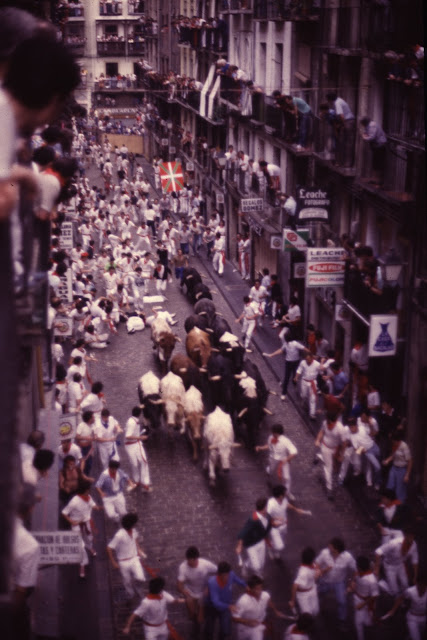
On July 8, 1970, I ran the bulls in Pamplona and became entangled in on of the most memorable montones, or pile-ups, in the history of the encierro (running of the bulls.)   

This is my story of what happened to me and my friends, including American Matador-artist John Fulton, that day.

Running the bulls on the Estafeta.
Photo by Gerry Dawes©2010.

Read the full story here

1/03/2023

James Michener's Iberia: Spanish Travels and Reflections: Photographs and Recollections from Iberia and from Gerry Dawes's Homage to Iberia

 
* * * * *
Gerry  Dawes giving a derechazo to a vaca brava at a tienta at Concha y Sierra ranch, 1971.  Photographs
of me showing my arte taurino and vino courage by Robert Vavra, photographer for James Michener's Iberia.
 
Although the passage from James Michener's Iberia below my Homage to Iberia excerpt doesn't have an autograph, it has a personal story behind. One day in 1971, I was lucky enough to be invited by Matador John Fulton to a tienta (a testing of the fighting stock) at Concha y Sierra ranch. Joining us was Iberia photographer Robert Vavra, the novillero Curro Camacho (about whom Vavra was writing and photographing a book), another bullfighter aspirant and my friend, the up-and-coming novillero Alonso Morillo, who had already had several triumphs in the La Maestranaza, Sevilla's La Scala of bullrings. 
 
Giving a derechazo to a vaca brava at a tienta at Concha y Sierra ranch, 1971.  Photograph by Robert Vavra, photographer for James Michener's Iberia.
 
The professional toreros gave passes to several of the vacas bravas as I photographed them from a burladero (the protective barrier behind which the toreros stand when the animal first comes into the ring). There was also plenty of Palma del Condado vino, a Sherry-like wine made in Huelva province. I had drunk my share to work up my courage in case they might invite me to try my hand at some passes.
 
Interior patio of our first home at Justino de Neve 3 in

the Barrio de Santa Cruz, the old Jewish quarter of Sevilla.
 
I had been living in a lovely house in the Barrio de Santa Cruz, the old Jewish quarter of Sevilla. Some nights when my pareja Diana Valenti and I came back from a night of in the tapas bars of Sevilla, in the Plaza de los Venerables, right off our street, Justino de Neve, we would encounter a very friendly big black and white hound that I called "Hombre."  Hombre was very playful, so I began pulling out my pocket handkerchief, unfurling it and giving the perro bullfighting passes. I had done this numerous times. Surprisingly, it was not much different from fighting a bull, except a bull is much, much larger and has horns that can kill you. 
 
Fulton and the others did not know that I had been practicing with the big dog plus I had the advantage of several of those glasses of 15% alcohol Condado de Palma wine, which mercifully was a fear inhibitor. So, when they asked me if I wanted to give some passes to that Concha y Sierra vaca brava, I was very pleased to get the chance. 
 
 Gerry  Dawes giving a derechazo to a vaca brava at a tienta at Concha y Sierra ranch, 1971.  Photograph by Robert Vavra, photographer for James Michener's Iberia.

John Fulton gave me his muleta and lighter wooden fake sword that is used to spread the cloth for right-handed passes. I went out into the ring for my date with destiny, a several hundred-pound cow from fighting stock, with horns. Cows, which are tested to see if they are brave enough for breeding fighting bulls, have wounded and killed numerous bullfighters. The most notable was the great Antonio Bienvenida, who was killed when a cow that had been fought and let out, came charging back into the ring, caught him behind, lifted him into the air and dropped him on his head, which broke his neck and caused his death. 

But, with my Condado de Palma-induced bravery and having seen El Cordobés, the most popular bullfighter in those days, advance towards a bull crossing the trajectory as they say, slapping his outer thigh and shouting, "Ey, ey, toro," imitating El Cordobés. I advanced slapping my left thigh.
Fulton shouted, "Don't do that, Gerry, you will call her in on you."


Giving a derechazo to a vaca brava at a tienta at Concha y Sierra ranch, 1971.  Photograph by Robert Vavra, photographer for James Michener's Iberia.


But, when I advanced the muleta (the red cloth), the vaca brava charged like she was "on rails' and was an excellent very brava specimen. She went for the cloth and not for me, for which I will forever be grateful. I got off seven passes, three of them linked, and actually heard "Ole's" from my professional torero friends and Bob Vavra, my photography mentor. Fortunately, Vavra used my cameras to capture my "faena" for posterity. --from Homage to Iberia, a work-in-progress by Gerry Dawes©2020
 
 
Giving a derechazo to a vaca brava at a tienta at Concha y Sierra ranch, 1971.  Photograph by Robert Vavra, photographer for James Michener's Iberia.

 Below:

Part of Jim Michener's description of his outing with John Fulton to visit Concha y Sierra ranch in Las Marismas in the province of Huelva. 
 
Photograph of a page about Concha y Sierra with a photo of a burladero at the ranch. Iberia, p. 213.  Photograph by Robert Vavra.
 
"I was fortunate in visiting Las Marismas for the first time in winter, for this was the rainy season and I was thus able to see the bull ranch in maximum swamp condition; it seemed to me that about seventy percent of its land was either under water or was so water-logged that if I stepped on what appeared to be a solid tussock, it collapsed beneath me with a soft squish, so that my feet were again in water. It was on such land that the Concha y Sierra bulls flourished, but it was not until the matador led me to the dry area on which the ranch buildings stood, and I saw the famous brand of an S inside a C scrawled on the side of a corral, that I was ready to believe that this was the territory of the bulls about which I had read so much. 

The Concha y Sierra bulls had a brave history, and many a noble head had gone from the bullring to the taxidermist’s and from there to the wall of some museum, with a plaque beneath to inform the visitor as to what this bull had accomplished before he died. 

On June 1, 1857, the Concha Bull Barrabás participated in what the books describe as ‘one of the most famous accidents in the history of bullfighting’ in that, with a deft horn, it caught the full Iberia 228 matador Manuel Domínguez under the chin and then in the right eye, gouging it out. It was assumed that Domínguez would die, for his face was laid open, but with a valor that had characterized his performance in the ring he survived, and three months later was fighting again as Spain’s only one-eyed matador, having stipulated that for his return the bulls must again be from Concha y Sierra. For another seventeen years he fought with only one eye and enjoyed some of his best afternoons with Concha bulls. He is known in taurine history as Desperdicios (Cast-off Scraps, from the contemptuous manner in which he tossed aside his gouged-out eyeball)." -- Iberia: Spanish Travels and Reflections, James A. Michener, page 213 in the original copy of the book.
 
______________________________________________________  

 Gastronomy Blogs

 About Gerry Dawes

Dawes was awarded Spain's prestigious Premio Nacional de Gastronomía (National Gastronomy Award) in 2003. He writes and speaks frequently on Spanish wine and gastronomy and leads gastronomy, wine and cultural tours to Spain. He was a finalist for the 2001 James Beard Foundation's Journalism Award for Best Magazine Writing on Wine, won The Cava Institute's First Prize for Journalism for his article on cava in 2004, was awarded the CineGourLand “Cinéfilos y Gourmets” (Cinephiles & Gourmets) prize in 2009 in Getxo (Vizcaya) and received the 2009 Association of Food Journalists Second Prize for Best Food Feature in a Magazine for his Food Arts article, a retrospective piece about Catalan star chef, Ferran Adrià. 

In December, 2009, Dawes was awarded the Food Arts Silver Spoon Award in a profile written by José Andrés

". . .That we were the first to introduce American readers to Ferran Adrià in 1997 and have ever since continued to bring you a blow-by-blow narrative of Spain's riveting ferment is chiefly due to our Spanish correspondent, Gerry "Mr. Spain" Dawes, the messianic wine and food journalist raised in Southern Illinois and possessor of a self-accumulated doctorate in the Spanish table. Gerry once again brings us up to the very minute. . ." - - Michael & Ariane Batterberry, Editor-in-Chief/Publisher and Founding Editor/Publisher, Food Arts, October 2009. 

Gerry Dawes was the Producer and Program Host of Gerry Dawes & Friends, a weekly radio program on WPWL 103.7 FM Pawling Public Radio in Pawling, New York.


Pilot for a reality television series on wine, gastronomy, culture and travel in Spain.
 

7/01/2022

Hemingway's Burguete & Mythical Feasts in the Mists of the Historical Pass of Roncesvalles in Navarra: Scenes from Sunset in a Glass: Adventures of a Food and Wine Road Warrior in Spain Volume I Enhanced Photography Edition by Gerry Dawes


* * * * *

Text & Photographs by Gerry Dawes©2020

   
Hostal Burguete, Burguete-Auritz (Navarra).


Roncesvalles.

My late former wife Diana Valenti Dawes and I spent many wonderful sanfermines, the annual fiestas at Pamplona with Alicia Hall, a spinster school teacher from Milledgeville, Georgia, who was a woman of great charm and character.  Some years we started before the Fiestas de San Fermín by driving up to Burguete in the Pyrenees mountains northeast of Pamplona for a few days. 


Alice "Alicia" Hall.

We stayed at the rustic Hostal Burguete, where Hemingway got the inspiration for the hotel  in The Sun Also Rises, where Jake Barnes and Bill Gorton stayed during their trout fishing expedition on the Irati River, which rushes down these green Navarrese-Basque mountains and offered great trout fishing. 


 Trout fishing in the Pyrenees of Navarra.

The hotel, with its heavy, dark wooden beams, big beds with warm covers, and plumbing from a by-gone era had changed little since Hemingway stayed there.  Diana, Alicia, and I loved to spend a couple of quiet relaxing days there - - reading, walking out on the road to Roncesvalles to pick wild strawberries to put on our ice cream, and having long discussions about Spain over dinner and plenty of Navarra’s country vino tinto.  

Floren and 1-year old Erica Dawes, Hostal Burguete, July 1977.

Floren, the prematurely middle-aged, but handsome daughter of the innkeeper, her mother, who often sat in the kitchen while Florián, on a big wood-fired, cast-iron cook stove prepared reasonably good Navarrese food (at these prices, a bargain): Stews of alubias (white beans) with chorizo, magras con tomate (pork slices in tomato sauce), pollo asado con patatas fritas (chicken with fried potatoes), trucha a la navarra (fried trout with a slice of ham tucked in its belly), and vainas (fresh green beans with boiled potatoes).   

 Kitchen, Hostal Burguete, Burguete (Navarra), July 1977.
 
 
 Pochas-alubias and Las Campanas Navarra Rosado.

After finishing a bottle or two of Navarra clarete (light young red wine) or rosado and, perhaps, a coffee, a Spanish brandy or Patxarán (sloe berry-infused anís) as we talked, we turned in early.  Diana and I would snuggle into the big wooden poster bed in a room that overlooked a green meadow behind the house, read a bit from The Sun Also Rises and other books on Spain and sleep next to one another soundly until morning.  Sometimes a rainstorm would come through at night, freshening the air and making it far cooler than the July calendar seemed to call for. 

The Sun Also Rises piano, Hostal Burguete, July 1977.  Photo by Gerry Dawes.


 Piano photo of the Hemingway "signature" from the internet.

In a side room, Floren showed us the upright piano that was supposedly the one that the Bill Gorton character played in The Sun Also Rises.  The piano was believable, but "E. Hemingway 25-7-1923" crudely scratched on the underside of the top of the piano was not so believable, especially since Hemingway, although he went to sanfermines in Pamplona in 1923, did not go to Burguete until 1924.  

 In the early 1970s, Diana Valenti Dawes during San Fermín dancing the riau-riau on the shoulders of Big Steve Lee, the "Gentle Giant," a very large friend of ours, in front of the Ayuntamiento, Pamplona.

On the morning of July 6, Alicia, Diana and I would pack up and head down the mountain roads to Pamplona, where, as Ernest Hemingway wrote about the beginning of the fiesta:  At noon of Sunday, the 6 of July, the fiesta exploded. There is no other way to describe it.”  Our tranquil days and nights in Burguete led to our surrendering to the wild, raucous days and nights of the nine-day, non-stop Fiestas de San Fermín that were to come. 

Always, during those years, about halfway through the fiesta, about the time everyone needed a break from the noise and jaleo of San Fermín, we formed a caravan of cars and headed back up into these same hills to the pass of Roncesvalles, just north of Burguete, where we had picnics that became legendary.  A couple of kilometers above the monastery of Ronscesvalles, along the road to France, I knew a splendid Brigadoon-like glade with an icy little stream that only the initiated can find. My friend John Fulton, the American Matador-and-artist, who had gone there with James Michener, who described it his Iberia:  Spanish Travels and Reflections,  and had introduced me to it during my first time at the Fiestas de San Fermín in 1970.  

 Matador John Fulton and Gerry Dawes in the plaza de toros de Pamplona 1970s.
Photo by the great Jim Hollander. 

   James Michener, Gerry Dawes and Diana Valenti Dawes at Michener's home in Austin, Texas.

In Iberia, Michener wrote about this very glade:  "I had spotted it on my pilgrimage to Santiago.  We were eight as we left Pamplona after the morning running of the bulls:  Patter (Ashcraft) and her husband; Bob Daley, long-time European sportswriter for The New York Times and his French wife, both with a sense of what makes a good picnic; Vavra ((Robert Vavra, photographer of Iberia) and Fulton; the Hemingway double (Kenneth Vanderford) and I.   We were headed north, toward the pass of Roncesvalles, that historic and mystery-laden route through the Pyrenees which Charlemagne had used in 778 for his retreat throught the mists and where he had failed to hear the battle horn of his dying Roland. . .and there in a glade so quiet, so softly green that it seemed as if defeated knights might have slept in it the evening before, we spread our blankets and prepared the meal."
    
With an odd collection of companions, each year we made the pilgrimage to this historic little valley in the pass that is haunted by the ghost of brave Roland and by the spirits of generations of pilgrims who passed this way over the centuries walking the Chemin de Saint Jacques, the great Camino de Santiago, a trek across northern Spain that from this point at Roncesvalles to the cathedral in Santiago de Compostela, where Saint James’s bones are said to reside, is over 600 miles. 


Sometime around July 10, Diana and I would round up a crazy band of picnickers that included the thin, but sassy, seventy-something Alicia Hall, the doyenne of foreign bullfight aficionados; Kenneth Vanderford, Ernest Hemingway's "double," a curmudgeonly university professor with long-billed ball cap, a white beard, and portly girth; and Lindsay Daen, an internationally known New Zealand sculptor.  The goateed Daen lived in Puerto Rico and Madrid, wore bush jackets and a strange looking glass device around his neck, drove a red Kharmann Ghia and showed up each year at the Bar Txoko in Pamplona with a new lady (or ladies), usually a young, impressionable art student.  

(Photo: Gerry Dawes at San Fermín 1971.)

Invariably Lindsay met these young women on his scouting forays into the Prado Museum in Madrid and just as invariably, when he showed up with one of them, we would slyly ask him, "Where did you meet Sally or Bev or Ronnie?"  I referred to these women as Lindsay's "recent acquisitions from the Prado."  One year, he arrived with a pretty young lady and claimed that he had met her when he saved her from a piece of cornice stone falling from a building in Madrid.
    
“Shocking that they have allowed the Prado to fall in such dis-repair!” was my comeback. 

In subsequent years, word of our band of Roncesvalles merry merienda makers got around and we were joined by an eclectic crew of adventurers and of the women of several nationalities who came to San Fermín with them each year.  Some of these regulars had been coming without fail for decades to the fiestas.  Many of them could best be described as the spiritual descendants of Ernest Hemingway’s Jake Barnes and other members of the Lost Generation.
    
Arriving at the hard to find spot on the eastern side of the steep road that climbed up to a pilgrim's sanctuary at the top of the pass, we unloaded the luncheon bounty from our cars.  The men helped Alicia down the steep, grassy slope to the green, mossy banks of the stream, where Diana, who had recruited some of the women to collect the food at the Pamplona mercado municipal that morning, laid out our splendid repast: Anchoas, salty anchovies cured in oil; roasted red pimientos; streaky pink slices of jamón;  garlicky red-orange chorizo; white Parmesan-like Roncal from the Pyrenees east of Roncesvalles and smoky Idiazábal ewes’ milk cheeses from a town south of San Sebastián; aceitunas, olives cured with rosemary, thyme and garlic; crusty, country bread; and fruits—blushing ripe peaches, big black picota cherries, and honeydew melons.  I put a dozen bottles of Las Campanas Navarra rosados (the same wines Hemingway carried in his car around Spain with him) and claretes (rosés and lighter red wines) and melons in the cold rushing little rivulet to cool, then dispatched a detail of volunteers for dry firewood to build a little fire.
    
The country food of Navarra is delicious, even more so in the mountain air, the wine flowed freelyand laughter came easily. Every now and then someone would step away from the group and stare out across the splendid green woods and watch the rivulet run down the valley.  They knew that back in the  frantic hustle of modern city life, these hours spent in the Garden  of Eden would ripen with age and retelling. 


 Birney Adams and George Semler at one of our meriendas in the magical glade of Roncesvalles, 1971.

Until some newcomers not present during the early years of these outings, decided one year by popular decree that the should move the show down out of the historical mists to an easier-to-get-to spot, thus destroying the magic, our picnic had a formula that didn't vary from the first year until the year we stopped having our picnics,   : Drink some wine, eat wonderful Navarrese food, drink some more wine, get mellow, lay down on the mossy slopes and tell jokes to a well-primed audience until the mystical fog drifts in, as it often does by mid-afternoon. The joke session began that first year, when Hemingway’s double Kenneth Vanderford, a man then in his sixties, who was sitting in a folding chair he carried in his car, began to hold court with the group sitting on the ground around him.  While stroking the arm of a attractive, flaxen-haired young model, who had worked for a Senator from California (and, with whom, I had had a mercifully short liason), Vanderford had drifted quite naturally onto the subject of sex and how, in our society, it was not easily accessible to men of his age.
    
“The only thing available to men like me,” he said, “is loneliness and masturbation.  In this society, sex seems to be forbidden to the very old and very young. ”
    
“That's not the case in all societies” the sculptor Lindsay Daen, himself obviously no stranger to the randy arts, said.  Then he told a tale of how he had once watched a five-year old girl openly masturbate on the veranda of a house in Polynesia, while he and her parents were carrying on a conversation.
    
“Her parents didn’t seem to find anything wrong with what she was doing,” Lindsay said, “and when I thought about it, I didn’t either.”
    
“Well,” I chimed in, “there’s plenty I find wrong with it.”
    
“Like what?” Daen asked.
    
“The kid could go blind, get pimples, and, if she continues masturbating, she will undoubtedly go crazy.  Look what it’s done to you and Vanderford.”
    
Any serious drift the conversation may have had disintegrated with the peals of laughter, then the jokes started.  After a few risque jokes in English got the group warmed up, a Swede had us rolling on the ground in fits by telling a particularly dirty joke in Swedish, which only the three other Swedes at the picnic, including my friend Birney Adam's wife Lotta understood.  No interpretation was necessary.  It didn’t matter, the food, the wine, the camaraderie, and the reverie of the country afternoon made these picnics the stuff of vintage nostalgia. 
 
The most incredible thing that ever happened during the five years we gathered for these picnics, was the near conversion of the Hemingway look-a-like, Kenneth Vanderford, a died-in-the-wool atheist and a friend of Madeleine Murray O’Hair, America’s most vociferous non-believer.


Kenneth Vanderford, "Hemingway's Double," at a picnic in Roncesvalles.
    
One year, early in the proceedings, a mist of metaphysical caliber had drifted into the upper tier of our little hidden valley.  Things were getting spooky and we were worried about Lindsay Daen, who had still not arrived.  We had already had some food and wine, when I coaxed Vanderford, a history professor, into telling us about the legend of Roland blowing his horn to summon his uncle Charlemagne's army as he fought for his life in this pass.  Vanderford ended his tale of the famous Chanson de Roland and remarked that, like lots of other religion-based legends, the popular accounts of the retreat of Roland and his death were mostly nonsense.  At that precise moment, several notes that sounded like a bugle call from Roland himself came from high in the woods.  Vanderford looked heavenward and seemed momentarily shaken by what he must have thought was a call to reckoning.  It was Lindsay blowing his bugle as he tried to locate us.  We never let Kenneth Vanderford live that day down. 

 Lindsay Daen blowing his bugle in Roncesvalles.
    
If it were not for the bullfights, for which most of us had tickets, we would have passed the whole afternoon here, immersed in the camaraderie we shared and in the reverie of this magical place.  Reluctantly, for the fight was to begin at six and Pamplona was at least an hour away, we packed up and wound our way back down the curvy mountain roads to the fiesta with another tale to add to the legends of the pass of Roncesvalles. 

- - The End - -


* * * * * 

 
(Available at Amazon, Despana (NYC), LaTienda.com, La Boca Restaurant (Santa Fe, NM) and at Kitchen Arts & Letters bookstore (NYC). 
 
Comments are welcome and encouraged.
 
Help Support Gerry Dawes's Spain & Its Content

If you enjoy these blog posts, please consider a contribution to help me continue the work of gathering all this great information and these photographs for Gerry Dawes's Insider's Guide to Spanish Food, Wine, Culture and Travel. Contributions of $5 and up will be greatly appreciated. Contributions of $100 or more will be acknowledged on the blog.

Please click on this secure link to Paypal to make your contribution.
 

* * * * *
  Shall deeds of Caesar or Napoleon ring
More true than Don Quixote's vapouring?
Hath winged Pegasus more nobly trod
Than Rocinante stumbling up to God?
 
Poem by Archer M. Huntington inscribed under the Don Quixote on his horse Rocinante bas-relief sculpture by his wife, Anna Vaughn Hyatt Huntington,
in the courtyard of the Hispanic Society of America’s incredible museum at 613 W. 155th Street, New York City.
 ______________________________________________________________________________________
 Gastronomy Blogs

Again ranked in the Top 50 Gastronomy Blogs and Websites for Gastronomists & Gastronomes by Feedspot. (Last Updated October, 2019) 

"The Best Gastronomy blogs selected from thousands of Food blogs, Culture blogs and Food Science blogs in our index using search and social metrics. We’ve carefully selected these websites because they are actively working to educate, inspire, and empower their readers with frequent updates and high-quality information."  

36. Gerry Dawes's Spain: An Insider's Guide to Spanish Food, Wine, Culture and Travel


About Gerry Dawes

My good friend Gerry Dawes, the unbridled Spanish food and wine enthusiast cum expert whose writing, photography, and countless crisscrossings of the peninsula have done the most to introduce Americans—and especially American food professionals—to my country's culinary life." -- Chef-restaurateur-humanitarian José Andrés, Nobel Peace Prize Nominee and Oscar Presenter 2019


Gerry Dawes is the Producer and Program Host of Gerry Dawes & Friends, a weekly radio progam on Pawling Public Radio in Pawling, New York (streaming live and archived at www.pawlingpublicradio.org and at www.beatofthevalley.com.)

Dawes was awarded Spain's prestigious Premio Nacional de Gastronomía (National Gastronomy Award) in 2003. He writes and speaks frequently on Spanish wine and gastronomy and leads gastronomy, wine and cultural tours to Spain. He was a finalist for the 2001 James Beard Foundation's Journalism Award for Best Magazine Writing on Wine, won The Cava Institute's First Prize for Journalism for his article on cava in 2004, was awarded the CineGourLand “Cinéfilos y Gourmets” (Cinephiles & Gourmets) prize in 2009 in Getxo (Vizcaya) and received the 2009 Association of Food Journalists Second Prize for Best Food Feature in a Magazine for his Food Arts article, a retrospective piece about Catalan star chef, Ferran Adrià. 


". . .That we were the first to introduce American readers to Ferran Adrià in 1997 and have ever since continued to bring you a blow-by-blow narrative of Spain's riveting ferment is chiefly due to our Spanish correspondent, Gerry "Mr. Spain" Dawes, the messianic wine and food journalist raised in Southern Illinois and possessor of a self-accumulated doctorate in the Spanish table. Gerry once again brings us up to the very minute. . ." - - Michael & Ariane Batterberry, Editor-in-Chief/Publisher and Founding Editor/Publisher, Food Arts, October 2009. 
 
Pilot for a reality television series on wine, gastronomy, culture and travel in Spain.
 
Related Posts with Thumbnails