Share This Gerry Dawes's Spain Post


Instagram

In 2026, ranked #7 in the Top 30 Gastronomy Blogs (and Websites for Gastronomists & Gastronomes by Feedspot. (Ranked in the top 50 since 2019). "The Best Gastronomy blogs selected from thousands of Food blogs, Culture blogs and Food Science. We’ve carefully selected these websites because they are actively working to educate, inspire, and empower their readers with . . . high-quality information.

More than 3,640,000 views since inception, 123,000+ views in August 2026.


Ranked #7. Gerry Dawes's Spain: An Insider's Guide to Spanish Food, Wine, Culture and Travel gerrydawesspain.com

"My good friend Gerry Dawes, the unbridled Spanish food and wine enthusiast cum expert whose writing, photography, and countless crisscrossings of the peninsula have done the most to introduce Americans—and especially American food professionals—to my country's culinary life. . .” - - Chef-restaurateur-humanitarian José Andrés, Nobel Peace Prize Nominee and Oscar Presenter 2019; Chef-partner of Mercado Little Spain at Hudson Yards, New York 2019

Showing posts with label Alice Hall. Show all posts

7/07/2026

Profiles of Pamplona: The Spiritual Descendants of Gertrude Stein's Lost Generation and of Ernest Hemingway's Characters in The Sun Also Rises. Scan of my article in Madrid's venerable English language magazine, Guidepost, July 11, 1975


* * * * *
 Profiles of Pamplona, an article with my photographs that I published 
in Madrid's venerable Guidepost magazine in Madrid back in 1975. 

The profiles in this article are about many of the incredible characters I knew in Pamplona at La Fiesta de San Fermín (featuring the Running of the Bulls), also known as sanfermines, in the 1970s.   Some of these regulars at the fiesta had been coming to Pamplona since the 1950s.

Many of these people were spiritual descendents of Gertrude Stein's Lost Generation and of Ernest Hemingway's spirit and his characters in The Sun Also Rises.  In fact, Juanito Quintana was the prototype for Montoya, the hotel owner in The Sun Also Rises, and bullrunner Matt Carney, American Matador John Fulton and others had actually been at San Fermín when Hemingway was there in the 1950s and had experiences with him.

Many of the unforgettable people in this article are no longer alive; many of them became friends, some of them very close friends for life -- and beyond.   

Here is the full original scanned article.


* * * * *
  Shall deeds of Caesar or Napoleon ring
More true than Don Quixote's vapouring?
Hath winged Pegasus more nobly trod
Than Rocinante stumbling up to God?
 
Poem by Archer M. Huntington inscribed under the Don Quixote on his horse Rocinante bas-relief sculpture by his wife, Anna Vaughn Hyatt Huntington,
in the courtyard of the Hispanic Society of America’s incredible museum at 613 W. 155th Street, New York City.
__________________________________________________________________________________

 Gastronomy Blogs

About Gerry Dawes

My good friend Gerry Dawes, the unbridled Spanish food and wine enthusiast cum expert whose writing, photography, and countless crisscrossings of the peninsula have done the most to introduce Americans—and especially American food professionals—to my country's culinary life." -- Chef-restaurateur-humanitarian José Andrés, Nobel Peace Prize Nominee and Oscar Presenter 2019


Dawes was awarded Spain's prestigious Premio Nacional de Gastronomía (National Gastronomy Award) in 2003. He writes and speaks frequently on Spanish wine and gastronomy and leads gastronomy, wine and cultural tours to Spain. He was a finalist for the 2001 James Beard Foundation's Journalism Award for Best Magazine Writing on Wine, won The Cava Institute's First Prize for Journalism for his article on cava in 2004, was awarded the CineGourLand “Cinéfilos y Gourmets” (Cinephiles & Gourmets) prize in 2009 in Getxo (Vizcaya) and received the 2009 Association of Food Journalists Second Prize for Best Food Feature in a Magazine for his Food Arts article, a retrospective piece about Catalan star chef, Ferran Adrià. 


". . .That we were the first to introduce American readers to Ferran Adrià in 1997 and have ever since continued to bring you a blow-by-blow narrative of Spain's riveting ferment is chiefly due to our Spanish correspondent, Gerry "Mr. Spain" Dawes, the messianic wine and food journalist raised in Southern Illinois and possessor of a self-accumulated doctorate in the Spanish table. Gerry once again brings us up to the very minute. . ." - - Michael & Ariane Batterberry, Editor-in-Chief/Publisher and Founding Editor/Publisher, Food Arts, October 2009. 

Writing, Photography, & Specialized Tours of Spain & Tour Advice

For custom-designed tours of Spain, organized and lead by Gerry Dawes, and custom-planned Spanish wine, food, cultural and photographic itineraries, send inquiries to gerrydawes@aol.com.  

I have planned and led tours for such culinary stars as Chefs Thomas Keller, Mark Miller, Mark Kiffin, Michael Lomonaco and Michael Chiarello and such personalities as baseball great Keith Hernandez and led on shorter excursions and have given detailed travel advice to many other well-known chefs and personalities such as Drew Nieporent, Norman Van Aken, Karen Page and Andrew Dornenberg, Christopher Gross, Rick Moonen, James Campbell Caruso and many others.
 * * * * *
“The American writer and town crier for all good Spanish things Gerry Dawes . . . the American connoisseur of all things Spanish . . .” Michael Paterniti, The Telling Room: A Tale of Love, Betrayal, Revenge and The World’s Greatest Piece of Cheese

* * * * *

"Gerry Dawes, I can't thank you enough for opening up Spain to me." -- Michael Chiarello on Twitter. 

"Chiarello embarked on a crash course by traveling to Spain for 10 days in 2011 with Food Arts
contributing authority Gerry Dawes, a noted expert on Spanish food and wine.  Coqueta's (Chiarello's new restaurant at Pier Five, San Francisco) chef de cuisine, Ryan McIlwraith, later joined Dawes for his own two week excursion, as well. Sampling both old and new, they visited wineries and marketplaces, as well as some of Spain's most revered dining establishments, including the Michelin three-star Arzak, Etxebarri, the temple to live fire-grilling; Tickets, the playful Barcelona tapas bar run by Ferran Adrià and his brother, Albert; and ABaC, where Catalan cooking goes avant-garde." - - Carolyn Jung, Food Arts, May 2013.


* * * * *

"In his nearly thirty years of wandering the back roads of Spain," Gerry Dawes has built up a much stronger bank of experiences than I had to rely on when I started writing Iberia...His adventures far exceeded mine in both width and depth..." -- James A. Michener, author of Iberia: Spanish Travels and Reflections
 
Pilot for a reality television series on wine, gastronomy, culture and travel in Spain.
 

7/01/2022

Hemingway's Burguete & Mythical Feasts in the Mists of the Historical Pass of Roncesvalles in Navarra: Scenes from Sunset in a Glass: Adventures of a Food and Wine Road Warrior in Spain Volume I Enhanced Photography Edition by Gerry Dawes


* * * * *

Text & Photographs by Gerry Dawes©2020

   
Hostal Burguete, Burguete-Auritz (Navarra).


Roncesvalles.

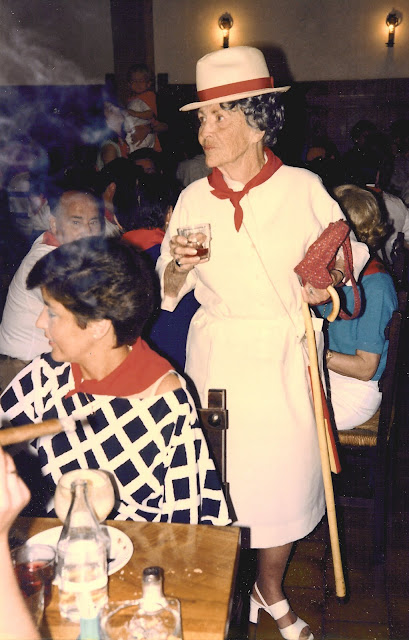
My late former wife Diana Valenti Dawes and I spent many wonderful sanfermines, the annual fiestas at Pamplona with Alicia Hall, a spinster school teacher from Milledgeville, Georgia, who was a woman of great charm and character.  Some years we started before the Fiestas de San Fermín by driving up to Burguete in the Pyrenees mountains northeast of Pamplona for a few days. 


Alice "Alicia" Hall.

We stayed at the rustic Hostal Burguete, where Hemingway got the inspiration for the hotel  in The Sun Also Rises, where Jake Barnes and Bill Gorton stayed during their trout fishing expedition on the Irati River, which rushes down these green Navarrese-Basque mountains and offered great trout fishing. 


 Trout fishing in the Pyrenees of Navarra.

The hotel, with its heavy, dark wooden beams, big beds with warm covers, and plumbing from a by-gone era had changed little since Hemingway stayed there.  Diana, Alicia, and I loved to spend a couple of quiet relaxing days there - - reading, walking out on the road to Roncesvalles to pick wild strawberries to put on our ice cream, and having long discussions about Spain over dinner and plenty of Navarra’s country vino tinto.  

Floren and 1-year old Erica Dawes, Hostal Burguete, July 1977.

Floren, the prematurely middle-aged, but handsome daughter of the innkeeper, her mother, who often sat in the kitchen while Florián, on a big wood-fired, cast-iron cook stove prepared reasonably good Navarrese food (at these prices, a bargain): Stews of alubias (white beans) with chorizo, magras con tomate (pork slices in tomato sauce), pollo asado con patatas fritas (chicken with fried potatoes), trucha a la navarra (fried trout with a slice of ham tucked in its belly), and vainas (fresh green beans with boiled potatoes).   

 Kitchen, Hostal Burguete, Burguete (Navarra), July 1977.
 
 
 Pochas-alubias and Las Campanas Navarra Rosado.

After finishing a bottle or two of Navarra clarete (light young red wine) or rosado and, perhaps, a coffee, a Spanish brandy or Patxarán (sloe berry-infused anís) as we talked, we turned in early.  Diana and I would snuggle into the big wooden poster bed in a room that overlooked a green meadow behind the house, read a bit from The Sun Also Rises and other books on Spain and sleep next to one another soundly until morning.  Sometimes a rainstorm would come through at night, freshening the air and making it far cooler than the July calendar seemed to call for. 

The Sun Also Rises piano, Hostal Burguete, July 1977.  Photo by Gerry Dawes.


 Piano photo of the Hemingway "signature" from the internet.

In a side room, Floren showed us the upright piano that was supposedly the one that the Bill Gorton character played in The Sun Also Rises.  The piano was believable, but "E. Hemingway 25-7-1923" crudely scratched on the underside of the top of the piano was not so believable, especially since Hemingway, although he went to sanfermines in Pamplona in 1923, did not go to Burguete until 1924.  

 In the early 1970s, Diana Valenti Dawes during San Fermín dancing the riau-riau on the shoulders of Big Steve Lee, the "Gentle Giant," a very large friend of ours, in front of the Ayuntamiento, Pamplona.

On the morning of July 6, Alicia, Diana and I would pack up and head down the mountain roads to Pamplona, where, as Ernest Hemingway wrote about the beginning of the fiesta:  “At noon of Sunday, the 6 of July, the fiesta exploded. There is no other way to describe it.”  Our tranquil days and nights in Burguete led to our surrendering to the wild, raucous days and nights of the nine-day, non-stop Fiestas de San Fermín that were to come. 

Always, during those years, about halfway through the fiesta, about the time everyone needed a break from the noise and jaleo of San Fermín, we formed a caravan of cars and headed back up into these same hills to the pass of Roncesvalles, just north of Burguete, where we had picnics that became legendary.  A couple of kilometers above the monastery of Ronscesvalles, along the road to France, I knew a splendid Brigadoon-like glade with an icy little stream that only the initiated can find. My friend John Fulton, the American Matador-and-artist, who had gone there with James Michener, who described it his Iberia:  Spanish Travels and Reflections,  and had introduced me to it during my first time at the Fiestas de San Fermín in 1970.  

 Matador John Fulton and Gerry Dawes in the plaza de toros de Pamplona 1970s.
Photo by the great Jim Hollander. 

   James Michener, Gerry Dawes and Diana Valenti Dawes at Michener's home in Austin, Texas.

In Iberia, Michener wrote about this very glade:  "I had spotted it on my pilgrimage to Santiago.  We were eight as we left Pamplona after the morning running of the bulls:  Patter (Ashcraft) and her husband; Bob Daley, long-time European sportswriter for The New York Times and his French wife, both with a sense of what makes a good picnic; Vavra ((Robert Vavra, photographer of Iberia) and Fulton; the Hemingway double (Kenneth Vanderford) and I.   We were headed north, toward the pass of Roncesvalles, that historic and mystery-laden route through the Pyrenees which Charlemagne had used in 778 for his retreat throught the mists and where he had failed to hear the battle horn of his dying Roland. . .and there in a glade so quiet, so softly green that it seemed as if defeated knights might have slept in it the evening before, we spread our blankets and prepared the meal."
    
With an odd collection of companions, each year we made the pilgrimage to this historic little valley in the pass that is haunted by the ghost of brave Roland and by the spirits of generations of pilgrims who passed this way over the centuries walking the Chemin de Saint Jacques, the great Camino de Santiago, a trek across northern Spain that from this point at Roncesvalles to the cathedral in Santiago de Compostela, where Saint James’s bones are said to reside, is over 600 miles. 


Sometime around July 10, Diana and I would round up a crazy band of picnickers that included the thin, but sassy, seventy-something Alicia Hall, the doyenne of foreign bullfight aficionados; Kenneth Vanderford, Ernest Hemingway's "double," a curmudgeonly university professor with long-billed ball cap, a white beard, and portly girth; and Lindsay Daen, an internationally known New Zealand sculptor.  The goateed Daen lived in Puerto Rico and Madrid, wore bush jackets and a strange looking glass device around his neck, drove a red Kharmann Ghia and showed up each year at the Bar Txoko in Pamplona with a new lady (or ladies), usually a young, impressionable art student.  

(Photo: Gerry Dawes at San Fermín 1971.)

Invariably Lindsay met these young women on his scouting forays into the Prado Museum in Madrid and just as invariably, when he showed up with one of them, we would slyly ask him, "Where did you meet Sally or Bev or Ronnie?"  I referred to these women as Lindsay's "recent acquisitions from the Prado."  One year, he arrived with a pretty young lady and claimed that he had met her when he saved her from a piece of cornice stone falling from a building in Madrid.
    
“Shocking that they have allowed the Prado to fall in such dis-repair!” was my comeback. 

In subsequent years, word of our band of Roncesvalles merry merienda makers got around and we were joined by an eclectic crew of adventurers and of the women of several nationalities who came to San Fermín with them each year.  Some of these regulars had been coming without fail for decades to the fiestas.  Many of them could best be described as the spiritual descendants of Ernest Hemingway’s Jake Barnes and other members of the Lost Generation.
    
Arriving at the hard to find spot on the eastern side of the steep road that climbed up to a pilgrim's sanctuary at the top of the pass, we unloaded the luncheon bounty from our cars.  The men helped Alicia down the steep, grassy slope to the green, mossy banks of the stream, where Diana, who had recruited some of the women to collect the food at the Pamplona mercado municipal that morning, laid out our splendid repast: Anchoas, salty anchovies cured in oil; roasted red pimientos; streaky pink slices of jamón;  garlicky red-orange chorizo; white Parmesan-like Roncal from the Pyrenees east of Roncesvalles and smoky Idiazábal ewes’ milk cheeses from a town south of San Sebastián; aceitunas, olives cured with rosemary, thyme and garlic; crusty, country bread; and fruits—blushing ripe peaches, big black picota cherries, and honeydew melons.  I put a dozen bottles of Las Campanas Navarra rosados (the same wines Hemingway carried in his car around Spain with him) and claretes (rosés and lighter red wines) and melons in the cold rushing little rivulet to cool, then dispatched a detail of volunteers for dry firewood to build a little fire.
    
The country food of Navarra is delicious, even more so in the mountain air, the wine flowed freelyand laughter came easily. Every now and then someone would step away from the group and stare out across the splendid green woods and watch the rivulet run down the valley.  They knew that back in the  frantic hustle of modern city life, these hours spent in the Garden  of Eden would ripen with age and retelling. 


 Birney Adams and George Semler at one of our meriendas in the magical glade of Roncesvalles, 1971.

Until some newcomers not present during the early years of these outings, decided one year by popular decree that the should move the show down out of the historical mists to an easier-to-get-to spot, thus destroying the magic, our picnic had a formula that didn't vary from the first year until the year we stopped having our picnics,   : Drink some wine, eat wonderful Navarrese food, drink some more wine, get mellow, lay down on the mossy slopes and tell jokes to a well-primed audience until the mystical fog drifts in, as it often does by mid-afternoon. The joke session began that first year, when Hemingway’s double Kenneth Vanderford, a man then in his sixties, who was sitting in a folding chair he carried in his car, began to hold court with the group sitting on the ground around him.  While stroking the arm of a attractive, flaxen-haired young model, who had worked for a Senator from California (and, with whom, I had had a mercifully short liason), Vanderford had drifted quite naturally onto the subject of sex and how, in our society, it was not easily accessible to men of his age.
    
“The only thing available to men like me,” he said, “is loneliness and masturbation.  In this society, sex seems to be forbidden to the very old and very young. ”
    
“That's not the case in all societies” the sculptor Lindsay Daen, himself obviously no stranger to the randy arts, said.  Then he told a tale of how he had once watched a five-year old girl openly masturbate on the veranda of a house in Polynesia, while he and her parents were carrying on a conversation.
    
“Her parents didn’t seem to find anything wrong with what she was doing,” Lindsay said, “and when I thought about it, I didn’t either.”
    
“Well,” I chimed in, “there’s plenty I find wrong with it.”
    
“Like what?” Daen asked.
    
“The kid could go blind, get pimples, and, if she continues masturbating, she will undoubtedly go crazy.  Look what it’s done to you and Vanderford.”
    
Any serious drift the conversation may have had disintegrated with the peals of laughter, then the jokes started.  After a few risque jokes in English got the group warmed up, a Swede had us rolling on the ground in fits by telling a particularly dirty joke in Swedish, which only the three other Swedes at the picnic, including my friend Birney Adam's wife Lotta understood.  No interpretation was necessary.  It didn’t matter, the food, the wine, the camaraderie, and the reverie of the country afternoon made these picnics the stuff of vintage nostalgia. 
 
The most incredible thing that ever happened during the five years we gathered for these picnics, was the near conversion of the Hemingway look-a-like, Kenneth Vanderford, a died-in-the-wool atheist and a friend of Madeleine Murray O’Hair, America’s most vociferous non-believer.


Kenneth Vanderford, "Hemingway's Double," at a picnic in Roncesvalles.
    
One year, early in the proceedings, a mist of metaphysical caliber had drifted into the upper tier of our little hidden valley.  Things were getting spooky and we were worried about Lindsay Daen, who had still not arrived.  We had already had some food and wine, when I coaxed Vanderford, a history professor, into telling us about the legend of Roland blowing his horn to summon his uncle Charlemagne's army as he fought for his life in this pass.  Vanderford ended his tale of the famous Chanson de Roland and remarked that, like lots of other religion-based legends, the popular accounts of the retreat of Roland and his death were mostly nonsense.  At that precise moment, several notes that sounded like a bugle call from Roland himself came from high in the woods.  Vanderford looked heavenward and seemed momentarily shaken by what he must have thought was a call to reckoning.  It was Lindsay blowing his bugle as he tried to locate us.  We never let Kenneth Vanderford live that day down. 

 Lindsay Daen blowing his bugle in Roncesvalles.
    
If it were not for the bullfights, for which most of us had tickets, we would have passed the whole afternoon here, immersed in the camaraderie we shared and in the reverie of this magical place.  Reluctantly, for the fight was to begin at six and Pamplona was at least an hour away, we packed up and wound our way back down the curvy mountain roads to the fiesta with another tale to add to the legends of the pass of Roncesvalles. 

- - The End - -


* * * * * 

 
(Available at Amazon, Despana (NYC), LaTienda.com, La Boca Restaurant (Santa Fe, NM) and at Kitchen Arts & Letters bookstore (NYC). 
 
Comments are welcome and encouraged.
 
Help Support Gerry Dawes's Spain & Its Content

If you enjoy these blog posts, please consider a contribution to help me continue the work of gathering all this great information and these photographs for Gerry Dawes's Insider's Guide to Spanish Food, Wine, Culture and Travel. Contributions of $5 and up will be greatly appreciated. Contributions of $100 or more will be acknowledged on the blog.

Please click on this secure link to Paypal to make your contribution.
 

* * * * *
  Shall deeds of Caesar or Napoleon ring
More true than Don Quixote's vapouring?
Hath winged Pegasus more nobly trod
Than Rocinante stumbling up to God?
 
Poem by Archer M. Huntington inscribed under the Don Quixote on his horse Rocinante bas-relief sculpture by his wife, Anna Vaughn Hyatt Huntington,
in the courtyard of the Hispanic Society of America’s incredible museum at 613 W. 155th Street, New York City.
 ______________________________________________________________________________________
 Gastronomy Blogs

Again ranked in the Top 50 Gastronomy Blogs and Websites for Gastronomists & Gastronomes by Feedspot. (Last Updated October, 2019) 

"The Best Gastronomy blogs selected from thousands of Food blogs, Culture blogs and Food Science blogs in our index using search and social metrics. We’ve carefully selected these websites because they are actively working to educate, inspire, and empower their readers with frequent updates and high-quality information."  

36. Gerry Dawes's Spain: An Insider's Guide to Spanish Food, Wine, Culture and Travel


About Gerry Dawes

My good friend Gerry Dawes, the unbridled Spanish food and wine enthusiast cum expert whose writing, photography, and countless crisscrossings of the peninsula have done the most to introduce Americans—and especially American food professionals—to my country's culinary life." -- Chef-restaurateur-humanitarian José Andrés, Nobel Peace Prize Nominee and Oscar Presenter 2019


Gerry Dawes is the Producer and Program Host of Gerry Dawes & Friends, a weekly radio progam on Pawling Public Radio in Pawling, New York (streaming live and archived at www.pawlingpublicradio.org and at www.beatofthevalley.com.)

Dawes was awarded Spain's prestigious Premio Nacional de Gastronomía (National Gastronomy Award) in 2003. He writes and speaks frequently on Spanish wine and gastronomy and leads gastronomy, wine and cultural tours to Spain. He was a finalist for the 2001 James Beard Foundation's Journalism Award for Best Magazine Writing on Wine, won The Cava Institute's First Prize for Journalism for his article on cava in 2004, was awarded the CineGourLand “Cinéfilos y Gourmets” (Cinephiles & Gourmets) prize in 2009 in Getxo (Vizcaya) and received the 2009 Association of Food Journalists Second Prize for Best Food Feature in a Magazine for his Food Arts article, a retrospective piece about Catalan star chef, Ferran Adrià. 


". . .That we were the first to introduce American readers to Ferran Adrià in 1997 and have ever since continued to bring you a blow-by-blow narrative of Spain's riveting ferment is chiefly due to our Spanish correspondent, Gerry "Mr. Spain" Dawes, the messianic wine and food journalist raised in Southern Illinois and possessor of a self-accumulated doctorate in the Spanish table. Gerry once again brings us up to the very minute. . ." - - Michael & Ariane Batterberry, Editor-in-Chief/Publisher and Founding Editor/Publisher, Food Arts, October 2009. 
 
Pilot for a reality television series on wine, gastronomy, culture and travel in Spain.
 

1/09/2021

James Michener's Iberia: Spanish Travels and Reflections: More Autographs, Stories & Photos Behind the Signatures in My Copy. The late Queen of American Aficionadas Alice Hall and Her Hero Matador Diego Puerta, Pg. 659

 
 * * * * *

 Alice Hall, Bar Txoko, Pamplona, 1972.  Photograph by Photograph by Gerry Dawes©2021.
 
"After my manuscript was completed, I had the privilege of meeting in person that queen of American bullfight aficionados, Alice Hall of Georgia. Her preferences were so violent and so
persuasive that I modified certain opinions I had previously expressed in the taurine material."--Acknowledgements, Iberia: Spanish Travels and Reflections, James A Michener.
 
 
Signatures of American Aficionada Alice Hall (top) and Matador Diego Puerta (side).
 
Alice Hall with a picador in the Plaza de Toros de Pamplona with her Diego Puerta banner that she always carried.  Photograph by Gerry Dawes
©2021.
  
"It is (Kenneth) Vanderford’s opinion that ‘the best-informed and most dedicated foreign bullfight expert of either sex is Alice Hall.’ This tall, slim gray-haired spinster was, until her recent retirement, a teacher of Spanish in a fancy private school in Atlanta, Georgia.  She came originally to Spain for the laudable purpose of improving her pronunciation, little aware of what was in store.  Like any dutiful tourist she went routinely to a bullfight, had the good fortune of seeing César Girón on one of his great days, and promptly surrendered. Year after year she returned during her vacations and applied to bullfighting the tenacious scholarship which had made her a fine teacher. A friend says, ‘Alice feels intuitively what the bull and the man are going to do next…what they must do…and she is in the ring with them when they do it.’‘Each autumn when I go back to Atlanta and face my first class of girls,’ she says quietly, ‘I feel as if I have been sentenced to exile, that I am in a strange land surrounded by strangers. My heart was left behind in Andalucía.’"--Iberia: Spanish Travels and Reflections, James A Michener, p. 659.


Alicia Hall at Asador Olaverri, Sanfermines, early 1970s.
Photograph by Gerry Dawes©2021.
 
"My late ex-wife Diana Valenti Dawes and I  spent many wonderful sanfermines with Alicia Hall from 1970 through 1975 and in 1977 and 1978. Some years we began in Burguete before fiesta, staying at Hostal Burguete, which was Ernest Hemingway's inspiration for Jake Barnes' hotel during his trout fishing expeditions in The Sun Also Rises.  We would drive Alicia up there and spend a quiet relaxing time - - reading, walking out on the road to Roncesvalles to pick tiny wild strawberries to put on our ice cream after dinner at the Hostal Burguete and having long discussions about Spain over dinner with plenty of vino tinto. . .
 
. . .  One time we were on our way with Alicia to Pamplona (via Rioja and Burguete).  To avoid the maniacs driving southbound Hellbent for the North African-bound ferries in far off Algeciras on NR1, which was then just a two-lane highway, which with homeward bound cars passing in the face of oncoming traffic, causing us to often head for the highway shoulder (or a ditch).  After a few of these close calls, I opted for a back country road in the direction of Burgo de Osma in Soria in northern Castile.  After a few kilometers, Alicia spotted a bar at the entrance to a village. "Stop the car!" she said, "Let's go in there and have some fun." We went in, ordered some vino tinto and had some fun.  
 
Alicia used to have a Pobre de Mí party at Maitena overlooking the Plaza del Castillo on the last night of San Fermín. From there, after dinner, we could watch the fiesta began to wind down with the soulful lament of "Pobre de mí" followed by the joyous, self-renewing "Siete de julio, San Fermín!" One memorable year, over a dozen of us gathered around Alicia for dinner and, as I usually did, I sat next to her.  

But, to set the stage, two things must be kept in mind: 1) When I first met Alicia she did not use blue language, so I claim to have taught her how to cuss and 2) Ever since the Pablo Romero tienta during one memorable Feria de Sevilla, I had been encouraging Alicia to marry some aging bull breeder and do him in with sexual excess, so she could inherit the ranch and invite us to secret tientas. These two items were a running joke between us.

After dinner and plenty of tinto and clarete, Alicia asked me to fetch her some tobaco negro (a black tobacco cigarette), so I bummed a Ducado from Mike Kelly and gave it to her. Alicia was trying to act like a seasoned smoker, so she tried to tamp the cigarette on the table and she broke it.  I had to get her another cigarette, show her how to tamp it, and light it for her. 

"Damn, Alicia," I said, "first I had to teach you how to cuss, now I'm having to teach you how to smoke, and I guess if you marry that bull breeder, I'm going to have to teach you how to do that too."

Holding her cigarette elegantly between her fingers, this retired teacher (from a fashionable young women's school in Atlanta), looked at me with a gleam in her eye and, with total aplomb she said, "Fuck you!"

That same night, we watched from the balcony as the mad chef of Maitena went down to the Plaza and began directing traffic with a meat cleaver in one hand and an enormous raw chuletón steak in the other.

Later, we all drifted down to the Bar Txoko and I encouraged a Navarrese girl with a beautiful voice to sing a jota.  
Looking at Alicia, the young woman sang a wonderful moving jota that had the line, “Madre mia, madre de Navarra."   I looked at Tía Alicia and we both had tears running down our cheeks. It was one of the most magical moments I have ever known in 50 years of running the roads and fiestas of mystical Spain.  But when Alicia was around, magic was never that far away."--Homage to Iberia (a work in progress), Gerry Dawes©2021.
 
 
In 1985, Alicia took her namesake, my daughter, Erica Catherine Alicia, to her first and only bullfight. Photograph by Gerry Dawes©2021.
 
_____________________________________________________________________________________________  

 Gastronomy Blogs
 About Gerry Dawes

Gerry Dawes is the Producer and Program Host of Gerry Dawes & Friends, a weekly radio progam on WPWL 103.7 FM Pawling Public Radio in Pawling, New York.

  Dawes was awarded Spain's prestigious Premio Nacional de Gastronomía (National Gastronomy Award) in 2003. He writes and speaks frequently on Spanish wine and gastronomy and leads gastronomy, wine and cultural tours to Spain. He was a finalist for the 2001 James Beard Foundation's Journalism Award for Best Magazine Writing on Wine, won The Cava Institute's First Prize for Journalism for his article on cava in 2004, was awarded the CineGourLand “Cinéfilos y Gourmets” (Cinephiles & Gourmets) prize in 2009 in Getxo (Vizcaya) and received the 2009 Association of Food Journalists Second Prize for Best Food Feature in a Magazine for his Food Arts article, a retrospective piece about Catalan star chef, Ferran Adrià. 

In December, 2009, Dawes was awarded the Food Arts Silver Spoon Award in a profile written by José Andrés. 

". . .That we were the first to introduce American readers to Ferran Adrià in 1997 and have ever since continued to bring you a blow-by-blow narrative of Spain's riveting ferment is chiefly due to our Spanish correspondent, Gerry "Mr. Spain" Dawes, the messianic wine and food journalist raised in Southern Illinois and possessor of a self-accumulated doctorate in the Spanish table. Gerry once again brings us up to the very minute. . ." - - Michael & Ariane Batterberry, Editor-in-Chief/Publisher and Founding Editor/Publisher, Food Arts, October 2009. 
 
Pilot for a reality television series on wine, gastronomy, culture and travel in Spain.
 

11/30/2020

James Michener's Iberia: Spanish Travels and Reflections: More Autographs & Stories Behind the Signatures. Juanito Quintana and Kenneth Vanderford, Picnics in Roncesvalles

 
* * * * *
Professor Kenneth Vanderford (center, autograph on page 495), Juanito Quintana (Montoya, the hotel owner, in The Sun Also Rises, autograph on photograph) and Conde de la Corte, a famous bull breeder, Plaza de Toros, Pamplona.  Iberia photograph by Robert Vavra.  Quintana signed "Para mi gran amigo Gerry Dawes con un fuerte abrazo, Juanito."

Juanito Quintana (Montoya, the hotel owner, in The Sun Also Rises, Bar Txoko, Plaza del Castillo, Pamplona, sanfermines, July 7, 1970.  Photograph by Gerry Dawes©2020.
 
 
Juanito Quintana (Montoya, the hotel owner, in The Sun Also Rises), and Matador John Fulton, Plaza de Toros, Pamplona, sanfermines, July 7, 1970.  Photograph by Gerry Dawes©2020.
 
 
 John Fulton & Juanito Quitana strolling and chatting in the Plaza del Castillo, Pamplona, 1970s.
Photograph by Gerry Dawes©2020.


Kenneth Vanderford, "Hemingway's Double," at a picnic in Roncesvalles, early 1970s.
 Photograph by Gerry Dawes©2020. 
 
Excerpt below from Homage to Iberia (a work-in-progress), the authorized sequel to James Michener's Iberia and for which Michener wrote the foreword before his passing.
 
Hemingway's Burguete & Mythical Feasts in the Mists of the Historical Pass of Roncesvalles in Navarra 
 
"Always, during those years, about halfway through the fiesta, about the time everyone needed a break from the noise and jaleo of San Fermín, we formed a caravan of cars and headed back up into these same hills to the pass of Roncesvalles, just north of Burguete, where we had picnics that became legendary.  A couple of kilometers above the monastery of Ronscesvalles, along the road to France, I knew a splendid Brigadoon-like glade with an icy little stream that only the initiated can find. My friend John Fulton, the American Matador-and-artist, who had gone there with James Michener, who described it his Iberia:  Spanish Travels and Reflections,  and had introduced me to it during my first time at the Fiestas de San Fermín in 1970. 
 
 Matador John Fulton, who was prominently featured in several chapters in James Michener's Iberia, and Gerry Dawes in the Plaza de Toros de Pamplona, early 1970s.  Photo by the great Jim Hollander.  
 
In Iberia, Michener wrote about this very glade:  "I had spotted it on my pilgrimage to Santiago.  We were eight as we left Pamplona after the morning running of the bulls:  Patter (Ashcraft) and her husband; Bob Daley, long-time European sportswriter for The New York Times and his French wife, both with a sense of what makes a good picnic; Vavra ((Robert Vavra, photographer of Iberia) and Fulton; the Hemingway double (Kenneth Vanderford) and I.   We were headed north, toward the pass of Roncesvalles, that historic and mystery-laden route through the Pyrenees which Charlemagne had used in 778 for his retreat throught the mists and where he had failed to hear the battle horn of his dying Roland. . .and there in a glade so quiet, so softly green that it seemed as if defeated knights might have slept in it the evening before, we spread our blankets and prepared the meal."
    
With an odd collection of companions, each year we made the pilgrimage to this historic little valley in the pass that is haunted by the ghost of brave Roland and by the spirits of generations of pilgrims who passed this way over the centuries walking the Chemin de Saint Jacques, the great Camino de Santiago, a trek across northern Spain that from this point at Roncesvalles to the cathedral in Santiago de Compostela, where Saint James’s bones are said to reside, is over 600 miles. 


Sometime around July 10, Diana and I would round up a crazy band of picnickers that included the thin, but sassy, seventy-something Alicia Hall, the doyenne of foreign bullfight aficionados; Kenneth Vanderford, Ernest Hemingway's "double," a curmudgeonly university professor with long-billed ball cap, a white beard, and portly girth; and Lindsay Daen, an internationally known New Zealand sculptor.  The goateed Daen lived in Puerto Rico and Madrid, wore bush jackets and a strange looking glass device around his neck, drove a red Kharmann Ghia and showed up each year at the Bar Txoko in Pamplona with a new lady (or ladies), usually a young, impressionable art student.  

Invariably Lindsay met these young women on his scouting forays into the Prado Museum in Madrid and just as invariably, when he showed up with one of them, we would slyly ask him, "Where did you meet Sally or Bev or Ronnie?"  I referred to these women as Lindsay's "recent acquisitions from the Prado."  One year, he arrived with a pretty young lady and claimed that he had met her when he saved her from a piece of cornice stone falling from a building in Madrid.
    
“Shocking that they have allowed the Prado to fall in such dis-repair!” was my comeback. 
(Photo: Gerry Dawes at San Fermín 1971.)
 
In subsequent years, word of our band of Roncesvalles merry merienda makers got around and we were joined by an eclectic crew of adventurers and of the women of several nationalities who came to San Fermín with them each year.  Some of these regulars had been coming without fail for decades to the fiestas.  Many of them could best be described as the spiritual descendants of Ernest Hemingway’s Jake Barnes and other members of the Lost Generation.
    
Arriving at the hard to find spot on the eastern side of the steep road that climbed up to a pilgrim's sanctuary at the top of the pass, we unloaded the luncheon bounty from our cars.  The men helped Alicia down the steep, grassy slope to the green, mossy banks of the stream, where Diana, who had recruited some of the women to collect the food at the Pamplona mercado municipal that morning, laid out our splendid repast: Anchoas, salty anchovies cured in oil; roasted red pimientos; streaky pink slices of jamón;  garlicky red-orange chorizo; white Parmesan-like Roncal from the Pyrenees east of Roncesvalles and smoky Idiazábal ewes’ milk cheeses from a town south of San Sebastián; aceitunas, olives cured with rosemary, thyme and garlic; crusty, country bread; and fruits—blushing ripe peaches, big black picota cherries, and honeydew melons.  I put a dozen bottles of Las Campanas Navarra rosados (the same wines Hemingway carried in his car around Spain with him) and claretes (rosés and lighter red wines) and melons in the cold rushing little rivulet to cool, then dispatched a detail of volunteers for dry firewood to build a little fire.
    
The country food of Navarra is delicious, even more so in the mountain air, the wine flowed freelyand laughter came easily. Every now and then someone would step away from the group and stare out across the splendid green woods and watch the rivulet run down the valley.  They knew that back in the  frantic hustle of modern city life, these hours spent in the Garden  of Eden would ripen with age and retelling. 

  
 Birney Adams and George Semler at one of our meriendas in the magical glade of Roncesvalles, 1971.

Until some newcomers not present during the early years of these outings, decided one year by popular decree that the should move the show down out of the historical mists to an easier-to-get-to spot, thus destroying the magic, our picnic had a formula that didn't vary from the first year until the year we stopped having our picnics,   : Drink some wine, eat wonderful Navarrese food, drink some more wine, get mellow, lay down on the mossy slopes and tell jokes to a well-primed audience until the mystical fog drifts in, as it often does by mid-afternoon. The joke session began that first year, when Hemingway’s double Kenneth Vanderford, a man then in his sixties, who was sitting in a folding chair he carried in his car, began to hold court with the group sitting on the ground around him.  While stroking the arm of a attractive, flaxen-haired young model, who had worked for a Senator from California (and, with whom, I had had a mercifully short liason), Vanderford had drifted quite naturally onto the subject of sex and how, in our society, it was not easily accessible to men of his age.
    
“The only thing available to men like me,” he said, “is loneliness and masturbation.  In this society, sex seems to be forbidden to the very old and very young. ”
    
“That's not the case in all societies” the sculptor Lindsay Daen, himself obviously no stranger to the randy arts, said.  Then he told a tale of how he had once watched a five-year old girl openly masturbate on the veranda of a house in Polynesia, while he and her parents were carrying on a conversation.
    
“Her parents didn’t seem to find anything wrong with what she was doing,” Lindsay said, “and when I thought about it, I didn’t either.”
    
“Well,” I chimed in, “there’s plenty I find wrong with it.”
    
“Like what?” Daen asked.
    
“The kid could go blind, get pimples, and, if she continues masturbating, she will undoubtedly go crazy.  Look what it’s done to you and Vanderford.”
    
Any serious drift the conversation may have had disintegrated with the peals of laughter, then the jokes started.  After a few risque jokes in English got the group warmed up, a Swede had us rolling on the ground in fits by telling a particularly dirty joke in Swedish, which only the three other Swedes at the picnic, including my friend Birney Adam's wife Lotta understood.  No interpretation was necessary.  It didn’t matter, the food, the wine, the camaraderie, and the reverie of the country afternoon made these picnics the stuff of vintage nostalgia. 
 
The most incredible thing that ever happened during the five years we gathered for these picnics, was the near conversion of the Hemingway look-a-like, Kenneth Vanderford, a died-in-the-wool atheist and a friend of Madeleine Murray O’Hair, America’s most vociferous non-believer.


Kenneth Vanderford, "Hemingway's Double," at a picnic in Roncesvalles.
    
One year, early in the proceedings, a mist of metaphysical caliber had drifted into the upper tier of our little hidden valley.  Things were getting spooky and we were worried about Lindsay Daen, who had still not arrived.  We had already had some food and wine, when I coaxed Vanderford, a history professor, into telling us about the legend of Roland blowing his horn to summon his uncle Charlemagne's army as he fought for his life in this pass.  Vanderford ended his tale of the famous Chanson de Roland and remarked that, like lots of other religion-based legends, the popular accounts of the retreat of Roland and his death were mostly nonsense.  At that precise moment, several notes that sounded like a bugle call from Roland himself came from high in the woods.  Vanderford looked heavenward and seemed momentarily shaken by what he must have thought was a call to reckoning.  It was Lindsay blowing his bugle as he tried to locate us.  We never let Kenneth Vanderford live that day down. 


 Lindsay Daen blowing his bugle in Roncesvalles.
    
If it were not for the bullfights, for which most of us had tickets, we would have passed the whole afternoon here, immersed in the camaraderie we shared and in the reverie of this magical place.  Reluctantly, for the fight was to begin at six and Pamplona was at least an hour away, we packed up and wound our way back down the curvy mountain roads to the fiesta with another tale to add to the legends of the pass of Roncesvalles. 
_____________________________________________________________________________________  

 Gastronomy Blogs
 About Gerry Dawes

Gerry Dawes is the Producer and Program Host of Gerry Dawes & Friends, a weekly radio progam on WPWL 103.7 FM Pawling Public Radio in Pawling, New York.

  Dawes was awarded Spain's prestigious Premio Nacional de Gastronomía (National Gastronomy Award) in 2003. He writes and speaks frequently on Spanish wine and gastronomy and leads gastronomy, wine and cultural tours to Spain. He was a finalist for the 2001 James Beard Foundation's Journalism Award for Best Magazine Writing on Wine, won The Cava Institute's First Prize for Journalism for his article on cava in 2004, was awarded the CineGourLand “Cinéfilos y Gourmets” (Cinephiles & Gourmets) prize in 2009 in Getxo (Vizcaya) and received the 2009 Association of Food Journalists Second Prize for Best Food Feature in a Magazine for his Food Arts article, a retrospective piece about Catalan star chef, Ferran Adrià. 

In December, 2009, Dawes was awarded the Food Arts Silver Spoon Award in a profile written by José Andrés. 

". . .That we were the first to introduce American readers to Ferran Adrià in 1997 and have ever since continued to bring you a blow-by-blow narrative of Spain's riveting ferment is chiefly due to our Spanish correspondent, Gerry "Mr. Spain" Dawes, the messianic wine and food journalist raised in Southern Illinois and possessor of a self-accumulated doctorate in the Spanish table. Gerry once again brings us up to the very minute. . ." - - Michael & Ariane Batterberry, Editor-in-Chief/Publisher and Founding Editor/Publisher, Food Arts, October 2009. 
 
Pilot for a reality television series on wine, gastronomy, culture and travel in Spain.
 
Related Posts with Thumbnails