



* * * * *
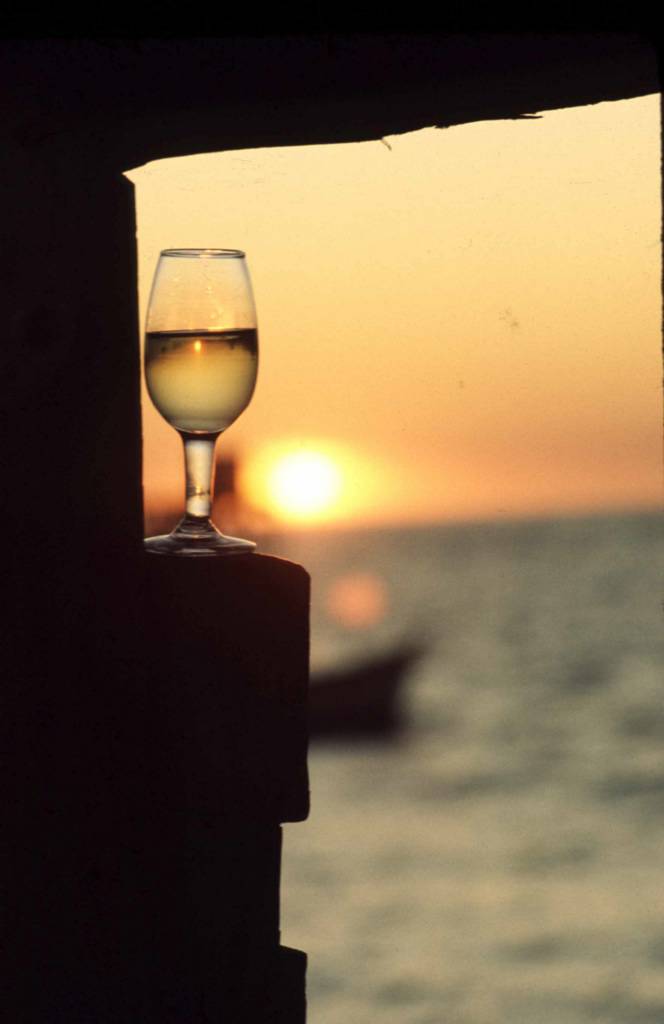
Sunset in a glass, Manzanilla sherry along the Guadalquivir River at Sanlúcar de Barrameda.
Gerry Dawes©2008 / gerrydawes@aol.com
In Sanlúcar de Barrameda, which along with Jerez de la Frontera and Puerto de Santa Maria, is one of Spain’s three great sherry producing towns, Javier Hidalgo, producer of La Gitana manzanilla and an old friend, once told me, “If you ever have a glass of manzanilla at sunset on Bajo de Guía beach, you will never have another glass of manzanilla anywhere in the world without seeing the Sanlúcar sunset in the glass.”
That sounds like a zealous public relations invention until you have actually seen a Sanlúcar sunset with a glass of manzanilla in your hand. Picture yourself on Bajo de Guía beach at the western edge of Sanlúcar. The main part of town, where most of the sherry bodegas are located, is perhaps a kilometer behind you. Before you is a broad river, the Guadalquiver, emptying into the Atlantic Ocean, a vista which stretches to the horizon. On the far bank of the river is the Coto Doñana, one of the greatest wildlife preserves and bird sanctuaries left in Europe and it is pristine, except for a small guard building on the shore and the remnants of a picnic carelessly left behind, which has drawn a wild boar down to the beach to forage. In the foreground, fishing boats roll in the gently lapping waves. A pair of old beached boats and several overturned fisherman’s dinghies, which make could seats for the viewing the sunset, are scattered along the beach.
That sounds like a zealous public relations invention until you have actually seen a Sanlúcar sunset with a glass of manzanilla in your hand. Picture yourself on Bajo de Guía beach at the western edge of Sanlúcar. The main part of town, where most of the sherry bodegas are located, is perhaps a kilometer behind you. Before you is a broad river, the Guadalquiver, emptying into the Atlantic Ocean, a vista which stretches to the horizon. On the far bank of the river is the Coto Doñana, one of the greatest wildlife preserves and bird sanctuaries left in Europe and it is pristine, except for a small guard building on the shore and the remnants of a picnic carelessly left behind, which has drawn a wild boar down to the beach to forage. In the foreground, fishing boats roll in the gently lapping waves. A pair of old beached boats and several overturned fisherman’s dinghies, which make could seats for the viewing the sunset, are scattered along the beach.

Langostinos de Sanlúcar with La Gitana manzanilla, in the evening,
Bajo de Guía beach on the Guadalquívir River, Sanlúcar de Barrameda.
Gerry Dawes©2008 / gerrydawes@aol.com
Just before sunset, I usually purchase a couple of ice-cold half bottles of manzanilla, a plate of the famous langostinos de Sanlúcar (spectacular prawns), and some olives from Bigote, Casa Juan, or Mirador de Doñana, just three of more than a half dozen quality seafood restaurants facing the beach.
I convince the owners that I will indeed return their catavinos, sherry glasses, and traipse across the sand with my culinary booty, the borrowed glasses, and my companion or companions (I once did this with a gourmet crowd of fifty people, including Chefs Allen Susser, Mark Miller, Jimmy Schmidt, and Robert del Grande) to one of the fisherman’s dinghies, preferably one with a flat bottom to serve as a table.
I stake my claim to primo viewing rights, pull the tapón (stopper) from one of the bottles, pour a glass of manzanilla, and toast those who are going to watch today’s version of one of nature’s finer miracles with me. I never forget to toast my own good fortune at being in Sanlúcar de Barrameda at sunset once again.
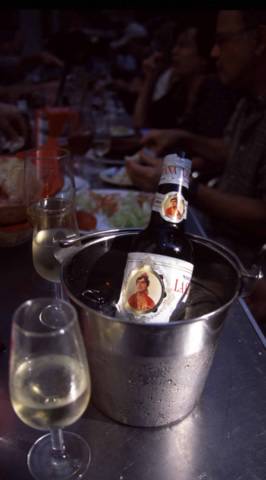
La Gitana Manzanilla, half-bottle chilled.
Gerry Dawes©2008 / gerrydawes@aol.com
To see a Sanlúcar sunset properly takes more than an hour and usually requires another quick sprint across the sands to replenish the stocks of cold wine, but the show is just beginning and we are on our first bottle of manzanilla as we peel and munch on those delicious prawns.
The sun is a giant red-gold ball hanging out on the horizon and it seems to be plating the surface of the ocean with gold leaf. The fishing boats bobbing in the foreground are gradually becoming silhouettes.
The smell of the fresh breeze off the Atlantic is echoed in the slightly salty taste of the manzanilla and the prawns, then one realizes that the greatest of wine and food matches are really wine, food, and place matches.
I lift my glass to the sunset while the sun is still a perfect sphere above the horizon and see the whole scene repeated upside down in my glass.
As the sun begins to sink into the sea way out at what once was the far reaches of the ancient mariner’s world - - Sanlúcar is west of the straits of Gibraltar, the Pillars of Hercules, beyond whose gates lay the unknown terrors of the vast open sea - - you almost expect the water to hiss as the blazing globe sinks below the horizon. One wonders what the sailors who accompanied Columbus when he sailed from Palos just 50 kilometers west of here - - Columbus sailed from Sanlúcar on his third voyage - - must have been thinking.
Gazing out there in the direction of that magnificent golden sphere, you can imagine all those treasure-laden ships sailing into Sanlúcar, which was the customs point where the gold and silver was counted before the ships could proceed upriver to Sevilla, yet another place for this rich lucre to change hands before eventually ending up in the hands of German bankers.
When you also know that most of the sailors who accompanied Magellan, when he sailed from Sanlúcar in an attempt to circumnavigate the earth, died and only one crippled ship commanded by a Basque, Juan Sebastián Elkano of Getaria, came limping back here three years later, you have a palpable sense of a monumental history to go with your sunset, your manzanilla, and your succulent langostinos.
The sun disappears beyond the horizon, ending another day, and its golden glow is replaced by an enchanting array of yellows, reds, blues, purples. The first bottle of manzanilla is now a soldado muerto, (a “dead soldier”) and we are into the second or third, lulled into a delicious state of reverie by the wine, the beauty of the sunset’s changing colors (now they are pastels), and the smell of the sea. The cares of the modern world have been reduced to a speck on my mind’s horizon - - a speck that soon becomes the twinkling of the evening star as it appears, growing brighter as the Technicolor background grows darker. This evening star was called lucero by the ancients who did not realize it was the same as the morning star, Venus, so they built temples to both. They say Sanlúcar’s name is derived from lucero.
As the star grows brighter, so do the lights beckoning from the bars and restaurants along Bajo de Guía beach. Enticing smells of grilled seafood, garlic, and spices drift across the sands, finishing the splendid job of whetting the appetite that the maritime air and the manzanilla have already begun. We have extracted the last hues of exquisite beauty from nature’s light show and savored the last drops of our manzanilla, so we head for Casa Bigote, a favorite tapas bar and my candidate for the greatest bar on earth.
The sun is a giant red-gold ball hanging out on the horizon and it seems to be plating the surface of the ocean with gold leaf. The fishing boats bobbing in the foreground are gradually becoming silhouettes.
The smell of the fresh breeze off the Atlantic is echoed in the slightly salty taste of the manzanilla and the prawns, then one realizes that the greatest of wine and food matches are really wine, food, and place matches.
I lift my glass to the sunset while the sun is still a perfect sphere above the horizon and see the whole scene repeated upside down in my glass.
As the sun begins to sink into the sea way out at what once was the far reaches of the ancient mariner’s world - - Sanlúcar is west of the straits of Gibraltar, the Pillars of Hercules, beyond whose gates lay the unknown terrors of the vast open sea - - you almost expect the water to hiss as the blazing globe sinks below the horizon. One wonders what the sailors who accompanied Columbus when he sailed from Palos just 50 kilometers west of here - - Columbus sailed from Sanlúcar on his third voyage - - must have been thinking.
Gazing out there in the direction of that magnificent golden sphere, you can imagine all those treasure-laden ships sailing into Sanlúcar, which was the customs point where the gold and silver was counted before the ships could proceed upriver to Sevilla, yet another place for this rich lucre to change hands before eventually ending up in the hands of German bankers.
When you also know that most of the sailors who accompanied Magellan, when he sailed from Sanlúcar in an attempt to circumnavigate the earth, died and only one crippled ship commanded by a Basque, Juan Sebastián Elkano of Getaria, came limping back here three years later, you have a palpable sense of a monumental history to go with your sunset, your manzanilla, and your succulent langostinos.
The sun disappears beyond the horizon, ending another day, and its golden glow is replaced by an enchanting array of yellows, reds, blues, purples. The first bottle of manzanilla is now a soldado muerto, (a “dead soldier”) and we are into the second or third, lulled into a delicious state of reverie by the wine, the beauty of the sunset’s changing colors (now they are pastels), and the smell of the sea. The cares of the modern world have been reduced to a speck on my mind’s horizon - - a speck that soon becomes the twinkling of the evening star as it appears, growing brighter as the Technicolor background grows darker. This evening star was called lucero by the ancients who did not realize it was the same as the morning star, Venus, so they built temples to both. They say Sanlúcar’s name is derived from lucero.
As the star grows brighter, so do the lights beckoning from the bars and restaurants along Bajo de Guía beach. Enticing smells of grilled seafood, garlic, and spices drift across the sands, finishing the splendid job of whetting the appetite that the maritime air and the manzanilla have already begun. We have extracted the last hues of exquisite beauty from nature’s light show and savored the last drops of our manzanilla, so we head for Casa Bigote, a favorite tapas bar and my candidate for the greatest bar on earth.
Bigote is an old-time fisherman’s tavern, a real taberna marinera so picturesque in its trappings that it could have been created by the Ministry of Tourism, except it is too authentic to have been fabricated. At the entrance to the bar, there are the ubiquitous bullfight posters, the mounted head of a fighting bull, and a number of taurine photographs of local bullfighters (the second most famous product of Sanlúcar after manzanilla), many of whom have been very successful. Inside the bar, apart from bullfight paraphernalia, the decoration - - calling it decoration is being charitable - - is nautical, maritime, (actually the stuff that fishermen have dragged up in their nets for the last several decades), authentic, raffish, unique, and utterly captivating.
Behind the bar, perched on a small upturned barrel of Barbiana Amontillado Viejo, is a small image of the Virgen del Carmen (the patroness of the fishermen) mounted in the yawning jawbone of a small shark. On the wall behind the bar is a huge tortoise shell with “Bar Bigote - Bajo de Guía” spelled out with pieces of fisherman’s rope, several starfish, all sorts of odd crustaceans, a mounted fish, a whale bone, and photographs of a whale beached at Sanlúcar. And suspended from the rafters, along with a blowfish, are amphoras, the pottery urns, which were used in the days when Spain was a part of the Roman Empire to ship wine, oil, olives, pickled fish, and other foodstuffs back to Rome.
Behind the bar, perched on a small upturned barrel of Barbiana Amontillado Viejo, is a small image of the Virgen del Carmen (the patroness of the fishermen) mounted in the yawning jawbone of a small shark. On the wall behind the bar is a huge tortoise shell with “Bar Bigote - Bajo de Guía” spelled out with pieces of fisherman’s rope, several starfish, all sorts of odd crustaceans, a mounted fish, a whale bone, and photographs of a whale beached at Sanlúcar. And suspended from the rafters, along with a blowfish, are amphoras, the pottery urns, which were used in the days when Spain was a part of the Roman Empire to ship wine, oil, olives, pickled fish, and other foodstuffs back to Rome.

Bar Bigote, Sanlúcar de Barrameda.
Gerry Dawes©2008 / gerrydawes@aol.com
Among the habitues of Bigote is the great Matador José Martínez “Limeño,” one of my oldest friends in Spain and the padrino of Sanlúcar’s bullfighters. Limeño gained fame as a journeyman matador, who became so good at fighting the feared Miura breed that he won the trophy as the best bullfighter in the Feria de Sevilla, one of Spain’s most prestigious taurine events, three years in a row, something not even Juan Belmonte, Manolete, or Antonio Ordoñez had accomplished. I almost never visit Sanlúcar without meeting Limeño at Bar Bigote and for over the more than 35 years I have known him, he has been proved to be the catalyst for many of my most memorable wining and dining experiences in this extraordinary town. This evening is no different. I am meeting Limeño at Bigote.

Bar Bigote, El Rocio, Guadalquivir Crossing Day
Gerry Dawes©2008 / gerrydawes@aol.com
Bigote grew spontaneously as a by-product of this legendary port. It is now the successful creation of the owners, Fernando and Paco Hermoso, and three generations of fishermen who have frequented this place since the Hermoso’s father opened it in more than fifty years ago. The Hermoso brothers’ father was a fisherman with a large bigote, a moustache. In 1951, he opened a little bar on Bajo de Guía beach, when it used to be the point where the fisherman unloaded their catch (before they moved to the new port in the little suburb of Bonanza, a couple of kilometers away). The fishermen and the owners of the boat would go to Bigote after the catch was sold to divvy up the proceeds of the day’s catch and drink manzanilla.
Señor Hermoso ran his little bar there until 1967, when he followed the fishing fleet upriver to Bonanza, Sanlúcar’s then-new fisherman’s port and site of the afternoon fish auction, which is conducted by a reverse bidding procedure in which the ceiling price is quoted first. Fernando and Paco Hermoso stayed at the original Bigote. Soon, they added a kitchen and a coffee machine.
Fernando Hermoso is the chef. He learned to cook for the crew of young fishermen with whom he worked in the local waters. He has a natural talent for the great guisos marineros, or fishermen’s stews, for which Sanlúcar is famous. Aside from Bigote’s own considerable attraction as one of the greatest places in Spain to eat seafood (and drink manzanilla), one of Fernando’s dishes - - huevo marinero - - has provoked many a gastronomic pilgrimage on its own. Huevo marinero, is a sublime dish of monkfish and shrimp, cooked with olive oil and manzanilla in a cazuela, a ceramics baking and serving dish. When the dish is bubbling hot, it is pulled from the fire, a fresh egg is cracked on top and is the yolk is still setting up as it is served. With a copita of manzanilla and a piece of local bread to mop up the sauce, this “fisherman’s egg,” is not just food, it is a culinary epiphany. Fernando is also famous for his rape a la marinera (another monkfish cazuela dish with saffron sauce) and raya a la naranja agría (skate in a sauce made with the juice of bitter oranges, the kind used to make orange marmalade).

Fernando Hermoso, Chef-partner, Bigote, Sanlúcar de Barrameda
Gerry Dawes©2008 / gerrydawes@aol.com
More than a decade ago, Fernando and Paco expanded into the building across a little alleyway from the bar and have formal dining rooms where they serve a maximum of 150 costumers per meal. There is usually one seating only; many people reserve two weeks in advance and start eating lunch here at 3:30 - 4:00 p.m.
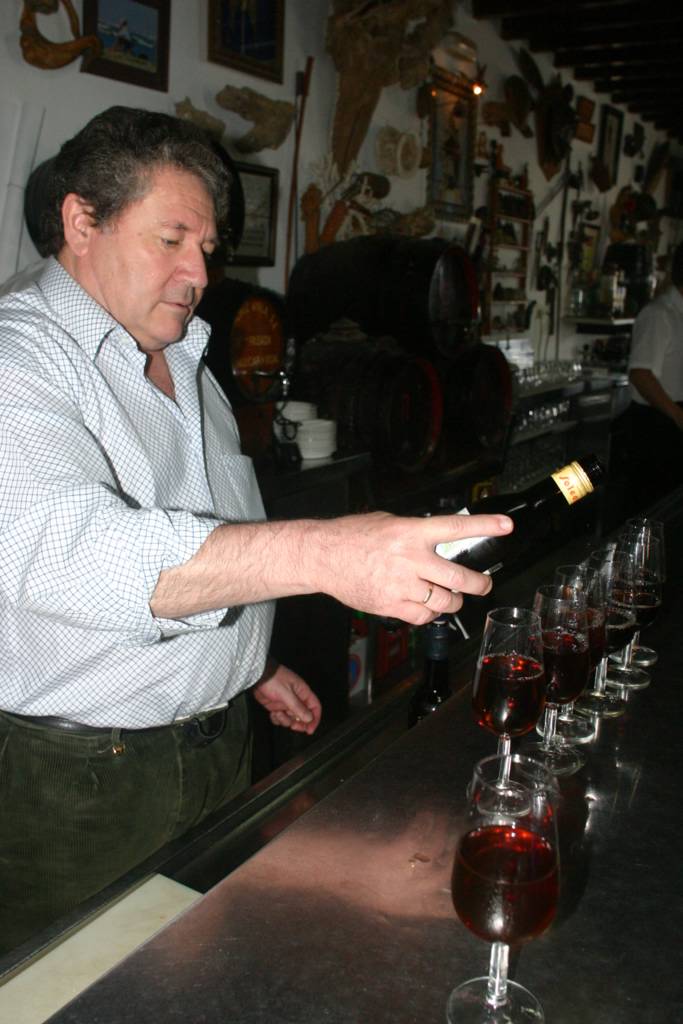
Bar Bigote, Fernando Hermoso.
Gerry Dawes©2008 / gerrydawes@aol.com
Bigote serves fish and shellfish from the area around Sanlúcar. They claim they don’t use fish from the North or the Mediterranean, nor do they serve frozen fish. In stormy weather when the fishing boats are kept in port for several days, the Hermoso brothers have been known to close the restaurant and just serve drinks at the bar. They try to serve only fish from that day’s catch for dinner that evening and at lunch the next day. Fernando waits each day at 5 p.m. for the catch to arrive. They use shaved ice, nieve or “snow” they call it, to keep fish cold in wooden crates, just as they come in from the fishing boats. They leave the ice on the fish, even in the refrigerators where it is stored. Fernando says the refrigerator is just to keep the “snow” from melting. As long as the ice stays on top the fish, it does not dehydrate in the dry cold of the refrigerator.
While I am waiting for Pepe Limeño, I order another glass of manzanilla, some house-cured olives, and a tapa, or small snack, of boquerones - - small, fresh whole anchovies, battered and flash deep-fried. The skin is crisp, but the anchovies are perfectly fried,moist, not greasy. Andalucians and Bigote, in particular, have elevated frying fish to an art form. It is said that the Japanese learned the art of frying fish from Spanish and Portuguese sailors in the 16th Century.
While I am waiting for Pepe Limeño, I order another glass of manzanilla, some house-cured olives, and a tapa, or small snack, of boquerones - - small, fresh whole anchovies, battered and flash deep-fried. The skin is crisp, but the anchovies are perfectly fried,moist, not greasy. Andalucians and Bigote, in particular, have elevated frying fish to an art form. It is said that the Japanese learned the art of frying fish from Spanish and Portuguese sailors in the 16th Century.
At about 9:30 p.m., Limeño appears, and there are abrazos (the friendly embrace that takes the place of a handshake amongst friends in Spain) all around. Nearly twenty years retired from the bull ring, he is still greeted by half the bar patrons before he can settle in for a manzanilla and a tapa. His appearance assures us of two things: We will dine informally, but exceptionally well, and we will consume our share of manzanilla. Limeño always seems to know which restaurant is serving the best current specialty. Sometimes we end up eating at tables outdoors along the beach, dining on tiny clams cooked in garlic, parsley, and wine sauce; another time we sample Fernando’s excellent fish-and-shellfish stews; and in an upstairs dining room down the beach, we have plates of salad followed by heaping platters of pescaito frito, perfectly fried fish - - acedías (baby sole), pijotas (small whiting fried with their tails stuck in their mouths), and calamares (fried squid).
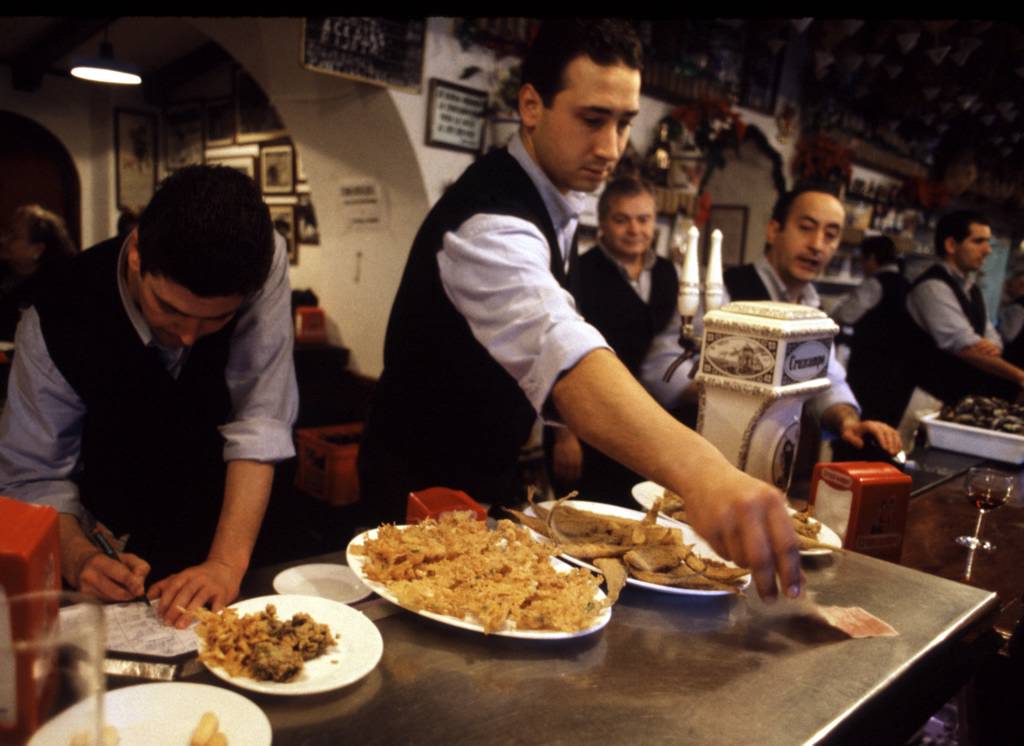
Pescaito frito, tortillitas de camarones, Bar Balbino, Sanlúcar de Barrameda
Gerry Dawes©2008 / gerrydawes@aol.com
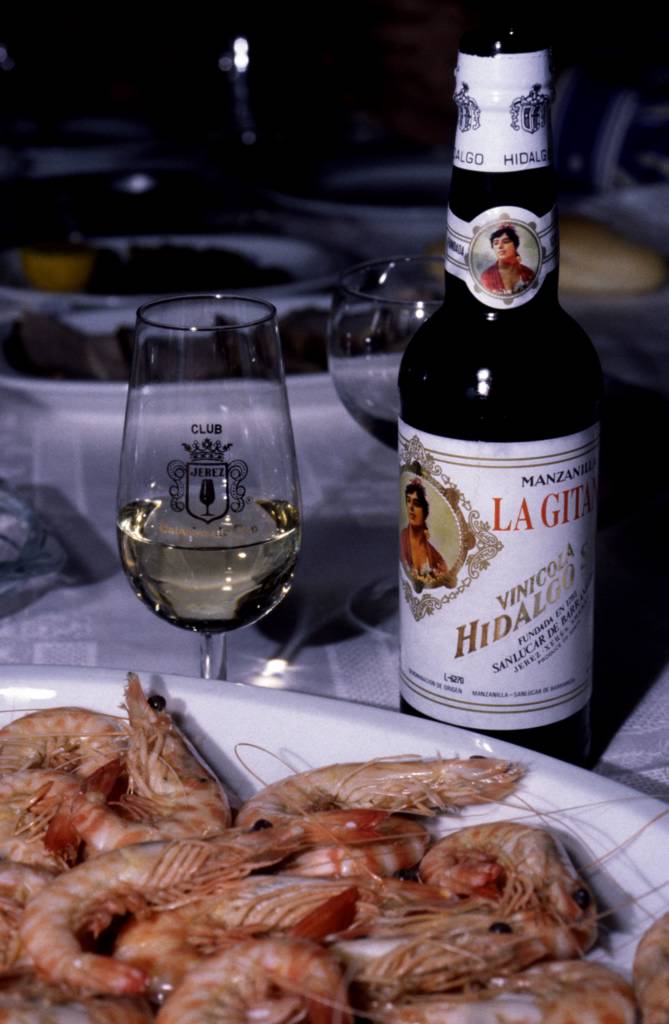
Langostinos de Sanlúcar and Manzanila La Gitana at Bigote.
Gerry Dawes©2008 / gerrydawes@aol.com
And sometime during our long, sometimes peripatetic, bar-hopping, lunches or dinners together, we have langostinos de Sanlúcar, those superb tiger prawns which can cost up to $60 per pound, depending on the season. And always, those chilled half bottles of manzanilla, sometimes Bodega Hidalgo’s La Gitana, a manzanilla fina, but just as often, the gold-tinged San León, a gutsy manzanilla pasada from Argüeso. And as we lift our glasses for yet another toast, I can still see the Sanlúcar sunset in the glass. Javier Hidalgo was right!!
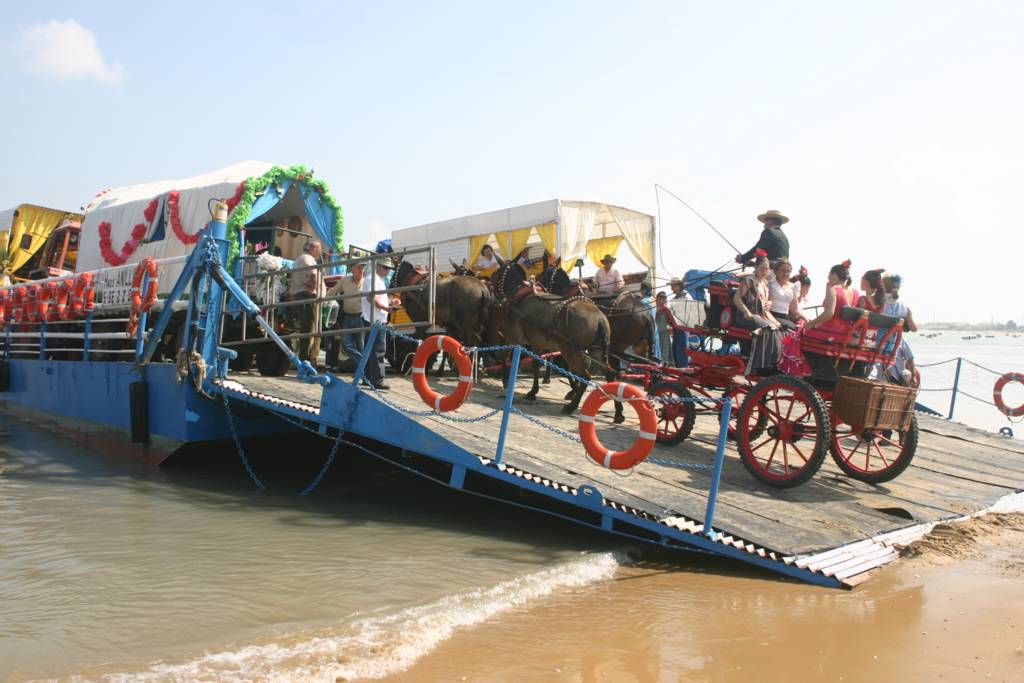
El Rocío pilgrimage, crossing the Guadalquivir at Sanlúcar de Barrameda
Gerry Dawes copyright 2008
Manzanilla has become such a runaway favorite in Spain that it now outsells fino sherry by more than two to one. In fact, at last report, 70% of the dry sherry sold in Spain was manzanilla. It is the drink of choice at most fiestas in southern Spain and can now be found fresh in the bars and restaurants of Madrid and many other northern cities.

Catavino: Manzanilla Sherry glass at Vinicola Hidalgo.

Gerry Dawes Copyright 2008
Manzanilla is a fino-type sherry, sometimes called el mas fino de los finos, the finest, the most elegant wine, of the fino family, which includes manzanillas, finos, and amontillados. It comes only from Sanlúcar de Barrameda and has its own denominación de origen, Spain’s equivalent of appellation controlée, called Manzanilla de Sanlúcar de Barrameda. Manzanilla can be sold as sherry from Jerez, but only wine aged in Sanlúcar can be called manzanilla. Like other sherries, it is produced by the classic solera system of fractional blending.
So fickle is nature in the production of manzanilla, that not all bodegas in Sanlúcar are capable of producing it and even in some bodegas that do produce it, there are areas in those bodegas in which manzanilla can not be produced. The big, airy, above-ground bodegas in the barrio alto of Sanlúcar have a number of doors and windows which can be opened to let in air from the ocean side of the bodega or can be closed off if there is too much heat. As with finos, the best producers of manzanilla use only free-run juice. After fermentation the mosto (must) becomes mosto-vino, then alcohol is added to bring it up to 15 - 15.5%. It then goes into 500-liter botas (butts), which are filled only 2/3 full, for ageing in large, airy, high-ceiling bodegas.
The special yeast which makes sherries of the fino family possible grows on top the wine in these partially fillled barrels and is called flor, literally flower, because it resembles the white flowers that grow near the surface of streams. In actuality, it looks like cottage cheese floating on top the wine. Because Sanlúcar is on the humid Atlantic, flor, which needs humidity, grows all year round on the surface of the wine in the manzanilla bodegas, while in Jerez in mid-summer and mid-winter, yeast growth can be severely retarded and the yeast will even submerge, exposing the wine to slight oxidation.
Since the flor does not disappear from manzanilla and the wine has no contact with air, it is the finest, lightest bodied sherry, and is the palest, usually a green-tinged color not unlike that of a fine Meursault. The poniente winds, the westerlies, bring a salt-laden sea breeze and give a light touch of salinity to the wine.
Manzanillas are aged a minimum of five years, which in practice means, that since the five year aged wine is fractionally blended with older wines in the criadera system, they will be five-seven years old, in the case of manzanillas finas, 7-10 years old in the case of manzanillas maduras, and 10 years or more in the case of manzanillas pasadas. While fino sherries in Jerez in a solera may be racked, never fully, just drawn down by quantities equal to a third of the capacity of the wine, maybe five to six times before the reach the bottling stage, manzanillas may be go through 14 rackings in the same period.


 '
'



 Posts
Posts


