Share This Gerry Dawes's Spain Post


Instagram

In 2026, ranked #7 in the Top 30 Gastronomy Blogs (and Websites for Gastronomists & Gastronomes by Feedspot. (Ranked in the top 50 since 2019). "The Best Gastronomy blogs selected from thousands of Food blogs, Culture blogs and Food Science. We’ve carefully selected these websites because they are actively working to educate, inspire, and empower their readers with . . . high-quality information.

More than 3,640,000 views since inception, 123,000+ views in August 2026.


Ranked #7. Gerry Dawes's Spain: An Insider's Guide to Spanish Food, Wine, Culture and Travel gerrydawesspain.com

"My good friend Gerry Dawes, the unbridled Spanish food and wine enthusiast cum expert whose writing, photography, and countless crisscrossings of the peninsula have done the most to introduce Americans—and especially American food professionals—to my country's culinary life. . .” - - Chef-restaurateur-humanitarian José Andrés, Nobel Peace Prize Nominee and Oscar Presenter 2019; Chef-partner of Mercado Little Spain at Hudson Yards, New York 2019

9/27/2012

Rioja: The Mountain Cat Springs to Life


 By Gerry Dawes

Introductory Notes from Reservaycata.com (Madrid), a wine shop on whose website the article was serialized in two installments:

The article that follows was first published on the net at Thewinenews.com, from the printed version of the October/November 2002 issue of this prestigious American wine magazine. With the consent of the author we offer you what we believe to be one of the most stunning in-depth analysis of current Rioja developments having been written this year. Regardless of having to agree with all his appreciations, this compelling and extensive account will lead you through the exciting new developments occurring in Spain's flagship Appellation for red wines. I was featured in two separate monthly articles (December 2002 and January 2003). Translation into Spanish has been performed by Ernesto de Serdio of Reserva y Cata. Enjoy this superb reading!

Note on the author: Gerry Dawes spent 20 years purveying fine wines to top Manhattan restaurants. Up until he left the wine trade to devote full time to his writing, he worked with such noted authorities as Frederick Wildman, Gerald Asher, Robert Haas, Robert Kacher and many top wineries in California, France and Italy. His avocation, however, has always been the wine, food and culture of Spain, a country in which he has lived and traveled for nearly 30 years. Dawes is considered the leading authority in the United States on Spanish wines. In addition to The Wine News, his articles and photographs have appeared in The New York Times and various national wine publications. He wrote several chapters in The Berlitz Travellers Guide to Spain and is currently writing Homage to Iberia (inspired by James A. Michener's Iberia: Spanish Travels & Reflections).

La Rioja, northern Spain's splendid, red-wine-producing enclave, has been regularly accused of being a sleeping giant by the critics. Many of the loudest voices come from Spain's own cadre of wine writers, some of whom seem to automatically equate the word nuevo with the concept of quality. A few among them have practically made a crusade of denigrating the region's balanced, food-friendly wines, even los buenos clasicos, as Jésus Madrazo, the young, highly regarded general manager of Contino and a descendant of the founding family of CUNE, calls the top traditionalist wines. A couple of these modernista proponents have even conjectured that the old guard's resistance to change is some kind of sinister, post-Franco movement.
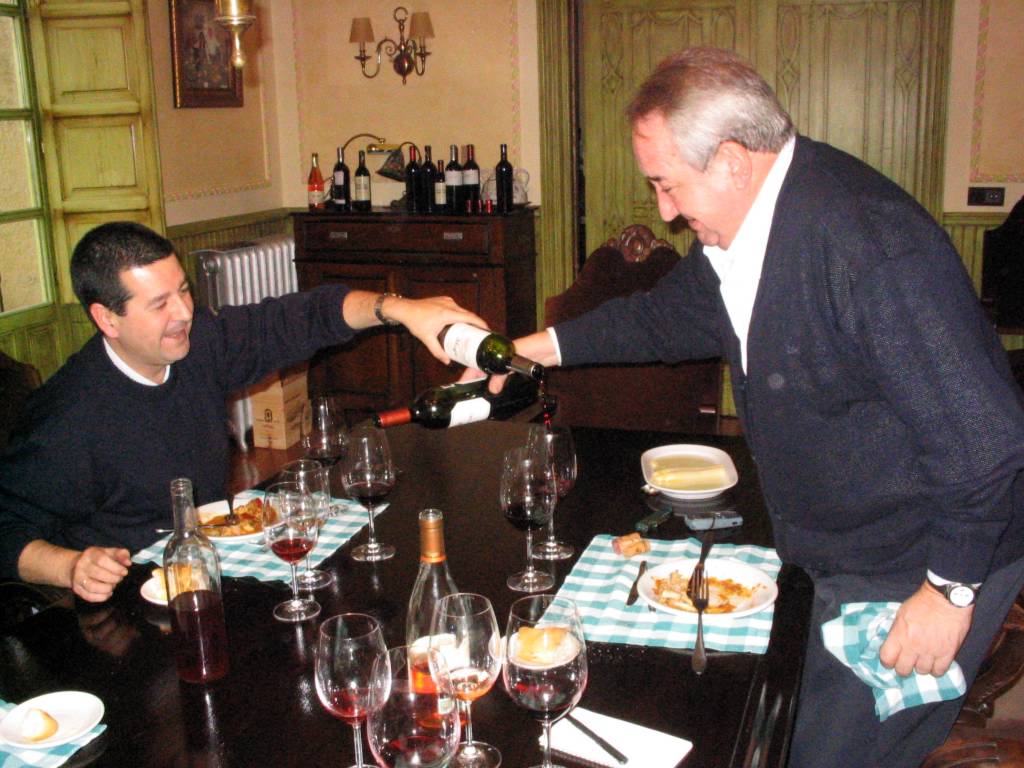
 Isaac Muga and Jesus Madrazo pouring each other's wine (Contino & Muga) at lunch at Bodegas Muga.
Photo by Gerry Dawes copyright 2004

Because La Rioja is so large and produces so much wine, this old lion may appear to move slowly, but like the mountain cat that it is, once this time-honored region springs to life, it will be hard to hold back. In fact, La Rioja is in a dynamic state of evolution, and many of its classic bodegas are already producing some of the best, modern-style wines in Spain.

The region's metamorphosis was aptly described in a recent issue of Sobremesa, one of Spain's leading epicurean magazines: "The old enological catechisms" are giving way to a new generation of red wines that are "capable of competing with the best wines on the planet." The author highlighted the emergence of a group of Rioja wines that "are escaping their local coordinates and aspiring to place themselves among the world elite."

A visit this spring confirmed the profound changes La Rioja is undergoing. A conference in Logroño entitled "Los Grandes de la Rioja" had drawn a field of international wine writers for a four-day marathon that would encompass a series of catas (tastings), winery visits and winemaker dinners. It soon became apparent, however, that the conference was being largely underwritten by La Communidad de La Rioja (the Rioja provincial government) and not by the official Rioja denominación de origen (DO), which also represents the Basque and Navarrese sections of the DO.

What this meant was that in the tastings (more than 130 wines were poured for evaluation) and visits, there would be no wines from Navarra's Rioja-designated communities, nor from the vital Basque Rioja Alavesa. The latter, which is located on the lower slopes of the Sierra Cantabria mountains north of the Ebro River, is home to many of La Rioja's most important (and some of the most polemic) wineries:  Marqués de Riscal, Martínez Bujanda, Faustino Martínez, Remelluri, Contino, Remírez de Ganuza and Artadi among others. Industry insiders said privately that the absence of the Rioja Alavesa DO wines was a result of infighting between the two regional governments.

Fernando Remirez de Ganuza
Gerry Dawes copyright 2004

Putting aside local politics, La Rioja is arguably the greatest red wine region in Spain. And its prowess is still based primarily on the ability of the top centenarian bodegas to produce millions of bottles of high-quality wines at reasonable prices. This core group includes CUNE (Companía Vinícola del Norte de España), La Rioja Alta, Muga, López de Heredia, Marqués de Riscal, Marqués de Murrieta and Bodegas Riojanas. This distinguished group of bodegas makes more bottles of 90-plus-rated wines than the rest of Spain put together.
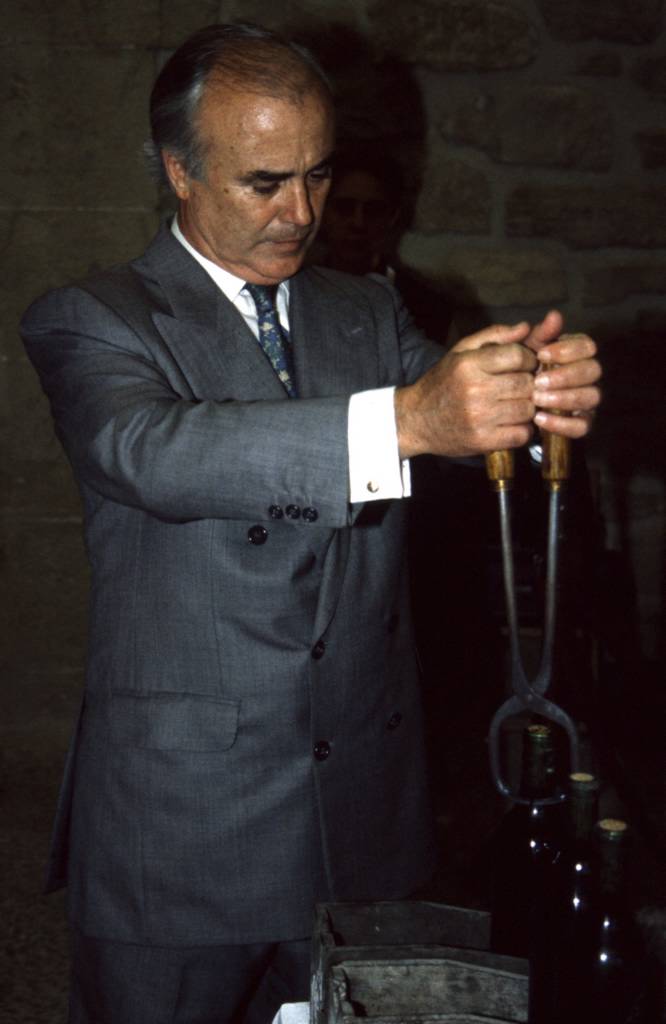
Francisco Hurtado de Amezaga, Technical Director of Marqués de Riscal, opening old reservas with hot tongs 
during the presentation of the plans for the new Frank Gehry-designed hospitality center at the winery.
Gerry Dawes copyright 2004

Marqués de Riscal alone has some two million cases of fine wine aging at the bodega at any one time. By contrast, even in bumper years like 1998 and 1999, the Ribera del Duero produces less than three million cases annually.
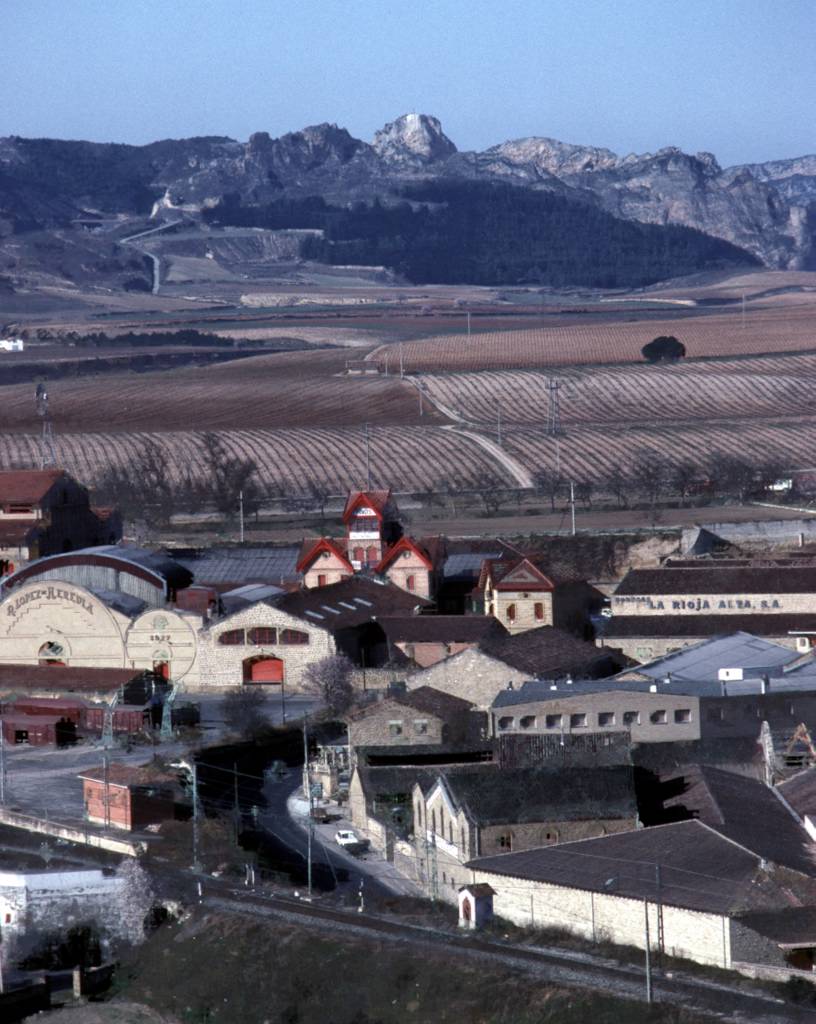
The famous Barrio de la Estación in Haro (Rioja Alta), home to CUNE, López de Heredia, La Rioja Alta, 
Bodegas Bilbainas, Muga, Roda and others. Beyond are the vineyards of La Rioja Alta and Rioja Alavesa.
Gerry Dawes copyright 2004

"Some like to say that La Rioja has been asleep, but the reality is that we continue to dominate the market in spite of the rise of other regions, and by a substantial margin," Contino's Madrazo asserts.

By the end of 2000, La Rioja reportedly had more than 130,000 acres in production, more than the Ribera del Duero (35,000 acres), Navarra (37,000 acres) and Priorato (3,500 acres) combined. But while La Rioja produces more red wine than all of those regions put together, not all of it is good. In fact, far too much is lamentably mediocre, a trait La Rioja shares with many other major wine-producing areas in the world. And there are overstocks in some bodegas that are approaching five times their average annual production, a scenario that caused grape prices to plummet in 2000 and 2001, though paradoxically the gross revenues actually increased last year because of higher average prices.

Over the last decade of the 20th century, vineyard acreage expanded by roughly 20 percent as diseased vines and old, underproducing stock were uprooted and replanted in a process that is ongoing. Higher-production clones trained on modern trellis systems and spaced for mechanization are contributing to an increased production estimated at between 50 and 60 percent. (So much for European Union controls to dry up the continent's vast wine lake - ironically, much of the replanting expense is actually being heavily subsidized by the EU.)

In the face of what is being called el crisis de la Rioja, producers of heretofore typical-style Rioja wines, many of which had lackluster reputations, have scrambled to improve the quality of their wines (other overstocked wine regions find themselves in similar predicaments, most notably Beaujolais, where 13 million bottles were recently - and embarrassingly - distilled into vinegar). Spurred by a combination of declining sales in European markets (down 34 percent in Sweden, for example) and the natural desire to compete globally at a higher level, medium- to large-size bodegas and cooperatives are changing their approach to winemaking.

Trasiego (racking) at La Rioja Alta.
Gerry Dawes copyright 2004

Having tasted so many Rioja Alta and Rioja Oriental (Baja) wines, I reasoned that it would be folly to leave without tasting the wines of the Basque Country's Rioja Alavesa. I hastily rearranged my plans to stay another six days. Over the course of my intensive winery visits and tastings in La Rioja, an in-depth picture of the revolutionary changes taking place on several Rioja fronts came into sharp focus. In most of the best traditional houses of Rioja Alta and Rioja Alavesa, 21st-century improvements in vineyard development, vinification facilities and winemaking techniques are dramatically changing the face of winemaking here. Even in La Rioja Baja/Oriental, traditionally the backwater of the region, quality is on the rise.
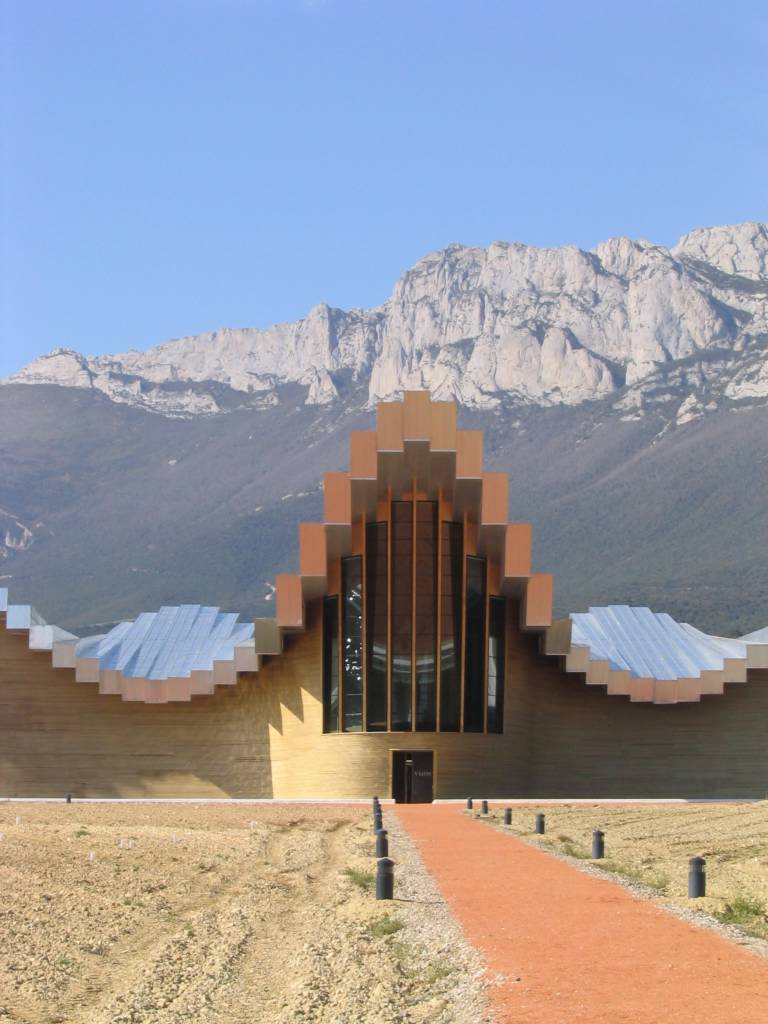
Isios winery near Laguardia
Gerry Dawes copyright 2004

Among the most important developments is the dramatically intensified focus on the vineyard, and thus grape quality, especially in the emerging, small-producer bodegas of La Rioja Alavesa.

Indeed, the current breeze of change prevailing in La Rioja is blowing from the vineyards. During the first 25 years I traveled there, I was almost never invited to tour the vineyards. Rather, my encounters largely took place in the cellars.
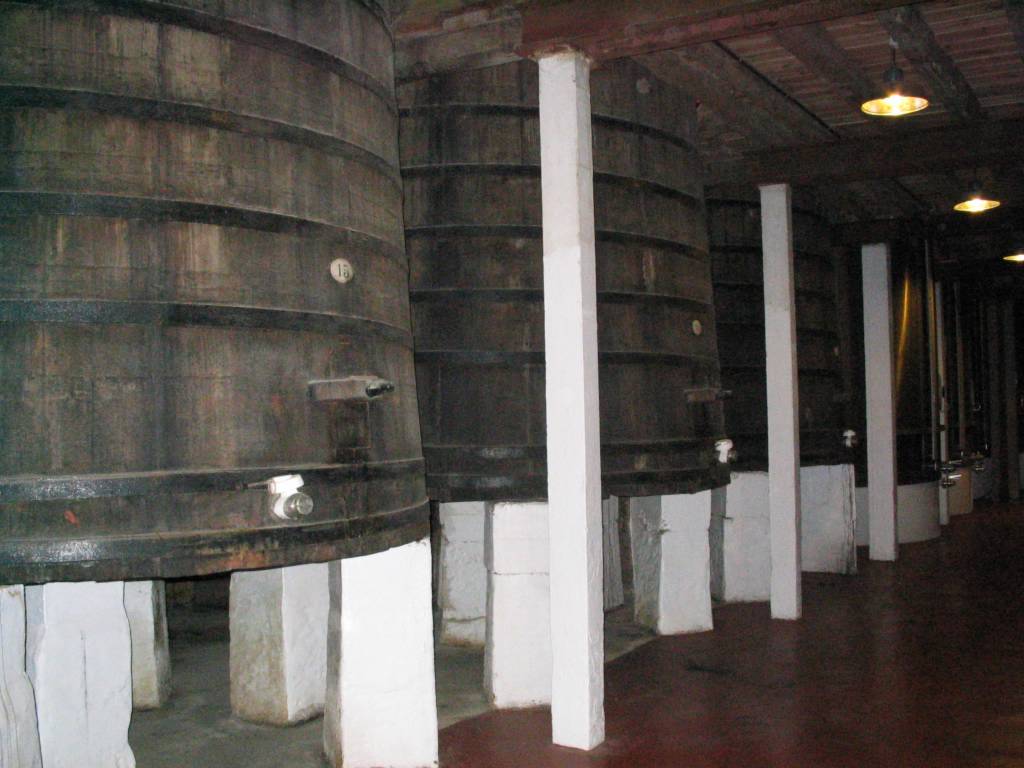
Tinos (wooden vats), La Rioja Alta
Gerry Dawes copyright 2004
 
(The same was generally true of my visits to Champagne and even Burgundy during that period.) In the past five years, however, I've seen more Rioja vineyards in the company of winegrowers than in my first quarter-century of combined visits.

This new-found interest in terroir is reflected in the number of site-specific wineries that have sprung up across the region over the past decade. Established to make luxury cuvées from pagos, or single vineyard and estate sites, these wineries are moving toward a Burgundian philosophy that is sure to lend additional excitement to their winemaking approach.

Andrés Proensa, the moderator of the Los Grandes de La Rioja conference and one Spain's top wine writers, approves of the change in philosophy. "La Rioja is living in a very interesting moment and undergoing a notable change in attitude," he says. "Not long ago, the thrust of the winemaking was in the cellars, and the vineyards were considered to be secondary - almost a necessary evil. Now Rioja producers are turning an eye toward the vineyards and this is changing the wines of the region for the better. Not just the modern and expensive wines, but the shift is also affecting the quality of wines priced at moderate levels."

The manner in which the conference tastings were presented illustrated the changes under way in La Rioja. The flights were arranged into seven categories: ecológicos (organic), estilo tradicional (traditional style), blancos con madera (whites with oak aging), renovados (new style), tintos cosecha 2001 (reds from the 2001 harvest), vanguardia (ultramodern) and grandes clásicos (great classics).  

Among the renovados were the alta expresión wines, a style that has been the subject of an often-heated debate among wine professionals and aficionados. The term was coined to categorize the usually big, powerful, dark, quite ripe wines, often loaded with French oak, that carry hefty price tags in the $50 to $100-plus range (see Alta Expresión Vino, April/May 2001). Had the Basque wines also been included, there would undoubtedly have been more categories, such as cosechero-viticultor (grower-vintner) and vinos de pago (single-vineyard wines).

Very much at odds with the alta expresión approach to winemaking is Manuel Camblor, a passionate and knowledgeable collector who lives in New York City (and who now lives in La Republica Dominicana).   A creative home and furniture design consultant, he developed his palate for Rioja gran reservas at his late grandfather's side in the Dominican Republic. At first, Camblor was excited about the new wave of Spanish wines that began to emerge in the mid-1990s. He had the means to buy them and did.  

Over the intervening years, as he pulled one expensive bottle after another from his cellar, he found none lived up to its billing. Disillusioned, he recently posted his concerns on El Mundo's Web site: "When wines begin to have aspirations to greatness, encouraged by certain critics who speak of their potential and put them in the same league with wines which over their history have earned a reputation, my skepticism was awakened."

La Rioja Alta, S.A.
Gerry Dawes copyright 2004

Several of the revered, proven producers to which Camblor alluded recently founded the Agrupación de Bodegas Centenarias (Centenarian Bodegas Group) to promote and defend their image. But for some time, traditional Rioja houses such as CUNE, Marqués de Riscal, La Rioja Alta and Marqués de Murrieta have been steadily upgrading their equipment. Most of them now have state-of-the-art, computer-controlled, vinification facilities, so don't let anyone tell you that these classic bodegas - no matter how picturesque their facades and museum-esque buildings may be - are mired in the past. It just isn't so. 

With the exception of the great virtual working wine museum, R. López de Heredia, which has steadfastly remained true to its traditions, many of the big, classic bodegas boast facilities on par with model California wineries. In particular, CUNE has had a technically spectacular, gravity-force operation for a decade; La Rioja Alta has built a large vinification site across the Ebro River just a couple of miles away from their early 20th-century bodega; and the ultramodern vinification plant at Marqués de Riscal is absolutely stunning.

The epic of the ongoing evolution at most of the great, classical Rioja bodegas is a story in itself, because in no other region in Spain are so many high-quality, traditional-style wines being made in tandem with so many exciting New Age wines. Indeed, over the past several years, almost all of the top Rioja bodegas have developed modern-profile wines meant to compete not only with Rioja's alta expresión wines, but also the tinto fino (tempranillo) mono-varietal, merlot-esque wines of the Ribera del Duero, the lush, high-octane wines of Priorato and a pandemic sprouting of powerful, French oak-basted New World-wannabes from all around Spain.

The big difference is that most of the contemporary wines from the best old-line, Atlantic-climate, Rioja bodegas are well-balanced and eminently drinkable. In fact, remarkably few have overstepped the bounds of good taste to enter the international wine sweepstakes. Wines such as CUNE's exceptional Real de Asua, Marqués de Riscal's cabernet sauvignon-laced Barón de Chirel, Marqués de Murrieta's Dalmau; Bodegas Muga's Super-Rioja, Torremuga; Martínez Bujanda's estate-grown Valpiedra; and Palacios Remondo's Herencia Remondo Propiedad have shown they can compete in the high-stakes, vino moderno game themselves.
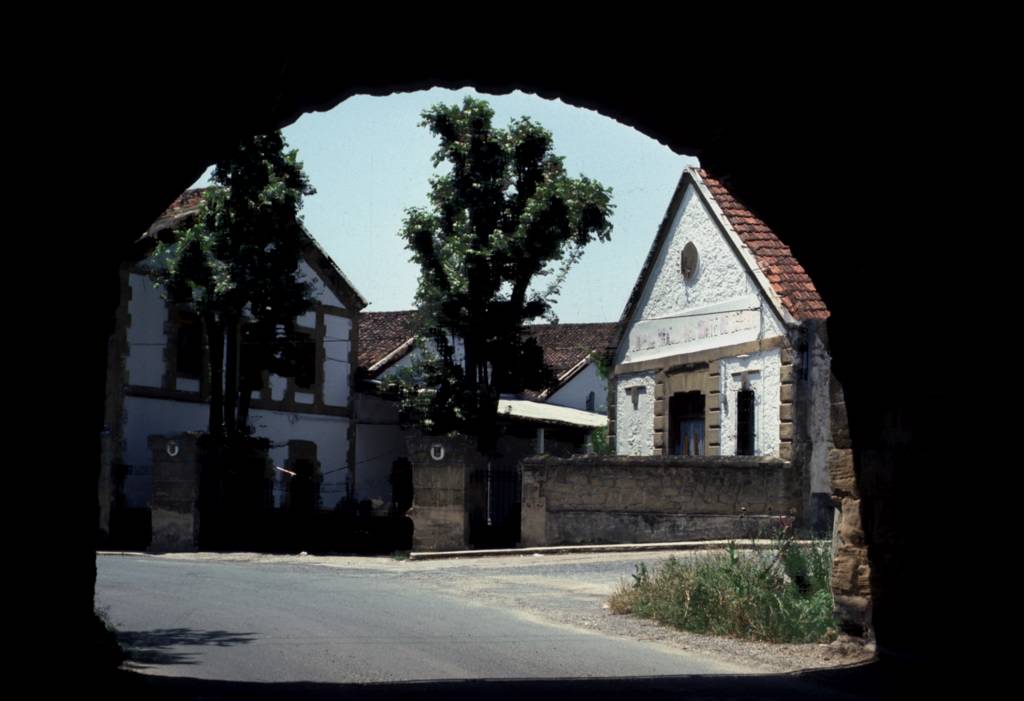
The historic buildings at CUNE, Compañía Vínicola del Norte de España.
Gerry Dawes copyright 2004

"With more than a century of making fine wines to our credit, we know a thing or two about making great wines in both classic and modern styles," observes Madrazo, who makes the increasingly elegant wines of the Contino estate.

A number of fledgling wineries - some representing substantial investments, others on a relative shoestring budget - have surfaced in La Rioja over the past 20 years. Since 1985, more than 50 bodegas have opened, a figure that doesn't even include the very small operations among the 420-odd registered bodegas that don't show up on Rioja DOs radar screen. The most highly regarded among this group of relative newcomers are Roda, Marqués de Vargas, Telmo Rodríguez, Remírez de Ganuza, Artadi, Finca Allende, Campillo (owned by Faustino), Ondarre (owned by Olarra), Barón de Ley, Marqués de Griñon, Barón de Oña (now owned by La Rioja Alta), Señorío de San Vicente, Abel Mendoza, Miguel Merino, Luberri-Monje Amestoi and Viña Villabuena. Most of these bodegas register high on the New Age vino del autor scoreboard.
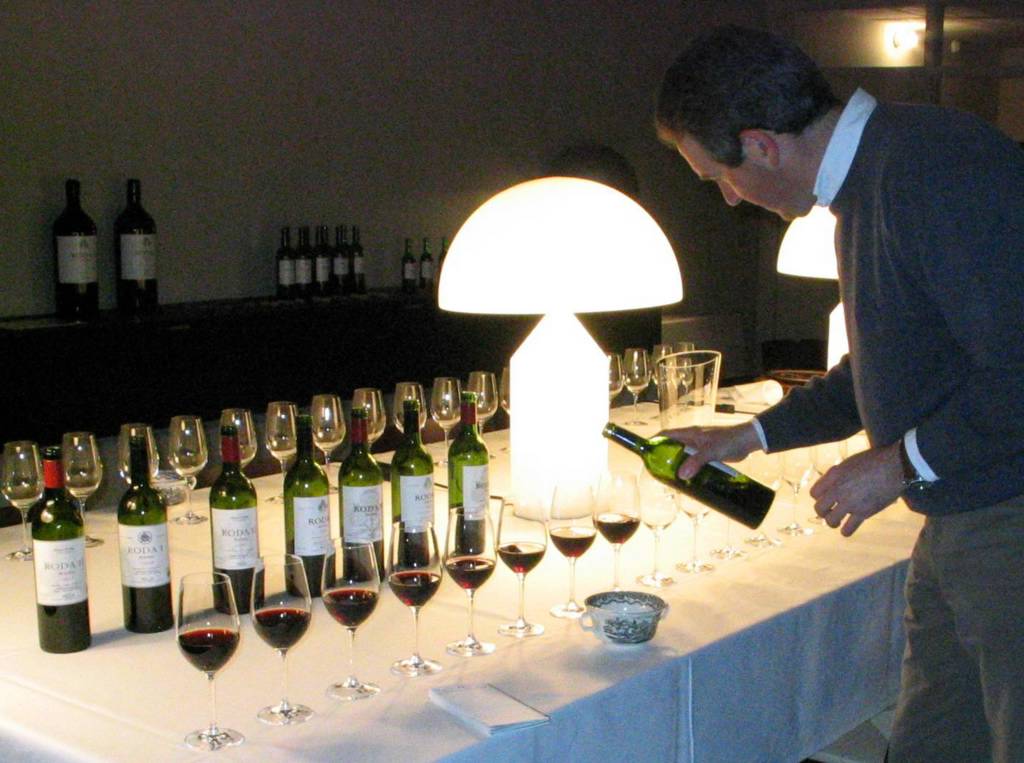
Agustin Santolaya pouring some of the 21 wines at a midnight tasting he organized for me at Roda in April 2003.
Gerry Dawes copyright 2003.

In response to this rising tide, the Rioja Baja region (which is now trying to reposition itself as La Rioja Oriental), is trying to establish its own regional identity. Historically, this southeastern section of Rioja has been the supplier of recourse for more robust, higher alcohol, Mediterranean-continental climate, garnacha-based wines used to beef up the crianza (and sometimes reserva wines) of the bodegas of La Rioja Alta in leaner years. Now wineries such as Palacios Remondo in Alfaro, under the guidance of Álvaro Palacios, are turning up the heat.

Palacios, who has become an international wine star because of his L'Ermita single-vineyard wine from Priorato, hopes to show that outstanding wines can be made in this heretofore little-appreciated area of La Rioja. A major advocate of the single-vineyard approach to producing superb wines (he has several spectacular vineyards in Priorato, La Rioja and the emerging Bierzo area), Palacios says, that "What we want to establish in our eastern zone is precisely the geo-climatic and varietal differences between grapes grown in the different areas of La Rioja, showing with absolutely dignified wines how distinctive the flavors in each region can be."

Palacios is convinced that "If La Rioja does not begin to offer wines that show the charm of its provenance and encourage its zonal distinctions, local microclimates and specific vineyard sites, it will continue to be a great wine region that produces a high volume of good quality wines at medium-to-low prices for large numbers of consumers, but it will never produce wines of exceptional quality."

The problem, Palacios says, "is the lack of [Rioja] wines that have truly elite status. A wine region has to have certain designated areas or single vineyards to create great works of viticultural art. In my opinion, La Rioja still has not yet done that."

It is hoped that Palacios's new Herencia Remondo Propiedad (a blend of 40 percent garnacha, 35 percent tempranillo, 15 percent mazuelo and 10 percent graciano) is indicative of what's in store here. Harvested from the family's 250-acre La Montesa vineyard situated 1,800 feet above sea level on the slopes of the Sierra de Yerga, the 1999, 2000 and the exceptional 2001 vintage of Propiedad may be the best wines ever produced in La Rioja Baja/Oriental.

Suddenly, in a region where, historically, most of the emphasis has been on elevating the juice in the winery into something quite palatable (and often, very, very good), everyone is beginning to focus on grape quality by taking control of their own grape sources and paying more attention to terroir.

In La Rioja Alta, Finca Valpiedra, Finca Allende and Señorío de San Vicente are notable for their distinctive sites, but the movement toward single- vineyard plots is strongest in La Rioja Alavesa, where a number of small producers with very old vines show the promise of the region. Such Alavesa producers as Contino, Remelluri, Remírez de Ganuza and Artadi are proving they can attract international attention with wines made from single-vineyard sites or a series of separate single vineyards. Producers such as Valdelana, Luberri Monje Amestoi and Ostatu draw from exceptional sites as well.

There are also a number of cosecheros-viticultores (grower-producers) in La Rioja Alavesa who have relatively small, single-vineyard pagos that have been in their families for generations; it is not uncommon to find vineyards here that are 50 to 80 years old. These producers are reminiscent of small Burgundy winegrowers, and some have the potential to craft extraordinary wines from these sites. The problem at this juncture is that many of them, with the help of Basque government subsidies, have only recently begun to attempt making serious, age-worthy wines. Traditionally, most made deeply fruity, rich, carbonic maceration cosechero vinos del año, a Beaujolais-style wine that was sold cheap and meant to be drunk before the next harvest. The wines were often delicious, but certainly not intended to sit on retail shelves for very long.

Many of these producers simply don't have the depth of experience necessary to make world-class wines from these quintessential grapes. Some have brought in consultants to advise them. Doroteo Sáenz de Samniego of Ostatu enlisted Bordeaux's Hubert de Boüard de Laforest, owner-winemaker of St.-Emilion's Château L'Angelus, to help him select three of his best parcels for his top-of-the-line Gloria de Ostatu, and he now uses 65 percent French oak (five types), because "Americans like French oak better," he says. Others, such as Florentino Martínez whose pampered vineyards at Luberri-Monje Amestoi en Elciego yield some of the best juice in La Rioja Alavesa, have followed the modern trend toward over-oaking their otherwise excellent wine (although Martínez says he is seriously considering lowering the percentage of new oak he uses). Some, such as Abel Mendoza in neighboring Rioja Alta and Señorío de San Vicente, are making new-wave wines that show great promise, but have been hyped out of proportion to their actual quality.

The Rioja Alavesa can be a confusing place to outsiders because its wineries run the gamut from the huge, internationally known Marqués de Riscal to the small, cosechero family home wineries such as Ostatu and Luberri Monje Amestoi. In between are the modern, high-production wineries such as Faustino Martínez, Martínez Bujanda and Campillo, and a string of good, medium-size, often family-owned wineries, such as Luis Cañas, Valserrano, Larchago and Valdelana. Then there are the single- vineyard estates such as Remelluri and the first-rate Contino. Even the main cooperative, the Unión de Cosecheros de Labastida (Grower's Union of Labastida), is one of the best in Spain. But the Basque region, with its separate and often peculiar politics, has incredible potential and will undoubtedly be the micromodel for what much of the rest of the Rioja will become in time.

"Producers in La Rioja are opening their minds to all kinds of influences - not all good, regretfully," Andrés Proensa noted at the conference. "[But] there is a new generation of winemakers, more or less young people, who are working with their heads in the cellars and their feet in the vineyards, studying soils, microclimates, grape varieties, production, vineyard treatments, grape maturation, and later crafting a style of wine that complements the terroir by choosing with great care how they make the wines, choose the types of oak, toast the barrels, the aging regimen and all the rest."

Contino's Madrazo is counted among this breed of enlightened winemaker. His carefully crafted wines are becoming more stylish and balanced with each vintage. The brother team of Álvaro and Rafael Palacios is adhering to a similar formula at Palacio Remondo, as are the young Muga cousins, who are responsible for Torre Muga. Not to be overlooked are Finca Allende's gregarious Miguel Angel de Gregorio, and Juan Jésus Valdelana of Bodegas Valdelana's Jésus de Valdelana, whose young wine is a work of art. At the 150-year-old Marqués de Murrieta, Vicente Dalmau Cebrián-Sagárriga has assembled a winemaking team whose average age is 29. He took over a few years ago after his father's sudden death and is guiding the bodega into the 21st century. His eponymous Dalmau is a thoroughly modern vino del autor wine, but it preserves the best of Murrieta's classic style.

María José López de Heredia in the 'cementerio' of her family's winery.
Gerry Dawes copyright 2004

Even the four young siblings (two women, two men) at R. López de Heredia are making their presence felt at that venerable institution. In a gesture that likely was unprecedented at this 125-year-old bodega, members of the Los Grandes de La Rioja group were allowed to taste a one-year-old wine, the 2000 vintage of Viña Tondonia. It may sound like a small thing to those accustomed to New World winemaking, but this simple offering spoke volumes about these enlightened young lions. Their generation will undoubtedly leave an indelible imprint on the storied wines of La Rioja. For now, they've already sent this big, sleeping cat a wake-up call that is resonating across Spain.

This article first appeared in The Wine News, Oct/Nov 2002

8/15/2012

Sanlúcar de Barrameda, The Incredible Horse Racing on Bajo de Guía Beach in August Gerry Dawes's Persistence of Memory* (Salvador Dalí) Five Melting Watch Awards.


* * * * *

 
 Gerry Dawes's Persistence of Memory* (Salvador Dalí)  Melting Watch Awards.


Horse racing during the annual thoroughbred horse races on Bajo de Guía Beach at Sanlúcar de Barrameda in August. All photos by Gerry Dawes©2010 / gerrydawes@aol.com.

* * * * *


A glass of La Gitana manzanilla at sunset on the beach at Sanlúcar de Barrameda. Javier Hidalgo, producer of La Gitana manzanilla, once told me, “If you ever have a glass of manzanilla at sunset on Bajo de Guía beach, you will never have another glass of manzanilla anywhere in the world without seeing the Sanlúcar sunset in the glass.” 

All photos by Gerry Dawes©2010. Contact gerrydawes@aol.com
_________________________________________________________________________________

About Gerry Dawes  

Gerry Dawes was awarded Spain's prestigious Premio Nacional de Gastronomía (National Gastronomy Award) in 2003. He writes and speaks frequently on Spanish wine and gastronomy and leads gastronomy, wine and cultural tours to Spain. He was a finalist for the 2001 James Beard Foundation's Journalism Award for Best Magazine Writing on Wine, won The Cava Institute's First Prize for Journalism for his article on cava in 2004, was awarded the CineGourLand “Cinéfilos y Gourmets” (Cinephiles & Gourmets) prize in 2009 in Getxo (Vizcaya) and received the 2009 Association of Food Journalists Second Prize for Best Food Feature in a Magazine for his Food Arts article, a retrospective piece about Catalan star chef, Ferran Adrià. 


". . .That we were the first to introduce American readers to Ferran Adrià in 1997 and have ever since continued to bring you a blow-by-blow narrative of Spain's riveting ferment is chiefly due to our Spanish correspondent, Gerry "Mr. Spain" Dawes, the messianic wine and food journalist raised in Southern Illinois and possessor of a self-accumulated doctorate in the Spanish table. Gerry once again brings us up to the very minute. . ." - - Michael & Ariane Batterberry, Editor-in-Chief/Publisher and Founding Editor/Publisher, Food Arts, October 2009. 

 
Trailer for a proposed reality television series on wine, 
gastronomy, culture and travel in Spain.
 
The Spanish Artisan Wine Group - Gerry Dawes Selections

Experience Spain With Gerry Dawes: Customized Culinary, Wine & Cultural Trips to Spain & Travel Consulting on Spain

 Gerry Dawes can be reached at gerrydawes@aol.com

8/11/2012

Arròs a la marinera (seafood rice) with Bomba rice, sofrito with green pepper (not bell pepper), squid, shrimp, clams, saffron.


* * * * *
 
Photograph by Gerry Dawes©2010 / gerrydawes@aol.com
_______________________________________________________________________________
About Gerry Dawes  

Gerry Dawes was awarded Spain's prestigious Premio Nacional de Gastronomía (National Gastronomy Award) in 2003. He writes and speaks frequently on Spanish wine and gastronomy and leads gastronomy, wine and cultural tours to Spain. He was a finalist for the 2001 James Beard Foundation's Journalism Award for Best Magazine Writing on Wine, won The Cava Institute's First Prize for Journalism for his article on cava in 2004, was awarded the CineGourLand “Cinéfilos y Gourmets” (Cinephiles & Gourmets) prize in 2009 in Getxo (Vizcaya) and received the 2009 Association of Food Journalists Second Prize for Best Food Feature in a Magazine for his Food Arts article, a retrospective piece about Catalan star chef, Ferran Adrià. 


". . .That we were the first to introduce American readers to Ferran Adrià in 1997 and have ever since continued to bring you a blow-by-blow narrative of Spain's riveting ferment is chiefly due to our Spanish correspondent, Gerry "Mr. Spain" Dawes, the messianic wine and food journalist raised in Southern Illinois and possessor of a self-accumulated doctorate in the Spanish table. Gerry once again brings us up to the very minute. . ." - - Michael & Ariane Batterberry, Editor-in-Chief/Publisher and Founding Editor/Publisher, Food Arts, October 2009. 

 
Trailer for a proposed reality television series on wine, gastronomy, culture and travel in Spain.
 

8/07/2012

Spanish Rosados: Among Spain's Most Delightful Wines


* * * * *


Spanish rosados, which I have been recommending to readers for years as some of the best roses in the world, are wonderful food wines. I particularly enjoy the great Garnacha-based rosados of Navarra. Saveur can talk about Hemingway downing them in one gulp, but he actually carried Las Campanas rosados around Spain with him in a cooling bag during the Dangerous Summer, when he was following Antonio Ordoñez and Dominguin.

During San Fermin, we drink them with meals every day. Some of the best are: Chivite Gran Feudo (excellent and cheap; 100% Garnacha), Señorio de Sarria (100% Garnacha), Malon de Echaide (100% Garnacha; very good, dry); Ochoa (100% Garnacha); and Las Campanas, which makes two 100% Garnacha rosados, the regular Las Campanas, which is quite good, and the superlative Castillo de Javier.

Castillo de Monjardin makes a very attractive rose from 100% Merlot, one of the best I have ever tasted from this varietal. Don't be put off by a Navarra Garnacha-based rosado that is a year or two old. They usually drink better in the second year than the first. I actually have had Rosado Reservas, including the memorable Las Campanas 1961, which I took to a wine expert in Bordeaux in 1978 - - he was floored by the wine. It was elegant, silky, complex, just delicious. It had been aged in used oak and had held up beautifully.

Viña Aliaga (Bodegas Camino del Villar; http://www.vinaaliaga.com/), a family-owned, vineyard-driven winery in southern Navarra makes an excellent garnacha rosado called Lagrima (tears) de Garnacha, from free-run juice.


Aliaga Lagrima de Garnacha Rosado.

From Rioja, Muga's rosado is first-rate. If you want to try something exotic but one of the great, great rosados, try Lopez de Heredia Rosado crianza (the current vintage is 1993! The 1988, which I am still drinking, was terrific. Then, of course, there are those wonderful, lovely pale rosados from the southeastern Rioja (from the villages of San Asensio, Cordovin and Badaran).  Called ojo de gallo (eye of the cock, known in other places as partridge eye roses) or claros, they are a pale, salmon-rust color, reminiscent of Billecart-Salmon rose Champagne.

Few of these wines reach the Amercian markets, but David Moreno, Florentino Martinez, Señorio de Villarica, and Bodegas Perica's Mi Villa are good ones to try. Muga's rosado (60% Garnacha, 30% Viura, 10% Tempranillo is somewhat in this style. Herencia Remondo (Alvaro Palacios's family bodega, where he consults) makes a good 100% Garnacha rosado. The reliable Sonsierra cooperative makes a 100% Tempranillo rosado. CUNE's 100% Garnacha is also good (sometimes in off years, when wines are normally more acidic, rosados are even better than in the good tinto vintages; CUNE's 1997 rosado, for instance.) Marques de Caceres makes one of the better Tempranillo-based rosados (80% Tempranillo; 20% Garnacha), a fresh pie cherry-red wine with good balance, good fruit, and a dry finish. There are others but I am sure neither the readers nor I have all day for this great category.

Garnacha rosado with alubias con chorizo, Cariñena.
Gerry Dawes copyright 2004


Think of rosados as "cold wines with character." You still drink chilled white wines in winter, no?

Gerry Dawes Copyright 2012

6/03/2012

Yo Godello: From Spanish Valley of Gold - Indian Wine Academy


* * * * *
The native grape variety Godello is Spain's emerging hope for producing a wine equivalent to great white Burgundy and may be one of the world's five greatest white wine grapes, writes our Spanish food and wine expert Gerry Dawes who has made more than twenty trips to Galicia during the past decade.

Click on the link to read: 


__________________________________________________________________________________
About Gerry Dawes   

Gerry Dawes was awarded Spain's prestigious Premio Nacional de Gastronomía (National Gastronomy Award) in 2003. He writes and speaks frequently on Spanish wine and gastronomy and leads gastronomy, wine and cultural tours to Spain. He was a finalist for the 2001 James Beard Foundation's Journalism Award for Best Magazine Writing on Wine, won The Cava Institute's First Prize for Journalism for his article on cava in 2004, was awarded the CineGourLand “Cinéfilos y Gourmets” (Cinephiles & Gourmets) prize in 2009 in Getxo (Vizcaya) and received the 2009 Association of Food Journalists Second Prize for Best Food Feature in a Magazine for his Food Arts article, a retrospective piece about Catalan star chef, Ferran Adrià. 

 In 2009, Dawes was awarded the Food Arts Silver Spoon Award in a profile written by José Andrés

". . .That we were the first to introduce American readers to Ferran Adrià in 1997 and have ever since continued to bring you a blow-by-blow narrative of Spain's riveting ferment is chiefly due to our Spanish correspondent, Gerry "Mr. Spain" Dawes, the messianic wine and food journalist raised in Southern Illinois and possessor of a self-accumulated doctorate in the Spanish table. Gerry once again brings us up to the very minute. . ." - - Michael & Ariane Batterberry, Editor-in-Chief/Publisher and Founding Editor/Publisher, Food Arts, October 2009. 


Pilot-trailer for a reality television series on wine, gastronomy, culture and travel in Spain.
 

5/29/2012

Gerry Dawes Quoted in The New York Times, Sat., May 26, 2012 in Eric Asimov's "In Spain, the Promise of Godello "


* * * * * 

 
Glass of Godello at sunset at Adegas D. Berna, Valdeorras.   
Photo by Gerry Dawes©2011 / gerrydawes@aol.com.  
(Not published with The New York Times article.)  


 In Spain, the Promise of Godello  
by Eric Asimov
The New York Times, Saturday, May 26, 2012

Excerpt: 
 

". . .Some people have already made up their minds about godello. Gerry Dawes, who has been writing about Spanish wines for decades and who recently went into the importing business, has called godello “Spain’s emerging hope as an equivalent to the great white Burgundies.”  

Others aren’t so sure. To assess godello for ourselves, the wine panel tasted 20 bottles from recent vintages, including 11 from Valdeorras and 3 each from Bierzo, Monterrei and Ribeira Sacra. Florence Fabricant and I were joined for the tasting by Kerin of Tinto Fino and Michael Madrigale, the head sommelier at Bar Boulud and Boulud Sud. 

Michael, it is safe to say, was far more familiar with white Burgundy than with godello, and he was not buying Mr. Dawes’s comparison, at least not yet. He said he often found the wines confusing, as if the aromas were telling one story and the flavors another. . ."

Godello Slide Show May 2012
________________________________________________________________________________  

About Gerry Dawes
  
Gerry Dawes was awarded Spain's prestigious Premio Nacional de Gastronomía (National Gastronomy Award) in 2003. He writes and speaks frequently on Spanish wine and gastronomy and leads gastronomy, wine and cultural tours to Spain. He was a finalist for the 2001 James Beard Foundation's Journalism Award for Best Magazine Writing on Wine, won The Cava Institute's First Prize for Journalism for his article on cava in 2004, was awarded the CineGourLand “Cinéfilos y Gourmets” (Cinephiles & Gourmets) prize in 2009 in Getxo (Vizcaya) and received the 2009 Association of Food Journalists Second Prize for Best Food Feature in a Magazine for his Food Arts article, a retrospective piece about Catalan star chef, Ferran Adrià. 


". . .That we were the first to introduce American readers to Ferran Adrià in 1997 and have ever since continued to bring you a blow-by-blow narrative of Spain's riveting ferment is chiefly due to our Spanish correspondent, Gerry "Mr. Spain" Dawes, the messianic wine and food journalist raised in Southern Illinois and possessor of a self-accumulated doctorate in the Spanish table. Gerry once again brings us up to the very minute. . ." - - Michael & Ariane Batterberry, Editor-in-Chief/Publisher and Founding Editor/Publisher, Food Arts. 
 
Trailer-pilot for a reality television series on wine, gastronomy, culture and travel in Spain.
 

5/15/2012

Ribeira Sacra Tasting Notes with Photographs

 * * * * *


Basilio Izquierdo, who made the top Rioja CUNE wines for 30 years, tasting wines in Ribeira Sacra. 
Photo by Gerry Dawes©2012


Ribeira Sacra Tasting Notes

Ribeira Sacra Summum, the highest red wine designation must contain a minimum of 85 per cent preferred red varieties, 60 per cent of which must be mencía. 

Summum wines can be sold as a designated varietal only if the wine contains 85% of that variety.

White Summum wines must be made entirely from the preferred varieties.  

Wines with just a non-Summum designation must contain at least 70% of preferred varieties and those that do not pass the Summum analytical and organoleptic tests are classifed simply as Ribeira Sacra. 

Ribeira Sacra Denominación de Origen (DO) Regulatory Council President José Manuel Rodríguez, 
owner-winemaker of Décima. Photo by Gerry Dawes©2012.


(Adega is Gallego for bodega, or wine cellar)

*Tasted at the bodega
**Tasted at outdoor wine fairs in Chantada and Castro Caldelas, Ribeira Sacra.
 

*Adega Algueira, Doade - Sober (Lugo) Amandi subzone (Raúl Pérez, consultant)

Fernando González of Adegas Alguiera. Photo by Gerry Dawes©2012.

Algueira Blanco $22 (Plurivarietal) 2008 Summum (40% godello, 40% albariño, 20% treixadura;13%) Beautiful nose of white peach, honeysuckle and minerals.   Silky and rich with white peach flavors and a mineral finish.  93 pts.
 

Algueira 2006 Summum $30 (90% mencía, 10% merenzao; aged 10 months in 3 yr. old oak; some stems left in; 14%)  Somewhat closed, attractive nose of fruit, oak and minerals.  A rich, tannic, juicy, mineral-laced, somewhat oaky, but balanced  that needs three years in bottle.  92 points. 

 
Author tasting wines with Raúl Pérez at Adegas Alguiera in Amandi, Ribeira Sacra, July 2012. 
Photo by Fernando González of Adegas Alguiera.

*Adega Moure, Escairón (Lugo) Ribeiras do Minho


José Manuel Moure, owner of Adegas Moure, producers of Abadia da Cova, 
which is one of the most spectacularly situated vineyards in Riberia Sacra. Photo by Gerry Dawes©2012.


Abadia da Cova Albariño 2008 Summum $22 (100% albariño; 12.5%)
White peach and melon nose.  Dry and well balanced with peachy, melony flavors and a long, stony, mineral finish.  89 points.


Abadia da Cova Mencía 2008 Summum $25 (100% mencía )
Nice nose of ripe fruit, graphite.  Cabernet franc-like with sweet black currants, dark chocolate and minerals, bitter finish.  88 points.


**Adegas Chao do Couso, Pobra de Trives (Orense), Quiroga-Bibei (Raúl Pérez, consultant) 


Chao Do Couso Soutollo Tinto Ribeira Scara, Restaurante O Canton, El Ferrol. 
Photo by Gerry Dawes©2012.


Soutollo Mencía 2007 Summum $30 (13.5%) Ripe black currants, graphite and horse barn rusticity in the nose.  Smooth, sweet currant fruit with graphite minerality and structure.  Good food wines.  89 points. 

Alcouce Mencía 2006 Summum $25? (13.5%) Nose of oak and minerals.  Big, rich, sweet, smooth with black and red currant fruit and a minerality obscured by oak tannins.   88 points.


Bodegas y Viñedos Raúl Pérez (Made at Pedro M. Rodríguez Pérez, Sober (Lugo), Amandi 

Raúl Pérez at Adegas Alguiera in Amandi, Ribeira Sacra. 
Photo by Gerry Dawes©2012.

Raúl Pérez draws a sample of red wine in Bierzo. 
Photo by Gerry Dawes©2012.

El Pecado 2007 Ribeira Sacra $75 (sold as Guímaro Barrica in Spain; says 100 per cent mencía on the label, but is 80 per cent mencía, 10 per cent caíño tinto and 10 per cent garnacha tintorera; fermented in 1,500 liter egg-shaped barrels from Austria for 12 months with battonage; 13.5%).  
Ripe, extracted red fruits, oak and some minerality.  Deep extracted attractive red currant fruit, very juicy acidity, rustic touches, oak and minerals, a laudable example of a modern Spanish wine made to fit a commercial profile.  93 points.
(Note:  This wine has been rated by some as high as 98 points, but while I find it to be a good wine, it seems not to be a prime example of Ribeira Sacra.) 

**Adegas Costoya, A Teixeria (Ourense), Ribeiras do Sil (“Enology” by Enológica Témera, S.L., Jorge González, a Ribiera Sacra native.)
   
Carlos Costoya with his wine, Alodio (he also produceds Thémera), 
at the Fira do Vinho in Castro Caldelas 2009. Photo by Gerry Dawes©2009.

Carlos Costoya's wife (r) opening a bottle of Alodio at La Fira do Vinho in Castro Caldelas. 
Photo by Gerry Dawes©2012.

Alodio Mencía 2007 Summum $15 (13%) Graphite and currants in the nose.  Delicious, full-flavored currant, cherry, pomegranate and dark chocolate flavors, lots of minerals and no oak, all balanced by good acid levels and moderate tannins for structure.  92 points.  Exceptional value.
        

Thémera 2005 Summum $25 (Mencía; aged briefly in acacia and chestnut; 13%) (Note to editors: sic, spelling differs maddeningly from Enológica Témera) Light oak, ripe red fruit, dark chocolate and mineral nose.  A wonderfully delicious wine with deep, rich cherry, cranberry and pomegranate flavors; a superb balance of acid, fruit, dark chocolate, light oak marking and minerals.  94 points.  Very good value.
 

D. Ventura, Losada Fernández, Ferreira de Pantón (Lugo), Ribeiras do Minho
(Consultant Gerardo Méndez of Rías Baixas’s Do Ferreiro; some of these wines may have small percentages of Brancellao and Garnacha; all are incredible bargains.)


Gerardo Méndez, Do Ferreiro. Photo by Gerry Dawes©2012.

Viña do Burato 2008 Summum $20 (80-year old vines from Viña de Balboa vineyard, Minho; mencía; slate/granite; non-certified organic; 12%) Nice nose of pomegranate, currants and minerals.  Delicious, eminently drinkable pomegranate and currant fruit with wonderful bracing minerality.  Exemplary, young Ribeira Sacra with loads of flavor at low alcohol and with no oak.  92 points.
 
Pena do Lobo 2007 Summum $23 (Amandi region vineyard; mencía; granite; non-certified organic; un-oaked; 13%) Nice ripe currants and pomegranate tinged with graphite in the nose.  Superb balance of perfectly ripe currant and pomegranate fruit and a compelling minerality reminiscent of Graves or Chinon.  Calls you back to the glass again and again.  94 points.
 
Viña Caneiro 2007 Summum $26 (Doade/Amandi region vineyard; mencía; slate; non-certified organic; un-oaked; 13%)  Lovely, haunting Ribeira Sacra nose of red fruits and minerals.  Exceptional, complex balance of rich wonderful red fruits (pie cherries, red currants, pomegranate) and a long, lingering mineral finish, no oak to mar it.  A stunningly good wine with few or any flaws and a steal at the price.  96 pts.
 
*Dominio do Bibei, Manzaneda (Ourense), Quiroga-Bibei (Sara Pérez and René Barbier, Jr., consultants)

 
Dominio do Bibei owner Javier Domínguez at his winery in the Quiroga-Bibei subzone. 
Photo by Gerry Dawes©2012.

La Pola Godello Summum 2008 (with Dona Blanca grapes; 12.8%)
Somewhat tropical nose.  Spicy and complex with rich, sweet white peach and good acidity.  93 pts.  (Also tasted was the La Pola 2004, a blend of 60% Godello, 40% Dona Blanca, which was at the quality level of a Meursault.)


Dominio do Bibei owner Javier Domínguez at his winery in the Quiroga-Bibei subzone. 
Photo by Gerry Dawes©2012.


La Lama 2004 Summum (mencía, garnacha, moratón; 13%)
Nose of exotic fruits and minerals.  Impressive on the palate with fresh acidity, moderate alcohol and pretty raspberry/black cherry fruit.  91 points.
 
           
Javier Domínguez also employs local in-house talent at Dominio do Bibei. Laura Lorenzo, with Suso Prieto Pérez, diligently helps to manage the vineyards 
and monitor the development of the wines. Photo by Gerry Dawes©2012.

Finca Míllara Bodegas y Viñedos, Pantón (Lugo), Ribeiras do Minho
 
Finca Míllara 2007 $45  (mencía; 13%)  Nose of graphite, ripe fruit and oak.  Soft up front, but rustic, with some ripe red fruits and oak in the finish.  87 points.
 
Guímaro, Pedro M. Rodríguez Pérez, Sober (Lugo), Amandi (Raúl Pérez, consultant) 

    
Raúl Pérez. Photo by Gerry Dawes©2012.

*Guímaro Mencía 2008 Summum $15 (Contains some caíño tinto; 13.5%)
Light toast, red fruits and minerals in the nose.  Gutsy, rich and fruity with black currants, cherries, a slate minerality shored up with skin tannins and light oak.  A delicious crowd pleasing wine that is more akin to a Bierzo wine than Ribeira Sacra.  90 points.  Great value.      
 
Guímaro B2M 2007 Summum $29  (Mencía field-blended with small amounts of caíño tinto; aged 14 months in oak; 2500 bottles made; 13.5%) Nose of deep, ripe pomegranate, oak and minerals.
Brassy, gutsy, big, sweet cola and pomegranate fruit; oaky with lots of minerals.  Delicious, but a bit too much of a good thing and more like a Bierzo wine than a Ribeira Sacra.  Very similar to El Pecado 2007 [see note] at $25 less .)  93 points.
 
*Pena das Donas, Pombeiro, Pantón (Lugo), Ribeiras do Minho

 
Riberas do Sil, in the lower Sil in the Ribeiros do Minho area where Pena Das Donas is located. 
Photo by Gerry Dawes©2012.

Antonio Lombardia, one of the owners of Adegas Pena Das Donas, who makes the stellar Almalarga Godello. 
With him a his vineyardist-partner, Jesus Vázquez Rodríguez and visitor Basilio Izquierdo, 
who made the top Rioja CUNE wines for 30 years. Photo by Gerry Dawes©2012.


Almalarga Godello 2008 Summum $21 (13%) Beautiful nose of lime, white peach and minerals.  Soft, silky and well balanced with lovely, sweet white peach fruit, and a haunting, lingering bitter almond and mineral finish.  93 points (This summer I drank the 2006 Almalarga and rated it 96 points.) Exceptional value. 

Verdes Matas Mencía 2007 Summum $21 (100 per cent mencía; 12.5%)
Pomegranate, currant and mineral nose.  Balanced, perfectly ripe and rich, with plenty or juicy cranberry, pomegranate and currant flavors, dark chocolate and a long, complex, mineral-laced finish.  93 points. 

 
Antonio Lombardia, one of the owners of Adegas Pena Das Donas, who makes the stellar Almalarga Godello. 
Photo by Gerry Dawes©2012.


**Peza do Rei, César Enríquez Diéguez, A Teixera (Ourense), Ribeiras do Sil

César Enríquez Diéguez, owner and son of the founder of Peza do Rei at the Fira do Vinho in Castro Caldelas. 
Photo by Gerry Dawes©2012.

Peza do Rei Blanco 2008 $23 (70% Godello, 20% Treixadura and 10% Albariño; 13%)
White stone fruit, minerals.  Delicious, sweet white peach fruit with lime, honeysuckle, stony minerals and a long, acid-laced finish.  89 points.  Good value.
 
Peza do Rei Colheita 2007 $40 (mencía; 12 months in French oak; 13.5%) Oak and ripe fruit nose.  A big mouthful of ripe, rich currant fruit, tarry licorice flavors, low acid and good minerality peeking through an oaky finish.  A wine with market appeal, but not particularly Ribeira Sacra typicity.  88 points.

(More Ribeira Sacra tasting notes for wines not in the American market to follow.)

About the author

Gerry Dawes was awarded Spain's prestigious Premio Nacional de Gastronomía (National Gastronomy Award) in 2003. He writes and speaks frequently on Spanish wine and gastronomy and leads gastronomy, wine and cultural tours to Spain. He was a finalist for the 2001 James Beard Foundation's Journalism Award for Best Magazine Writing on Wine, won The Cava Institute's First Prize for Journalism for his article on cava in 2004, was awarded the CineGourLand prize in 2009 and received the Association of Food Journalists 2009 Second Prize for Best Food Feature in a Magazine for his Food Arts article, a retrospective piece about Catalan star chef, Ferran Adrià.


Mr. Dawes is currently working on a reality television
series on wine, gastronomy, culture and travel in Spain.

Experience Spain With Gerry Dawes: Culinary Trips to Spain & Travel Consulting on Spain

Gerry Dawes can be reached at gerrydawes@aol.com; Alternate e-mail (use only if your e-mail to AOL is rejected): gerrydawes@hotmail.com

5/09/2012

Photographic Gallery of Spanish Chefs & Food Personalities


* * * * *


José Andrés with "The Ultimate Gin & Tonic," made with Hendrick's gin and Fever Tree tonic water, Bar Blanca at The Bazaar by José Andrés at the SLS Hotel, Beverly Hills. All photos by Gerry Dawes ©2011. Contact gerrydawes@aol.com for publication rights.

* * * * *


(Slide Show, click on images to enlarge.)


___________________________________________________________________  


About Gerry Dawes


Gerry Dawes is a writer-photographer-and lecturer on Spain.  He writes and speaks frequently on Spanish wine and gastronomy and leads and plans customized gastronomy, wine and cultural tours to SpainHe was awarded Spain's prestigious Premio Nacional de Gastronomía (National Gastronomy Award) in 2003.

Gerry Dawes was a finalist for the 2001 James Beard Foundation's Journalism Award for Best Magazine Writing on Wine, won The Cava Institute's First Prize for Journalism for his article on cava in 2004, was awarded the CineGourLand “Cinéfilos y Gourmets” (Cinephiles & Gourmets) prize in 2009 in Getxo (Vizcaya) and received the 2009 Association of Food Journalists Second Prize for Best Food Feature in a Magazine for his Food Arts article, a retrospective piece about Catalan star chef, Ferran Adrià. 


". . .That we were the first to introduce American readers to Ferran Adrià in 1997 and have ever since continued to bring you a blow-by-blow narrative of Spain's riveting ferment is chiefly due to our Spanish correspondent, Gerry "Mr. Spain" Dawes, the messianic wine and food journalist raised in Southern Illinois and possessor of a self-accumulated doctorate in the Spanish table. Gerry once again brings us up to the very minute. . ." - - Michael & Ariane Batterberry, Editor-in-Chief/Publisher and Founding Editor/Publisher, Food Arts, October 2009. 


Pilot for a reality television series on wine, gastronomy, culture and travel in Spain.
 
Related Posts with Thumbnails