Share This Gerry Dawes's Spain Post


Instagram

In 2026, ranked #7 in the Top 30 Gastronomy Blogs (and Websites for Gastronomists & Gastronomes by Feedspot. (Ranked in the top 50 since 2019). "The Best Gastronomy blogs selected from thousands of Food blogs, Culture blogs and Food Science. We’ve carefully selected these websites because they are actively working to educate, inspire, and empower their readers with . . . high-quality information.

More than 3,640,000 views since inception, 123,000+ views in August 2026.


Ranked #7. Gerry Dawes's Spain: An Insider's Guide to Spanish Food, Wine, Culture and Travel gerrydawesspain.com

"My good friend Gerry Dawes, the unbridled Spanish food and wine enthusiast cum expert whose writing, photography, and countless crisscrossings of the peninsula have done the most to introduce Americans—and especially American food professionals—to my country's culinary life. . .” - - Chef-restaurateur-humanitarian José Andrés, Nobel Peace Prize Nominee and Oscar Presenter 2019; Chef-partner of Mercado Little Spain at Hudson Yards, New York 2019

1/17/2008

Spain’s Food & Wine Fairs: A Perpetual Feast


Palacio de Congresos in Valencia, Scene of Vino Elite


Tetsuya Wakuda at Madrid Fusión


Ferran Ádria at Alimentaria's BCN Vanguardia

Spain’s Food & Wine Fairs: A Perpetual Feast

by Gerry Dawes

All photographs copyright 2008 by Gerry Dawes (Not to be used without permission gerrydawes@aol.com)

Spanish food and wine fairs, wine trade fairs, promotional events and gastronomic conferences can keep dedicated Spanish wine professionals, foodies and aficionados alike busy all year round, as I found out over the course of 2007, when I made a half dozen ten trips to Spain, many of them connected two and three deep to Spanish wine events. Spain now has thousands of wineries and it takes a lot of tastings to bring all that wine to the attention of the press, importers and consumers.

Read more. . . . .


Three-star Michelin Chefs Santi Santamaria, Ferran Ádria, Paul Bocuse and Juan Mari Arzak
at the Salón Internacional de Gourmets in Madrid


Vinoble: Tasting in the former Mezquita of the Alcazar in Jerez de la Frontera


Wine News Oct/Nov 2007 Mencía - Terroir & Balance

The unheralded existence of terroir-driven native varietals flourishing in northwestern Spain is comparable to the iceman encased in the glacier: By shining a critical spotlight on Bierzo, at the gates of Galicia in León province, and Ribeira Sacra, in Galicia's Ourense and Lugo provinces - much like sunlight melting back a glacier - the native mencía grape emerges from obscurity. Grown in precariously steep vineyards and often clinging to treacherous slate-strewn hillsides and Roman-style terraces, the indigenous variety is responsible for some of Spain's most intriguing and delicious terroir-laced reds. Read More

1/02/2008

Gerry Dawes: Biography & Credits

*****

". . . Gerry Dawes, the gastronomy/travel writer known for good reasons in wine and periodical circles as ‘Mr. Spain." An inexhaustible fund of knowledge on his favorite subject, Dawes, who has joined our masthead as Contributing Authority on Spain, composed this month's apt tribute to Arzak and Adríà on page 112 and has arranged for them to be guests of honor at the James Beard Foundation's November auction dinner in New York City, of which he is chair." - - Michael & Ariane Batterberry, Publishers of Food Arts

Gerry Dawes was born in Alto Pass, Illinois (pop. 398) and lived in Spain for eight years in the sherry country of Cádiz province, in Sevilla, and in Mijas (Málaga). He sold paintings for the late American artist-matador John Fulton in Sevilla and Marbella; apprenticed under Robert Vavra, photographer of James Michener's Iberia; worked as a movie extra in Barcelona on The Great White Hope; ran The Dawes Gallery, a contemporary art gallery in Mijas, and studied Spain's language, history, and culture at the University of Sevilla (in the former Fábrica de Tabaco--made famous as the setting of the opera Carmen). Dawes has a B.A. in Spanish and Creative Writing from State University of New York (SUNY).

Dawes has been cited for his knowledge of Spain in The New York Times and New York Times Magazine, New York Newsday, The Wine Spectator, The James Beard Foundation Newsletter, Food Arts, Men's Journal, The Rosengarten Report and Spain's Deia, El País, Cambio 16, and many other publications.

— Premio Nacional de Gastronomía 2003 (Spanish National Gastronomy Prize): 2003 Marques de Busianos Award from the Academia Española de Gastronomía (Spanish Academy of Gastronomy) & La Cofradia de la Buena Mesa for writing, photography, and lectures about Spanish gastronomy and wines.

— James Beard Foundation Restaurant Awards Judge (1998 - present)

— Amigo de Madrid (Presented by the Mayor of Madrid.)

— Chairman, 17th Annual James Beard Foundation Auction Dinner, Essex House Hotel, New York, Nov. 16, 2003 The Flavors of Spain Honoring Juan Mari Arzak & Ferran Adriá (Broke all existing records by $100,000.)

— Judge, GourmetQuesos Championship Finals, Salón de Gourmets, Madrid, Spain (April, 2004)

— Honoree, Premio Cena de los 11 Vinos, Madrid & Barcelona (Two annual wine dinners in Spain honoring someone distinguished in enhancing the image of Spanish wines.)

— Irmandinho (member), Irmandade de Vinhos Galegos (Brotherhood of Galician Wines)

Photography

An avid aficionado of Spanish fiestas and a photographer, Dawes traveled extensively in Spain during the eight years he lived there, putting muchos kilómetros on Rocinante, his Volkswagen sedan. He amassed thousands of color transparencies and a wealth of knowledge about the country, its wine and food, customs and culture. He has published hundreds of wine, food and travel photographs in numerous magazines and has had cover photographs for The Wine Spectator, The Wine News, Wine Enthusiast and others.

Gastronomic & Wine Tours of Spain

Gerry Dawes has led numerous culinary and wine tours to Spain. His clients have included The World Trade Center Club, Club Managers of America Wine Society, Chef Mark Miller and his management team, the mythical 61st Tactical Fighter Squadron and the Commonwealth Club of California.

"I have taken eight trips to Spain, but the best trip was the one Gerry Dawes orchestrated. His love and knowledge of the foods and wines of Spain are intoxicating. His ever present enthusiasm made my Spanish experiences with him memorable." – Mark Miller, author and chef/owner, Coyote Cafe (Santa Fe, New Mexico), winner of the James Beard Foundation's Southwestern Chef of the Year Award.

Contributor

The Wine News, Food Arts, Decanter, Wine Enthusiast, Stephen Tanzer's International Wine Cellar, Restauradores (Madrid), Santé, Cocina Futuro (Madrid), Berlitz Travellers Guide to Spain, Kevin Zraly's Windows on the World Complete Wine Course

Articles & Photographs Published In

The New York Times, Martha Stewart Living, The Chicago Tribune, Food & Wine, James Beard Foundation Magazine, Fine Wine Folio, Playboy (America's Best Restaurants; America's Best Bars), Spain Gourmetour (Madrid), La Prensa del Rioja, El Diario de La Rioja, Sobremesa (Madrid & Latin America), Restauradores (Madrid).

Public Speaking Engagements

Gerry Dawes has been a featured speaker on Spain, Spanish wines, gastronomy, culture and travel at:

— The Smithsonian Institution
— Macy's De Gustibus
— Executive Wine Seminars
— Tasters Guild International
— International Wine Center
— Boston Wine Expo
— Centro Riojano (Madrid)
— Culinary Institute of America-Greystone (Napa Valley)
— Madrid Fusi

Speaking Engagements and Conference Presentations

Far too numerous to list here, list available on request for events in both the U.S. & Spain.

Television & Radio

EO Agency's 7 Days, 7 Nights: A Video Culinary, Wine & Travel Adventure in Valencia-Alicante with Gerry Dawes & Guest Chef Terrance Brennan

— Food Network, as an expert on Spanish food and wine. Dawes's color photographs also used as background for Food Network segments on the Basque Country and on Sherry. (Video clips available.)

— "A Matter of Taste," 2003 JBF Award winning program of David Michael & Rachel Kane, San Francisco. (July, 2004)

— CNN, interviewed by Carolyn O'Neill on Spanish Cuisine.

— Has appeared in numerous interviews on television and radio in Spain.

— CBS-TV 'Sixty Minutes' - Associate Producer for a segment on Spain.

Quotes

"Gerry Dawes--has emerged as the leading American speaker, consultant, and writer on the subject of Spanish wine. . . suffice to say that everyone from The New York Times to the James Beard Foundation, from 60 Minutes to CNN, has sought Gerry's wisdom on the subject of Spanish wine, food and culture." - -David Rosengarten, The Rosengarten Report (August, 2004)

"I am sure you are happy about the article (Arthur Lubow's A Laboratory of Taste, The New York Times Magazine, August 10, 2003), since you have been talking about it (Spain's culinary ascendancy) for the past ten years." - - From an 8/13/03 e-mail from Ferran Adriá, Chef-partner, El Bulli.

"Gerry Dawes's knowledge of Spanish wines is encyclopedic. . .", John Mariani, author, food and travel columnist for Esquire, restaurant columnist for Wine Spectator, and food columnist for Diversion. (Prodigy.com, 2003)
"Gerry Dawes . . . is probably America's premier expert on Spanish wines." – Frank J. Prial, The NewYork Times

"When it comes to the wines of Spain, Gerry Dawes is as passionate, enthusiastic and knowledgeable as they come. Every time we hear him speak about Spain, we long to travel there ourselves, to get to know the wines better." - - Mary Mulligan, Master of Wine and Author of Wine for Dummies, New York.

"Dawes is uniquely qualified to comment on the wines of Spain, having lived there for eight years in the late '60s and early '70s and since returned frequently to keep abreast of new developments. While his consulting career has been built on his knowledge of French and American wines, his passion has always been for Spain and its wines . . . Dawes is one of the most painstaking tasters we know." – Stephen D. Tanzer, The New York Wine Cellar.

1/01/2008

Articles on Spanish Gastronomy, Wine & Travel by Gerry Dawes

Spain’s Ferias del Vino - Spanish Wine Fairs

Madrid Fusión 2007: A Watershed Moment in Spanish Modern Cuisine History

Encuentro Verema: Valencia's Winter Wine Conference, January 26 & 27, 2007

Galicia’s Green Gold: White Wines from Native Spanish Grapes

Valencia: Damned Near Everything You Need to Know About the Incredible Food, Wine & Cultural Scene in Valencia & Alicante

Rice to Riches, Food Arts, May 2007 (The Surprising Cuisines of Valencia & Alicante)

The Cuisines of La Comunitat Valenciana (Valencia, Alicante & Castellón)

Alicante: Monastrell Restaurant & La Taberna del Gourmet

The Emerging Wines of Valencia: Hitting Their Stride

The Wines of Murcia: Jumilla, Land of Monastrell

Cava: Spain's Champagne Method Bubbly is Perfect for the Holidays

Vinoble: "Noble" Dessert & Fortified Wines Fair in Jerez de la Frontera, the Sherry Capital

La Rioja: Roda & Contino Mano a Mano

Spanish Artisan Cheeses & Spanish Wines That Complement Them

Con-queso-dores: A Ham & Cheese Adventure in the Conquistador Villages of Western Spain, Castilla y León & The Mountains of Asturias

Con-queso-dores: A Ham & Cheese Journey in the Columbine and Conquistador Villages of Western Spain; the highlands of Castilla y León & The Mountains of Asturias

SPECTACULAR DALÍ EXHIBITION IN PHILADELPHIA

Sanlúcar Sunset in a Manzanilla Glass

And suspended from the rafters, along with a blowfish, are amphoras, the pottery urns, which were used in the days when Spain was a part of the Roman Empire to ship. . . .

Cervecerías: Spain's Beer Bars

If you ask the average Spaniard (and most foreigners, for that matter) for a definition of a cervecería, one of Spain’s ubiquitous so-called beer bars, you will get all kinds of answers, almost none of them right.

Alta Expresión Vino -Black gold or fool's gold?During the past decade, scores of powerful, highly concentrated, new-wave wines have cropped up all over Spain like the saffron crocuses that proliferate in La Mancha every October. These intensely extracted, international style wines encompass a bewildering array of newly minted brands that vary widely in quality and seriousness. Lumped together under the controversial term vinos de alta expresión ("high expression," or "high concept" wines--read high extract and some say "alta extorsión," for the outrageous prices some command), these potent wines depart sharply from the traditional, mellow, age-worthy style for which La Rioja, the country's premier wine region, is famous. Winning high praise in some circles and vociferous criticism in others, alta expresión wines have pushed Spain smack into the center of the brewing international debate between winemaking traditionalists and advocates of the high-octane New World approach.

Spain's Vaunted 2001 VintageFirst appeared in The Wine News, April/May 2002.For fans of Spanish wines, and particularly those crafted from tempranillo - Spain's finest indigenous red wine grape - the 2001 harvest may have produced one of the greatest vintages of all time - an ironic conclusion to a rollercoaster growing season afflicted by hard frost, inordinate heat, prolonged drought and potentially damaging rains.On back-to-back visits in September and October, I spent more than six weeks prowling the vineyards of Spain's key red wine-producing regions - from the firmly established La Rioja, Ribera del Duero, Navarra, Penedès and Priorato to up-and-coming spots such as Toro and La Mancha. A veteran of more than a dozen Spanish harvests, I have rarely seen grapes in such healthy condition or a harvest season (vendimia) that enjoyed such propitious weather.

Rioja: The Mountain Cat Springs to Life

Because La Rioja is so large and produces so much wine, this old lion may appear to move slowly, but like the mountain cat that it is, once this time-honored region springs to life, it will be hard to hold back. In fact, La Rioja is in a dynamic state of evolution, and many of its classic bodegas are already producing some of the best, modern-style wines in Spain.

Photo Gallery: Spanish Food A collection of food photographs from around Spain.

Chocolateria San Gines

Churros, C. San Gines Gerry Dawes copyright 2004...Churros con chocolate at Chocolatería San Ginés

The Estate Wines of Jean León

Summary: Miguel Torres Maczassek, Managing Director of Jean León and son of Miguel Torres Riera, Bodegas Miguel Torres, long one of Spain's most important wineries.

Spanish Rosados*

Saveur can talk about Hemingway downing them in one gulp, but he actually carried Las Campanas rosados around Spain with him in a cooling bag during the Dangerous Summer. . .

The New Wines of The Ancient Kingdom of Navarra

Navarra, the landlocked northern Spanish province that shares a wild stretch of the western Pyrenees with neighboring France, is one of the most rewarding places in Spain for wine aficionados in search of good up-and-coming wines, exceptional regional cuisine and off-the-beaten-track travel experiences. Given the advances of the past few years, Navarra promises to be Spain's next great wine discovery and is set to become a major producer of top-quality wines from across a spectrum that includes world-class whites, exceptional rosés, native and foreign varietal reds and surprising dessert wines.

Food in Navarra: Navarra's Country Cuisine

Navarra's country cuisine, talented chefs and lively restaurants are among the best in Spain. They have at their disposal a vast cornucopia of ingredients to draw from: garden-fresh produce such as artichokes, asparagus, beans and red piquillo peppers from the Ribera of southern Navarra; quail, partridge and rabbit from the mountains; trout from the cold, clear mountain streams; fish and shellfish from the nearby Atlantic; excellent artisan cheeses from Roncal in the Pyrenees; and lamb from all across the province.

Tasting & Touring in Navarra

Bodegas Julián ChiviteThe 1994 vintage – combined with the coming of age of the Chivite family's spectacular 150-hectare Arínzano Estate Vineyard (planted to tempranillo, cabernet sauvignon, merlot and chardonnay near the historic town of Estella) and the maturation of Fernando Chivite's winemaking skills – will firmly place Chivite among the ranks of Spain's greatest wineries.

Rias Baixas Wines

Spain: Looking Back To The Future

Three-star restaurants, cultish boutique wines and appreciative, affluent consumers: europe’s gastronomic epicenter just may be shifting to España.When I first began traveling the wine roads of Spain in the early 1970s, the state of Spanish wine and food was dramatically different than it is today...

About the Author

* * * * *

Gerry Dawes was awarded Spain's prestigious Premio Nacional de Gastronomía (National Gastronomy Award) in 2003. He writes and speaks frequently on Spanish wine and gastronomy and leads gastronomy, wine and cultural tours to Spain. He was a finalist for the 2001 James Beard Foundation's Journalism Award for Best Magazine Writing on Wine.


* * * * *

Mr. Dawes is currently working on a reality television
series on wine, gastronomy, culture and travel in Spain.


(Click on arrow to play video


Experience Spain With Gerry Dawes: Culinary Trips to Spain & Travel Consulting on Spain


Gerry Dawes can be reached at gerrydawes@aol.com Alternate e-mails (use only if your e-mail to AOL is rejected): gerrydawes@optonline.net or gerrydawes@hotmail.com

10/17/2007

Mencía: Articles on an Amazing Grape Variety From Northwestern Atlantic Spain

 * * * * *
 Articles on the Mencía grape in Bierzo & in Galicia (Ribeira Sacra & Valdeorras):

All Photographs by Gerry Dawes.


Pilgrims on the Camino de Santiago in Vilafranca del Bierzo, Castle of Vilafranca del Bierzo


Godello Grapes


Mencía grapes.


Mencía grapes.


Ricardo Pérez tasting Corullon at Descendientes de José Palacios Bierzo.


Old vines vineyard near Corullón.


Plowing in the precipitously steep vineyards of Corullón
A mule is brought in especially for this task.


Vineyard worker in the Palacios's vineyards near Corullón take a vino break with a drink from a wine bota.


Corullón, Bierzo.


Sunset from Palacios's Moncerbal Vineyard in Corullón, Bierzo.

9/22/2007

New Spain Posts January-September 2007

New Spain Posts January-September 2007

Some of my faithful readers, among the dozen of you, have expressed concern about the lack of posts and rightfully so. I have been traveling to Spain too much and can't keep up with it all!!! I am now averaging eight trips per year. To cut down on that average, I consolidated what would have been three-four trips in April-May to a one-month stay, so I have done three trips so far this year, a total of nearly eight weeks, and I am overloaded with information and backlogged with photographs. Some times you wish upon star and the star answers.

Posted (click on links below) and upcoming reports include: Read More

9/18/2007

Spain’s Food & Wine Fairs: A Perpetual Feast

Text & Photographs by Gerry Dawes

All photographs copyright 2008 by Gerry Dawes (Not to be used without permission, gerrydawes@aol.com)

Spanish food and wine fairs, wine trade fairs, , promotional events and gastronomic conferences can keep dedicated Spanish wine professionals, foodies and aficionados alike busy all year round, as I found out over the course of 2007, when I made a half dozen ten trips to Spain, many of them connected two and three deep to Spanish wine events. Spain now has thousands of wineries and it takes a lot of tastings to bring all that wine to the attention of the press, importers and consumers.

In January, it all begins at
Madrid Fusión, an annual event, where a roster of the top chefs in Spain—augmented by other star chefs from around the world—come to show the latest superstar cooking techniques. Taking best advantage of the drawing power of the superchefs, ICEX Vinos de España / Wines From Spain puts on a star-studded show of their own at the event. In 2007, celebrating its 25th Anniversary, Wines From Spain presented more than 130 top-rated Spanish wines in several España: Vientos de Terruño / Spain: Winds of Terroir tastings at Madrid Fusión. La Rioja also presented two big panel tastings—one contrasting classic and modern style Rioja reds, the other focusing on versatility of the tempranillo grape.

Tetsuya Wakuda at Madrid Fusión


Ferran Adrià with a food producer at Madrid Fusión

Juli Soler, El Bulli & Teresa Barrenechea, Termomix Spain at Madrid Fusión


Esmeralda Capel with white truffles


José Mari Arzak, Ferran Adrià, Rafael Ansón, Tetsuya Wakuda


Wakuda, Trotter, Norman Van Aken and Friends Having Tapas at Rafa in Madrid

Gerry Dawes and Paul Prudhomme at Madrid Fusión

That was just the beginning. Later that month in Valencia, the sixth edition of Encuentro Verema, one of Spain's most prestigious wine conferences, took place in Valencia on January 26 and 27 at the five-star Meliá Valencia Palace Hotel. The conference, organized by Valencia-based verema.com, one of the world's most visited wine websites, featured two days of high level seminars and tastings. Bodegas Herederos de Marqués de Riscal, presented "The Evolution of Rioja Wines in the Past Century," following by a tasting of historic vintages of Marqués de Riscal Reserva wines back to the stellar, legendary 1945, as well as their 2001 Barón de Chirel, perhaps the greatest in that wine’s history. The next day, Managing Director-Winemaking Team Leader Agustín Santolaya of Bodegas Roda presented a tasting of representative vintages from the winery since its creation. One of the event’s highlights was the presentation of the Verema Awards for 2006 to: Best Bodega 2006: Bodegas Roda; Rising Star Bodega: Viñas del Vero; Best Wine Award 2006: Vega Sicilia Único 1994; Wine Personality of the Year 2006 Award: Mariano García of Bodegas Mauro, Maurodos and other wineries; and Award for Best Restaurant Wine Service: Restaurante Atrio (Cáceres).

León Grau, José Luís Contreras, Verema.com & Ricardo Pérez, Descendientes de J. Palacios, Bierzo

Ricardo Pérez, Descendientes de J. Palacios, Bierzo (left) & Juan Such, Verema.com (right)

Telmo Rodríguez

In early March in Ferrol (A Coruña, Galicia) the Chamber of Commerce of Vilagarcia de Arousa staged the bi-annual (2009 is next) Fevino—Fería de Vino de Noroeste—a show based primarily on the white wines of Galicia, but with exhibitors from around Spain. Here, in a less crowded environment, some 300 bodegas brought more than 1,000 wines to taste. This one is particularly good for importers and the press interested in the wines of northwestern Spain, because sit-down sessions with bodega principals and representatives are available on a one-on-one basis.

Also a bi-annual fair—and the biggest of them all—is the huge Alimentaria fair, a huge event with thousands of exhibitors (which next will take place in Barcelona from March 10-14, 2008). Hundreds of bodegas bring thousands of wines to show and along with a mind-boggling variety of foodstuffs, there is Barcelona’s equivalent of Madrid Fusión, the less well-known, but superb BCNVanguardia Congreso Internacional de Gastronomía de Alimentaria, all of which combine to make Alimentaria a not-to-be-missed event for wine lovers and foodies alike.

Charlie Trotter at BCN Vanguardia

Ferran Àdria at BCN Vanguardia

Juli Soler of El Bulli


José Andrés & Quique Dacosta at BCN Vanguardia

In April, back in Madrid at the Casa del Campo, the Grupo Gourmets, for the past 21 years, has staged the Salón Internacional de Gourmets in three different exhibition halls, where some 1,000 exhibitors show an estimated 35,000 products, among them thousands more wines from all around Spain. This is one of best wine and food fairs I know and another no-miss event for wine and food professionals and aficionados of the best of Spanish products. For more than 30 years, Grupo Gourmets has been the publisher of Club de Gourmets magazine and an outstanding guidebook series that includes the annual Gourmetour Guía Gastronómica y Turística de España and the Guía de Vinos Gourmets wine guide.


Three-star Michelin Chefs Santi Santamaria, Ferran Ádria, Paul Bocuse and Juan Mari Arzak at the Salón Internacional de Gourmets in Madrid


Torta del Casar at the Cheese Judging at the Salon Internacional de Gourmets in Madrid

Also in April and coinciding with the Salón de Gourmets, the group behind verema.com, started a new upscale bienial wine event, Vino Elite, which featured some of Spain’s top wineries and seminars by such luminaries as Spanish art film maker José Luís Cuerda (also owner of the D.O. Ribiero wine, Sanclodio), Jonathan Nossiter of Mondovino wine documentary fame and his wife, Paula Pradini, who showed her Mondoespaña segment. The verema.com group and Emiliano García—owner of Casa Montaña (a revered Valencian bodega and tapas bar that dates to 1836) and Aranleón (a very promising new Utiel-Requena winery), also staged another star turn tasting event, Vino a Toda Vela (Wine at Full Sail), one of a string of events celebrating Valencia’s turn at playing host to the America’s Cup yacht races. The event, which featured top wines from Spain and around the world was held in the cloister of the 500-year old monastery that now houses part of the University of Valencia.

Palacio de Congresos, Valencia, site of Vino Elite

Paco Higón, Verema.com; Paula & Jonathan Nossiter

The Feria Nacional del Queso (National Cheese Fair), of Trujillo (Cáceres province) in the region of Extremadura, has taken place the first weekend in May since 1986. Called the most important cheese fair in Europe, this consumer-friendly event has nearly 100 cheesemakers showing some 300 different cheeses, which can be sampled with local wines by buying tickets that are exchanged for tastes at each tented stand. The fair takes place outdoors in Trujillo's spectacular, historic Plaza Mayor, the main square, which is surrounded by distinguished buildings and the large equestrian statue of Francisco Pizarro, the conqueror of Peru.

Cheese Fair in Trujillo's Main Plaza, La Plaza Mayor.

This is a wonderful fiesta for cheese lovers. All one has to do is show up, make your way to the Plaza on foot, purchase some tickets and enjoy a superb range of artisan cheeses, the majority of which are from Spain and neighboring Portugal. The local Extremaduran cheese such as the ewe's milk Torta de la Serena, Torta del Casar and Tortita de Barros, along with Trujillo's own goats' milk cheese Ibores, are superb and among the best cheeses in Spain.

Cheese stand at Trujillo's Feria del Queso.


Following on the heels of those events was Castilla y León’s most important wine judging event, Premios Zarcillo, in which wineries from this large region’s denominaciones de origen, which includes Ribera del Duero, Rueda, Toro, Bierzo and Cigales, vie for the coveted Zarcillo de Oro top prizes in each category. The judges—a distinguished group of Spanish and international tasters—labors for several days tasting hundreds of wines from the region (and beyond; there are wines from other Spanish wine regions and foreign countries) in an unforgettable setting in the heart of the Ribera del Duero at the 14th-century Castillo de Peñafiel, one of Spain’s most spectacular castles and now the Museum of Wine.


Premios Zarcillo, Peñafiel (Valladolid)

After the Premios Zarcillo, Fenavin (Fería Nacional del Vino), Spain’s biggest annual trade fair dedicated solely to wine, takes place the second week in May in Cuidad Real. Fenavin has more than 1,000 exclusively Spanish bodegas exhibiting in seven pavilions and some 2,500 wine buyers and importers scour the exhibition spaces for four days seeking new treasures for their portfolios. This fair also features some of the best wine seminars in Spain with top experts from the around the world and Spanish experts who are only a short AVE high-speed train ride away from Madrid.


Fenavin, Spain's Largest Wine Fair, Cuidad Real

Another bi-annual fair, and one of the most rewarding, is The Vinoble International Noble Wines Exhibition, is held every two years at the end of May in Jerez de la Frontera. In 2008, it will be staged from May 25 through May 28. It is the only wine fair dedicated exclusively to fortified, dessert, and naturally produced sweet wines, not just from Spain, which has a much overlooked vibrant production of luscious wine in this genre, but from around the world. The setting for Vinoble is Jerez’s beautifully renovated 12th-century Arabic Alcazar fortress, which dates from the Almohade epoch of the Moorish occupation of Spain. The site is spectacular with wine tasting stands occupying the gardens of the Alcazar, and wine tastings such as a Château D'Yquem retrospective and a palo cortado Sherries presentation are held in the complex's former mezquita (mosque) and tasting pavilions in the Renaissance Palace of Villavicencio, which was built within the walls of the fortress in the 17th and 18th centuries. More than 100 noble wine producing areas for from fortified and sweet wines from around the world show their best labels at Vinoble.


Vinoble: Tasting in the former Mezquita of the Alcazar in Jerez de la Frontera

But, at Vinoble, as might be expected, it is the host country, Spain, which shows the most extensive variety of high quality sweet and fortified wines. Local Sherry bodegas bring out a broad range of high quality fortified wines--finos, manzanillas, olorosos, amontillados, creams, pale creams, moscatels and Pedro Ximénez sweet wines, as do bodegas from nearby Andalucian wine regions such as Montilla-Moriles (Cordoba) with a range of finos, amontillados, olorosos and Pedro Ximénez; the Condado de Huelva with fortified Sherry-like wines, including delicious orange essence-flavored ones; and Málaga, which showed some exceptional moscatels. Cataluña was represented by sweet wines from Penedès and Priorat; Valencia by sweet mistela moscatels; Navarra by late harvest moscatels and vinos rancios; Alicante by moscatels and fondillones; Jumilla by late harvest Monastrell-based wines; and Rueda, Rías Baixas and Yecla by late harvest entries.

Only in Jerez at Vinoble can wine professionals and aficionados alike find such a broad range of high quality "Noble" wines. Even one day at Vinoble is an education into this relatively little-known, magical world of late harvest, fortified, botrytisized, dessert and dry wines such as manzanilla, fino and amontillado Sherries. Touring the Spanish stands in May 2006, I was able to taste an amazing array of wines that underscored the importance of this emerging genre of exceptional wines from all around Spain.

All these food and wine fairs take place before June, but there is more. On the first weekend in August, there is the lively Fiesta de Albariño (no permanent website) in Cambados, a charming Galician seaside town in the Val do Salnés region of Spain’s top white wine producing area, Rías Baixas. This region is where a wide range of producers make most of the excellent Albariños that are so food-friendly to modern (and traditional) cuisines have taken American wine lists by storm. Scores of the Val do Salnés region’s best Albariños are available for tasting at open-air stands along an esplanade outside the Parador de Cambados. Top wine journalists (and one American, this writer) taste wines for two days to select the top Albariños each year.

Xosé Posada, Presidente of the Irmandade de Vinhos Galegos (Brotherhood of Galician Wines) & Irmandade Member Gerry Dawes at La Festa de Albarinho in Cambados

Do Ferreiro Cepas Velhas Albariño & Nécoras (Crabs) from the Rías of Galicia, from which comes some of the world's greatest shellfish.

Those who think they might not get enough Albariño at Cambados can show up a week earlier for wonderful, little-known, country Albariño wine fair in Meaño, where more than a dozen small wineries from the Asociación de Bodegueros Artesanos, led by Francisco Dovalo of Cabaleiro do Val, stages a weekend showing of their artisan wines, along with Galician bagpipe music and culinary specialties such as pulpo a la gallega (octopus steamed or grilled and sprinkled with Spanish olive oil, superb Spanish pimentón [paprika] and sea salt) and local shellfish, which is some of the best in the world.

Asociación de Bodegueros Artesanos Emblem


With Francisco 'Paco' Dovalo, Presidente of the Asociación de Bodegueros Artesanos at their Albariño wine fair in Meaño.

I have gone to all the events described in the past two years and was privileged to be invited to speak at several of them. I could have kept on going to any number of Spanish harvest wine fairs in September, October and November, when the great chefs conference, Lo Mejor de la Gastronómía, takes place in San Sebastián, and the excellent IberWine, billed the Salón Internacional de Vino (a biannual event devoted to Spanish and Portuguese wines that alternates between Madrid, Portugal and the U.S.), but even a marathon Spanish wine geek like me needs a respite sometimes. Still, I can’t wait for the next round to start each year.

--The end--

6/06/2007

Toro: The Black Bull of Spain is Poised to Roar into the International Wine Arena


* * * * * 
 (Photos to follow)

Many wine experts believe that Toro, a relatively little-known denominación de origen (DO), located in Zamora province around the town of Toro some 215 kilometers northwest of Madrid and 75 kilometers east of the Portuguese border, is Spain’s most promising up-and-coming wine region. Once known for black, stout, powerful wines that lived up to their name (toro means fighting bull in Spanish), easily reaching 17 degrees alcohol naturally, Toro is now being touted as the new vini-cultural Eldorado of Spain by top Spanish wine authorities such as Andrés Proensa, author of the annual La Guía de Oro de los Vinos de España and perhaps Spain’s most insightful wine writer.

Toro hopes to follow in the footsteps of a number of other Spanish wine regions, which have recently risen from obscurity to international prominence. Until the 1980s, other than the red wines of La Rioja and Cataluña, Cava (Spain’s sparkling wine equivalent of Champagne) and Sherry, few Spanish wines were well known outside the country. But, in the past decade or so, all that has changed dramatically.

First, the Ribera del Duero area northwest of Madrid proved that, in addition to Vega Sicilia, Spain’s legendary equivalent to Bordeaux’s Chateau Latour, other wineries in Castilla-León were capable of producing world-class red wines. Then Galicia’s Rías Baixas and Castilla-León’s Rueda began making high quality white wines from Albaríno and Verdejo grapes respectively. In the past few years, the northern province of Navarra, just east of La Rioja, has also risen to prominence as a versatile producer of fine Chardonnays, exceptional dry Garnacha rosados (rosés), fine indigenous reds and international varietals as Merlot and Cabernet Sauvignon, and even luscious Moscatel dessert wines. Miguel Torres and his flagship Penedès wine Mas de la Plana (Black Label) Cabernet Sauvignon had long represented Cataluña as a star player on the world wine stage, but little else of red wine significance bore the Catalan banner. Then, seemingly overnight, several new producers began shipping the stunningly concentrated Priorato red wines from the beautiful, isolated, primeval hills of the Mediterranean province of Tarragona southwest of Barcelona.

Historically, Toro was part of the ancient kingdom of León, but it is now part of the modern Spanish administrative region of Castilla-León, so several Madrid-based Spanish wine writers are already using a little poetic license in calling the region "the Priorato of Castile," because its big, powerful, dark, ripe wines call to mind those of its Catalan counterpart. In this age of power palates, especially in America, with a taste for dark, monster wines with concentrated black fruits, many wine writers see in Toro yet another Spanish wine region poised to gain a substantial international, as well as domestic, following.

Like the Ribera del Duero (and the Port-producing regions of Portugal), Toro straddles the great Duero wine river (known as the Douro in Portugal). The main grape of Toro is called Tinta de Toro, the same great red wine grape known as Tinto del País or Tinto Fino in Ribera del Duero and a cousin of the great Tempranillo of La Rioja. Old Tinta de Toro vineyards, planted with only about 1,000 vines per hectare (as opposed to places such as Cataluña, where a hectare supports 2,500 to 3,000 vines per hectare), makes up 65% of the vines in region. The rest is high-quality old vines Garnacha and the white grapes, Malvasía and Verdejo. Most of Toro’s vineyards are planted at 600 to 750 meters above sea level. Toro’s Continental climate is very sunny and dry; the region gets only about half the annual rainfall of Bordeaux, but the vineyards are dry farmed. The soils around Toro are well-drained and often sandy, so, curiously, they are not friendly hosts to the phylloxera bug, so most of the vines in Toro are not grafted onto American rootstocks.

In recent years, the long-time Toro producer Manuel Fariña, whose Bodegas Fariña is still the major bodega exporting from the region, tamed the alcohol levels and began to win international recognition for the concentration of fruit, balance, and price-to-quality of its red wines. Fariña’s rich, fruity, but well-balanced Colegiata brand, which is named for 12th-Century Colegiate church of Toro and carries the image on the label, was the first to show the true potential of the region. Still somewhat rustic and sturdy in style, these well-priced wines taste of black cherries, currants, coffee, and bittersweet chocolate. Gran Colegiata tintos de reserva are aged in American oak for 18 months to two years and there is also a Gran Colegiata "media" crianza, which spends just 4 months in new American oak de reserva. Fariña’s also makes a rich, young Colegiata that is blend of 50% Tinto de Toro and 50% Garnacha, sees no oak, and is a bargain. Manuel Fariña was the driving force behind Toro’s acceptance in 1987 as a full-fledged denominación de origen and he served as the DO’s first president.

During the past few years, major players from other Spanish wine regions such as the Ribera del Duero, La Rioja, and Navarra have moved in to purchase or plant vineyards and produce wines in Toro. A number of them are building new wineries. Alejandro Fernández, owner of Pesquera and Condado de Haza in the Ribera del Duero, has purchased a 600-acre former fighting bull ranch outside the village of Vadillo de la Guareña and has planted new, ungrafted vineyards on 250 hectares of the estate. The first wine to come from this new venture will be the 1998, provisionally to be called Alejandro Tinto. Fernández made 300,000 bottles from old vines Tinto de Toro purchased from growers in the Guareña River valley near the estate. The wine has been aging at Vadillo in 900 all-new American oak barrels in Fernández’s spectacular, hand-hewn, centuries-old deep cellars, which once belonged to the diocese of nearby Salamanca. Although, only a few hectares of the Fernández spread are actually within the DO Toro, the new wine, like many others to come, will carry the designation, Vino de Castilla y León. The cognoscenti will know that it comes from the Toro region and, given the track record of Alejandro Fernández with Pesquera, few will doubt that it will soon rank with the top red wines in Spain.

Mariano García, the former winemaker of Vega Sicilia and a partner and winemaker in the acclaimed Bodegas Mauro in Tudela de Duero, is already making a non-DO San Román from existing old vines Tinto de Toro and Garnacha from his recently-purchased vineyards at San Román de Hornijos, which has the reputation for producing the best wines in the region. At San Román, García has acquired some nine hectares of vines, which are reminiscent of the rock-strewn vineyards of Châteauneuf-du-Pape. He plans to plant 15 more hectares here.

Although it does not carry the designation Toro on the label, just Vino de Castilla-León (analogous to Italy’s super-Tuscans), the 1997 Bodegas Mauro San Román Tinto that García showed me in April 1999 over lunch at the excellent Chivo restaurant in Morales de Toro, is probably the best wine ever made from the Toro region. 

A subsequent bottle, which I drank in late August of 1999 confirmed my earlier impression. It is a rich, powerful wine (13.8 ) made from 91% Tinta de Toro and 9% Garnacha grapes, both harvested from mature vines and aged for aged for a year in partly new and partly used French oak. This deep, black cherry-colored wine shows toasty French oak and concentrated ripe berry fruits (black currants and black cherries) in the nose. On the palate it is incredibly rich with ripe black currant and black cherry flavors, hints of the "tarry" licorice similar to that found in Vega Sicilia, and a long finish with bittersweet chocolate flavors. A 1998 San Román barrel sample had not yet spent the requisite time in oak, nor had it been clarified, but it showed promise with lots of sweet, ripe fruit and fine, stylish finish. A year later, the wine was still tight, but showed deep black currant fruit under the tannins.

García’s former employers at Vega Sicilia, Spain’s most prestigious winery, are also planning to launch a new wine, made from Tinto de Toro grapes from the Toro region. They have purchased vineyards and are currently aging their first as yet un-named released at a bodega in a village not far from Vega Sicilia. When I tasted it from barrel this spring, I found it rich, though reasonably well-balanced, but still dominated by the new oak in which it was aging.
Antonio Sanz, the Rueda-based winemaker of the peripatetic "have pipette, will travel" school, has been making basic Toro wines in the cooperative bodega at Morales de Toro since 1984, but since 1997, he has been aging his reasonably-priced, full-bodied, but well-balanced, Tinto de Toro-based Bodegas Toresanas Amant in an old convent in the town of Toro. (Some markets may see this wine under the name Dehesa Gago Chamerlot.) Sanz, who also produces
the excellent Palacio de Bornos Rueda whites and Dehesa de Cañonigos Ribera del Duero reds, can be counted among the major players in the emergence of Toro as an important wine region.

Several other producers have been making journeyman Toro wines for several years.
Wenceslao Gil, a highly-regarded winemaker who came to Toro in the late 1970s, but has made wine at in Cigales, Burgos, and Salamanca, produces Vega Sauco at an old underground bodega near Morales de Toro. Vega Sauco, which can be overripe, rustic, and tanky, is well regarded by some in Spain, but I have never found it much more than quaffable. The wines generally contain at least 90% and usually 100% Tinto de Toro. The crianza is aged for one year in American (80%) and French oak; the reserva gets the same treatment for 18 months.

Frutos Villar, a big producer of commercial table wines, is based in Cigales (Valladolid). Their Muruve Toro wines can be spotty in quality, but in good years, the Muruve crianza, which is made from 100% Tinto de Toro and spends 12 - 14 months in oak can be a good, rich, if somewhat meaty, powerful, and quite ripe wine. The Gran Muruve reserva spends two years in oak. The cooperative at Morales de Toro, where several good winemakers have vinified their wines in the past few years while waiting for their new wineries to be finished, makes the serviceable, sometimes pleasant and quaffable, but quite heady and rustic tasting Viña Bajoz.
But, even the minor players in Toro will soon feel the pressure to upgrade the quality of their wines, as Alejandro Fernández, Mariano García, Antonio Sanz, the people at Vega Sicilia, and others including Rioja’s Eguren family (producers of Señorío de San Vicente) and others join the rush for black gold around the ancient town of Toro.

And, where once Toro wines were black, brusque and as heady as a Spanish fighting bull tearing into the ring, more sophisticated wine making techniques should bring the finesse that these wines have lacked in the past, and these bullish wines may indeed become Spain’s new wine Eldorado.

--Gerry Dawes

5/27/2007

Press File: English Clips - Spanish Clips

March 27th, 2007

Adrian Murcia's musings on my rant about high alcohol wines from a Spanish wine luncheon at Per Se.


May 17 & May 21, 2007 Two-part Podcast interview at Fenavin by Ryan Opaz, www.catavino.net

Interview with Gerry Dawes, Part One / Part Two

Today, I present part one of an interview I recorded at FENAVIN with Gerry Dawes. Gerry has been traveling Spain for over 30 years and has written several books and articles on his experiences, which have gained both the respect and attention of several other well-known Iberian authors.

From beginning to end, the entire interview lasted about 40 minutes and I think its a great peak into Gerry’s career, along with some of his opinions about Spain, Spanish wine and Spanish food. If you’ve been interested in Spain as a culture, you’ve probably read at least one of his articles, if not several over the years without even realizing it. His endless knowledge on the subject is impressive and worth listening to if you desire an understanding of Spain’s gastronomical and wine evolution beginning right after Franco’s three decades of oppression.
I want to thank Gerry for taking the time to talk with me, and I look forward to crossing paths with him many more times as we continue to explore Iberia.

Cheers, Ryan Opaz

5/26/2007

Gerry Dawes's New Spain Web Log

A new web log on Spanish gastronomy, wines, travel and culture by Gerry Dawes, a award-winning authority on Spain.

Writing, Photography, Speaking Engagements, Culinary & Wine Trips to Spain, Spanish Travel Planning

Available for writing assignments, photography assignments (digital and transparencies), and speaking engagements on Spanish gastronomy, wine, cheeses, travel, etc.

Recent Appearances (Autumn, 2006)

I also customize and lead culinary and wine tours to Spain and do Spanish travel planning.

Contact: gerrydawes@aol.com

"Gerry Dawes--has emerged as the leading American speaker, consultant, and writer on the subject of Spanish wine. . . suffice to say that everyone from The New York Times to the James Beard Foundation, from 60 Minutes to CNN, has sought Gerry's wisdom on... Spanish wine, food and culture." - David Rosengarten, The Rosengarten Report

(Note: To see photographs at optimum quality, please double click on each picture.)


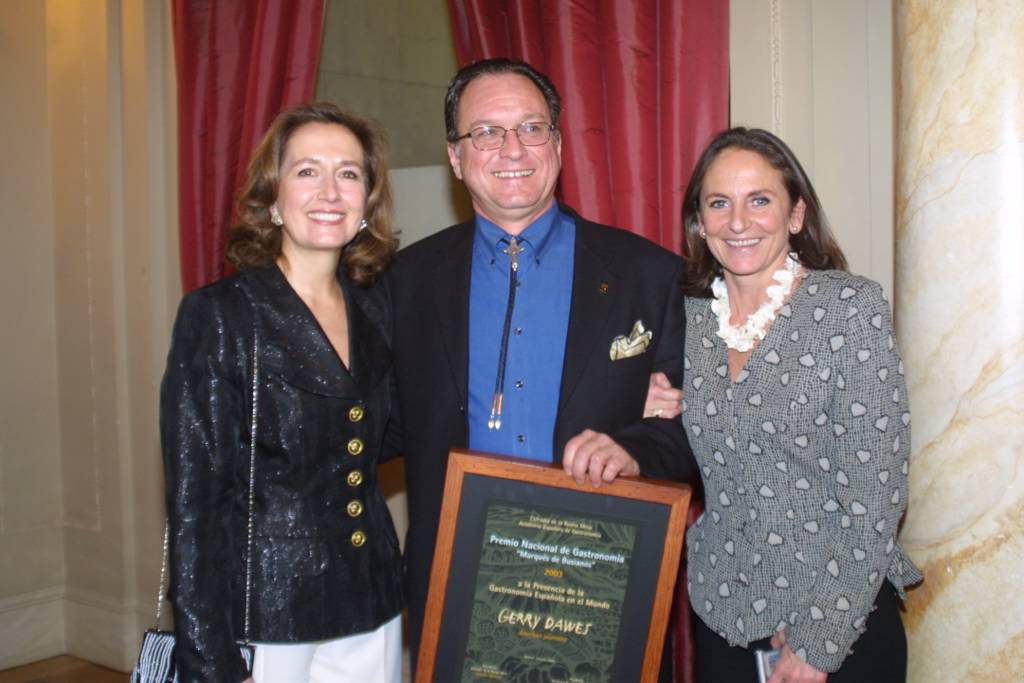
Premio Nacional de Gastronomía 2003 (Spanish National Gastronomy Prize): 2003 Marques de Busianos Award from the Academia Española de Gastronomía (Spanish Academy of Gastronomy) & La Cofradia de la Buena Mesa for writing, photography, and lectures about Spanish gastronomy and wines. At the Casino de Madrid, with Lourdes Plana of Madrid Fusion & Teresa Barrenechea, Chef-owner of Marichu (New York)


Gerry Dawes has been traveling in Spain for more than three decades. Since 1995, he has made sixty extensive food and wine trips to Spain, twenty since 2003 alone. In his Daytimer notebooks, he has written down every dish and every wine he has had in Spain for the past 15 years and photographs most of the dishes with digital cameras.


Gerry's notebook - Navarra, April 2003
Gerry Dawes copyright 2004

Only non-Spaniard to receive the prestigious Premio Cena de Los 11 Vinos, an award created to honor those who have made significant lifetime contribution to enhancing the image and culture of Spanish wines (for writing on Spanish wines.)


Marqués de Vargas & wife Anya, Gabriela Llamas, Gerry Dawes at Casino de Madrid, Cava Writing Award Presentation, May 2004. Primer Premio--Artículo sobre Cava, Instituto de Cava (Barcelona, Spain): First Prize of 12,000 Euros for Bebiendo Estrellas (Drinking Stars), an article on Spanish Cava (Spanish sparkling wine), written in Spanish for Cocina Futuro magazine (Madrid).


Click for Gerry Dawes Biography & Credits

Gerry Dawes
17 Charnwood Drive - Suite A
Montebello, NY 10901
Cell phone: 914-414-6982
Phone & Fax (call before faxing): 845-368-3486


Telefono movil (durante estancias en España): (011 34) 670 67 39 34
Contact:
gerrydawes@aol.com


Join Our List

5/07/2007

New Spain Posts January-September 2007

Some of my faithful readers, among the dozen of you, have expressed concern about the lack of posts and rightfully so. I have been traveling to Spain too much and can't keep up with it all!!! I am now averaging eight trips per year. To cut down on that average, I consolidated what would have been three-four trips in April-May to a one-month stay, so I have done three trips so far this year, a total of nearly eight weeks, and I am overloaded with information and backlogged with photographs. Some times you wish upon star and the star answers.

Posted (click on links below) and upcoming reports include:

In January, Madrid Fusión and Valencia's Encuentro Verema

In March, more Madrid, a wild, exhilarating swing through all the D.O.s of Galicia (Valdeorras, Rías Baixas, Ribeira Sacra, Ribeiro and Monterrei) in early March and a return to Arévalo for supernal roast suckling pig at Las Cubas.

And in April-May, Madrid again (after all, I am an official "Amigo de Madrid") for Grupo Gourmet's annual Salón Internaciónal de Gourmets

Valencia (Vino Elite & Vino a Toda Vela) with reports on paellas (arroces & fideua), the surprising gastonomic scene in Valencia and Alicante and encounters of another kind with Jonathan Nossiter of Mondovino fame and his wife, Paula Pradini, who showed her MondoEspaña film at Vino Elite.

Another visit to wonderful, under-rated Chinchón

Trujillo's exceptional Feria de Quesos in Extremadura

A visit to an old friend at Restaurante Cala Fornells in Salamanca

Castilla y León's prestigious Premios Zarcillo at which prizes are awarded to the best wines submitted (from around the world), the vast majority of which are from the Castilla y León region, which includes Ribera del Duero, Rueda, Toro, Cigales & Bierzo and Vinos de la Tierra de Castilla y León)

Valladolid, getting re-acquainted with Castilla y León's historic, but modern capital city

Cuídad Real for the Fenavin (Feria Naciónal del Vino; Spain's biggest wine fair) and a re-visit to Mesón del Corregidor in Almagro

And, remarkable Toledo, where chef-restaurateur-bodeguero Adolfo Muñoz and his family (Julita, his wife, and Adolfo and Javier, his sons) took me and my traveling companion captive for nearly 24 hours and charged a handsome ransom. We had to visit their Viñedos Cigarral de Santa María property, which has drop-dead views overlooking Toledo (a stone's throw away) and has a 300+ seat restaurant for weddings and banquets. The cigarral is surrounded by their Pago del Ama vineyards, olive groves and gardens with aromatic plants and flowers that play an important role in Adolfo (and his chef son Adolfo's cooking. We were sequestered for the night in the five-star Hotel Palacio de Eugenia de Montijo hotel where Adolfo operates Belvis restaurant, had dinner at Aldofo restaurant (considered the best in Toledo) and, with Adolfo and restaurant director-summiller son, Javier, we got a private tour of their extensive wine collection, which is housed in the cellars of a 9th-century Jewish home in the old quarter. The next morning we had a tapas-"breakfast" at Adolfo Colección restaurant-delicatessen, then, after re-acquainting myself with monumental Toledo and re-visiting the Santa María La Blanca and Tránsito syngogues (a first for my friend), plus a damascene ware shop, it was back for a farewell lunch at Restaurante Adolfo in Toledo's old Jewish quarter.

After lunch at Adolfo, we headed for Madrid for another remarkable seafood dinner at Casa Mundi, one of a series of remarkable meals with my new-found friend, José Luís Cuerda, the great Spanish film director, producer and screen writer (Bosque Animado, La Lengua de Las Mariposas, Amanecer, The Others and more). Cuerda also owns vineyards and a winery, Sanclodio, in Galicia's Ribeiro, where he produces a delicious treixadura-based white wine, which will soon be available on the East Coast and is the subject of a New York Times article due to be published in late June (for more info on Sanclodio, e-mail alex@marblehillcellars ).

I am going back to Spain in June for two weeks and I will have reports on trout fishing in La Rioja and a much anticipated dinner at Bodegas Riojanas in Cenicero, the wedding of my friend, chef-cookbook author (The Cuisines of Spain, The Basque Table) Teresa Barrenechea's daughter, Maria, in Madrid; the Grupo Gourmet Gourmet Plus Gastronomic Feria in Bilbao at the Palacio Eskalduna from June 15-17; the superb rosados, moscatels and red wines from Navarra; plans for Expo 2008 in Zaragoza; the lastest developments in Cava, Conca de Barberá, & Priorat; another dinner at unbeatable Ca Sento in Valencia; another adventure in Alicante with my friend, María José San Román and her husband, "El Portero Pitu," owners of Monastrell, la Taberna del Gourmet and other excellent restaurants;" and a dash via Jumilla back to Madrid for yet another dinner with Sr. Cuerda, with whom I am planning a Spanish television series based on many of the adventures, people, places, wines and food you are reading about here.

After Spain, it is off to speak at several wine and Spanish artisanal cheese seminars at the Telluride Wine Festival (June 28-July 1), stopping off in Dolores, Colorado, 60 miles south of Telluride, to see my daughter Erica, her husband Ivan and my adorable Gerber Baby grandson, Graham Robert. I keep telling this now eight-month old wonder that I am his Tio Geraldo!

In July, I will be in Portugal's cork country with the Amorim cork producers to report on the state of wine corks. Despite the problems with so-called "cork taint"--many instances of which are not the fault of a cork at all--is an issue that is being successfully addressed by cork producers, for me and many other long-time wine world observers (and participants!!) abandoning the cork for plastic "corks," synthetic closures and the God Awful screw cap is not the answer (scientifically, aesthetically, romantically, image-wise and otherwise).

From Portugal, I will migrate via Oporto back into Spain and spend more time in Galicia, where within a few years fascinating, terroir-driven, indigenous varietal wines will put Spanish white wines on a par with those of the Loire Valley in France (the godello grape has the potential to rival some chardonnays from Burgundy!).

Projecting to September, I will be traveling in Murcia for an in-depth re-visit to the land of the Monastrell grape, Jumilla, Yecla and Bullas.

And, for November, see A Taste of Spain Tour of La Mancha and Andalucía for my cultural, gastronomic and wine tour.

Related Posts with Thumbnails